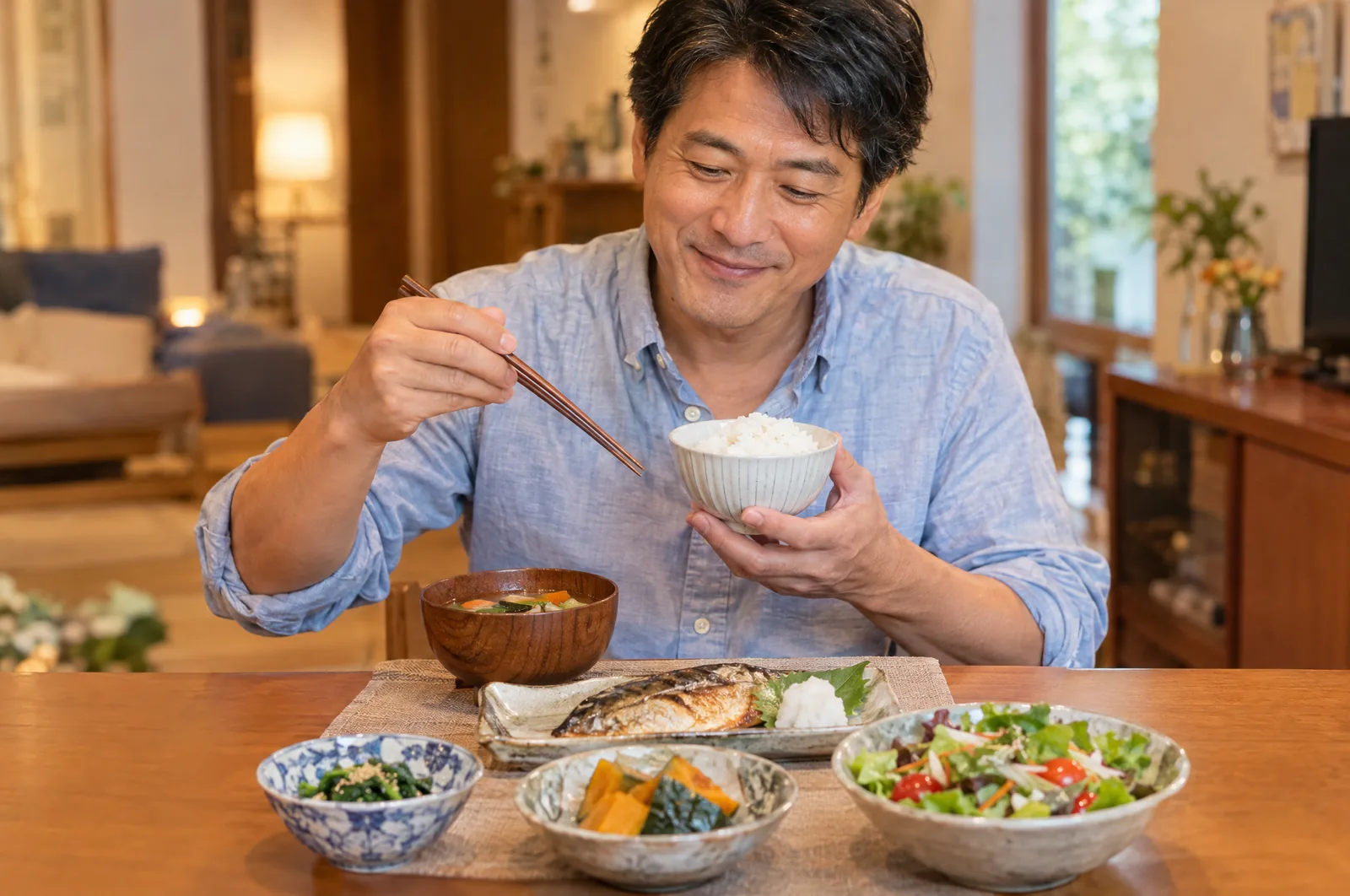
To see whether you get enough vegetables, count yesterday’s “small vegetable dishes” (小鉢). One dish is about 70 g; 5 a day (about 350 g) is a guide. Even on days short on vegetables, aim for days when you can think “at least I have topped up a little today.” ※Not a substitute for vegetables. Start by adding one dish to one meal.
Three familiar scenes (imagined)
- On the way home from work you drop two rice balls and a bottle of tea into a convenience store basket. “Convenience store again. Wait, did I eat any vegetables today?”
- Lunch between meetings is just bread and coffee. “When was the last time I ate vegetables?”
- You get home late and eat whatever is left in the fridge. “It feels like it has been like this for a while.”
On busy days, it is normal not to get as far as a salad. Still, the feeling “maybe I’m short on vegetables” is hard to judge until you count. (These are not the voices of real customers, but imagined scenes.)
The signs in this article are not symptoms of the body but signs that show up in your daily meals. In materials from Japan’s Ministry of Health, Labour and Welfare, one vegetable dish is about 70 g and 5–6 dishes a day is given as a guide. This article goes in order: how to count, five meal patterns that tend to run short, and ways to add vegetables.
What you will learn in this article
- How to count yesterday’s and this week’s small vegetable dishes (with a 7-day chart to fill in)
- Five meal patterns that tend to run short of vegetables (a checklist)
- How many grams one small dish is, and how much people actually eat in the national survey
- Ways to add vegetables without buying anything special, even at a convenience store or when eating out
This article is based on public materials from the Ministry of Health, Labour and Welfare, the Ministry of Agriculture, Forestry and Fisheries and the Izumi Public Health Center (Osaka Prefecture), and on Rakuten Ichiba reviews (checked October 9, 2026). It is not a substitute for a doctor’s diagnosis or for advice about an individual.
Try Counting: “How Many Vegetables Did I Eat This Week?”
The quickest way to know whether you are getting enough is not to look for signs in your body but to count how many small vegetable dishes you ate yesterday. One dish whose main ingredient is vegetables counts as one small dish (about 70 g; details in the third section).
Think back to yesterday morning, noon and evening and count in this order.
- Morning: how many dishes had vegetables as the main ingredient?
- Noon: in a boxed lunch or when eating out, was there a small vegetable dish or a soup with vegetables?
- Evening: salad, ohitashi, a simmered dish, stir-fried vegetables, a miso soup full of ingredients… how many dishes did you have?
A small amount served only as a garnish is not counted; only count dishes where vegetables are the star. If the total is low, there is no need to blame yourself. Knowing where you are now is the starting point for a review.
If it is hard to remember, write it in the chart below for one week. Stick it on the fridge and fill in one day each evening; it takes a few minutes.
| Day | Morning (dishes) | Noon (dishes) | Evening (dishes) | Total (dishes) |
|---|---|---|---|---|
| Mon | ||||
| Tue | ||||
| Wed | ||||
| Thu | ||||
| Fri | ||||
| Sat | ||||
| Sun |
You do not need to worry about the target number yet. After a week of writing, you may see “noon is always 0 dishes” or “vegetables are all squeezed into dinner.” That “shape” of your meals is the material for seeing which of the five patterns to come it resembles.
Five Meal Patterns That Tend to Run Short of Vegetables
Meals that end up low in vegetables often take a familiar shape. See how many of the five below match yours. This is not a check of how your body is doing, but a check for reviewing how your meals are put together.

Put a ✓ next to the ones that match you.
- □ ⓐ Some days you finish with only a starchy staple: only rice balls, noodles or bread, with no vegetable dish
- □ ⓑ At boxed lunches or convenience stores you tend to choose items low in vegetables: fried chicken lunch boxes, rice bowls, pasta and so on
- □ ⓒ Breakfast is only coffee and bread, or you often skip it: the first dish of the day is hard to fit in
- □ ⓓ You eat something quick late at night: on tired days you eat whatever is there and call it done
- □ ⓔ You skip a side dish when eating out / vegetables are only a garnish: even with a set meal, it is mostly a main dish and rice
e-ヘルスネット of the Ministry of Health, Labour and Welfare writes the following about eating out and boxed lunches.
「しかし、外食や持ち帰り弁当の利用が多い人は、主食・主菜・副菜を組み合わせた食事の頻度が低いことが報告されています」(厚生労働省 e-ヘルスネット「外食・中食の上手な活用法」より一部抜粋)
Translation: “However, people who often eat out or buy takeaway boxed lunches are reported to have meals that combine a staple, a main dish and a side dish less often.”
The same material also mentions items such as cold tofu, rolled omelet and fried chicken offered as side menu items when eating out.
「…これらは主にたんぱく質の供給源で、副菜としての組み合わせにはなりませんので気を付けてください。」(同上より一部抜粋)
Translation: “…these are mainly sources of protein and do not count as a side dish in a combination, so please be aware.”
In other words, even when a small dish comes with the meal, whether it counts depends on whether it is a vegetable dish. The Reiwa 6 (2024) National Health and Nutrition Survey by the Ministry of Health, Labour and Welfare also gives this figure.
「主食・主菜・副菜を組み合わせた食事が1日2回以上の日がほぼ毎日の者の割合は、52.8%である。」(厚生労働省「令和6年国民健康・栄養調査結果の概要」第4章1より)
Translation: “The proportion of people who have meals combining a staple, a main dish and a side dish at least twice a day almost every day is 52.8%.”
This is the proportion across the whole survey, not a number that decides whether your meals are good or bad. Still, “when busy, the combination tends to fall apart” seems to be common to many people. Whether you matched many patterns or few, get a feel for the size of one dish in the next section and then move on to ways to add vegetables.
How Many Small Dishes? A Simple Way to Count
One small vegetable dish is about 70 g, and 5 dishes a day is about 350 g. In the Food Guide of the Ministry of Agriculture, Forestry and Fisheries, the standard for one serving of a side dish is about 70 g of the main ingredient, equal to one small dish.
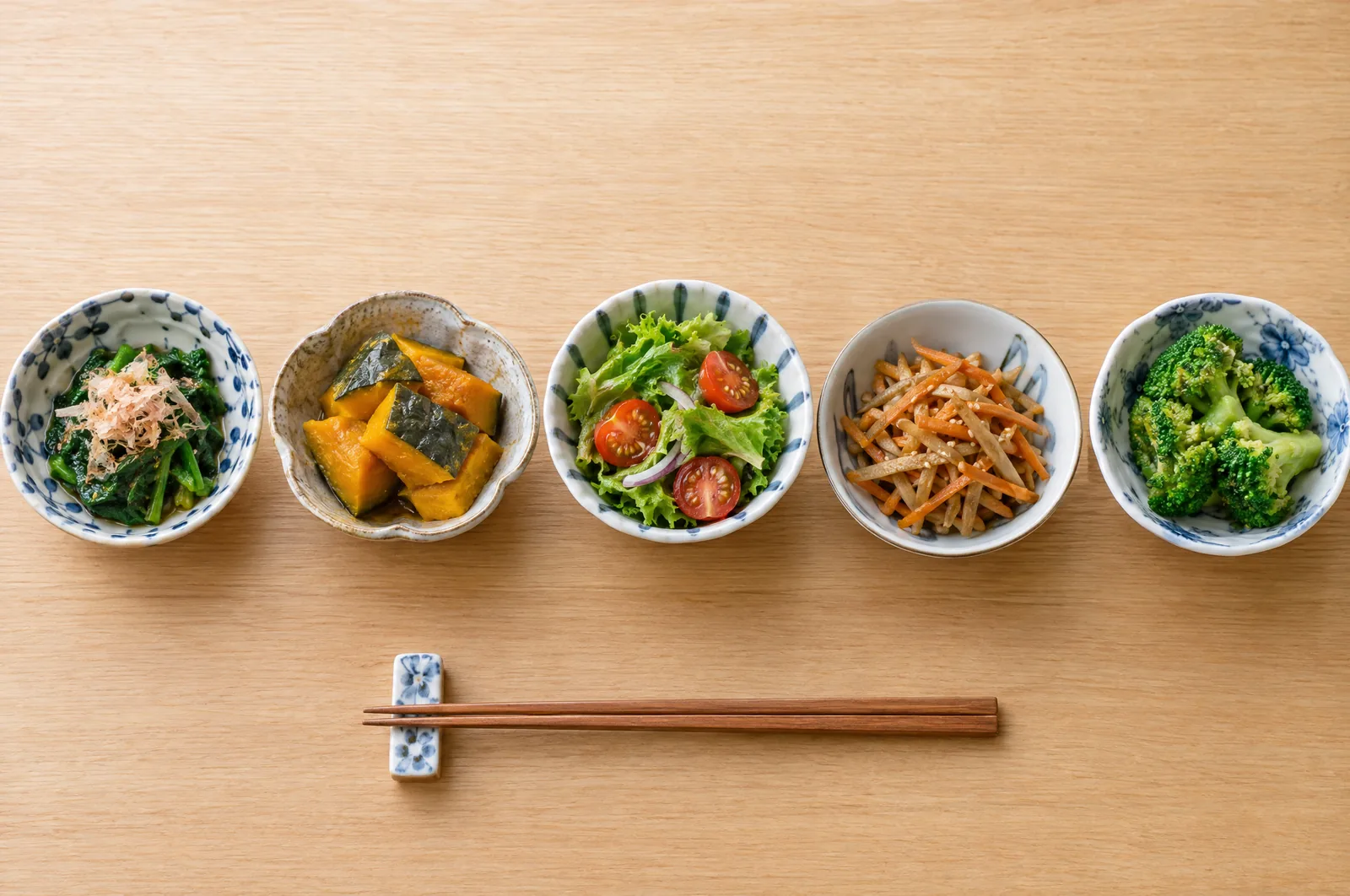
The following materials help with how to count.
- Food Guide (Ministry of Agriculture, Forestry and Fisheries): side dishes are “5~6つ(SV)2,200±200kcalの場合” (5–6 servings, for 2,200±200 kcal). “1つ(SV)の基準=主材料の重量約70g” (the standard for 1 serving = about 70 g of the main ingredient). “副菜の目安となる『1つ』は、小鉢1皿分。” (one serving of a side dish is one small dish).
- e-ヘルスネット: “一般的な野菜料理1皿には、約70gの野菜が含まれています。” (a typical vegetable dish contains about 70 g of vegetables) and “1回の食事で野菜を主材料とした料理を1皿以上取り入れ、1日5皿~6皿分を目安に摂取することを心がけましょう。” (include at least one dish with vegetables as the main ingredient in each meal, and aim for 5–6 dishes a day).
- Izumi Public Health Center (Osaka Prefecture): “1日に5皿の野菜料理を食べると、目標量の350gを達成することができます。” (eating 5 vegetable dishes a day reaches the target of 350 g) and “「朝1皿・昼2皿・夕2皿」を合言葉に、毎食野菜を食べることを目標にしましょう!” (use “1 dish at breakfast, 2 at lunch, 2 at dinner” as a motto and aim to eat vegetables at every meal).
- Nutrition guidance material from the Ministry of Health, Labour and Welfare: as examples of “料理の場合 野菜50〜80g”, it gives a small dish of spinach ohitashi and a small dish of kinpira gobo.
Note that 5–6 servings is a guide for 2,200±200 kcal, not one number that fits everyone. The Izumi Public Health Center also explains that one dish (70 g) of vegetables is about the amount that fits on one hand, but this changes with the type of vegetable and the size of the hand, so please use it only as an image.
Here are examples of dishes counted as “1 serving” of side dish in the Food Guide.
| How a side dish is counted | Example dishes (from the Food Guide) |
|---|---|
| 1 serving (one small dish) | Vegetable salad, cucumber and wakame in vinegar, miso soup full of ingredients, spinach ohitashi, simmered hijiki, simmered beans, sautéed mushrooms |
| 2 servings (two dishes) | Simmered vegetables, stir-fried vegetables, simmered potatoes (nikkorogashi) |
※Side dishes in the Food Guide also include potato, bean, mushroom and seaweed dishes, but ‘vegetables’ in the 350 g target exclude potatoes, beans, mushrooms and seaweed (MHLW nutrition guidance material). When counting vegetable dishes, count simmered hijiki, simmered beans, sautéed mushrooms and simmered potatoes separately to compare with the 350 g guide.
This is also the place to confirm what the 350 g figure means. “Health Japan 21 (Third Term)” from the Ministry of Health, Labour and Welfare sets “平均値 350g(令和14年度)” (average 350 g, fiscal Reiwa 14, i.e. 2032) as the target for vegetable intake. This is a target for the national “average.” It does not mean that you must eat 350 g every single day.
So what is the average now for adults aged 20+? The Reiwa 6 National Health and Nutrition Survey (Ministry of Health, Labour and Welfare) says the following.
「野菜摂取量の平均値は 258.7 g であり、男女別にみると、男性 268.6 g、女性 250.3 g である。年齢階級別にみると、年齢階級が高い層で摂取量が多い。」(同調査 第4章3より)
Translation: “The average vegetable intake is 258.7 g; by sex, it is 268.6 g for men and 250.3 g for women. Intake is higher in older age groups.”
The gap between the 350 g target and the 258.7 g average is about 91 g, a little more than one small dish (about 70 g). The age-group figures from the same survey (from Figure 9), divided by 70 g to give a number of small dishes, are as follows.
| Age group | Men (g/day) | In small dishes | Women (g/day) | In small dishes |
|---|---|---|---|---|
| 40s | 248.7 | about 3.6 | 217.8 | about 3.1 |
| 50s | 259.2 | about 3.7 | 244.9 | about 3.5 |
| 60s | 285.2 | about 4.1 | 267.7 | about 3.8 |
※The number of small dishes is an estimate made by dividing by 70 g. These are group averages and do not show whether any one person has reached a target.
This table is just a reference point: “this is roughly where people are.” If yesterday’s total was 3 dishes, as a rough guide, you are near the average. If you aim for 5 dishes, that is 1–2 more. The ideas in the next section let you add them without buying anything special.
First, Add Vegetables Through Your Meals
The trick is not to “buy something new” but to add one small dish to the meals you already eat. The nutrition guidance material from the Ministry of Health, Labour and Welfare also lists sample goals such as “小鉢1皿分の野菜を増やす。” (add one small dish worth of vegetables) and “1食で3種類の異なる野菜を食べる。” (eat 3 different kinds of vegetables in one meal).
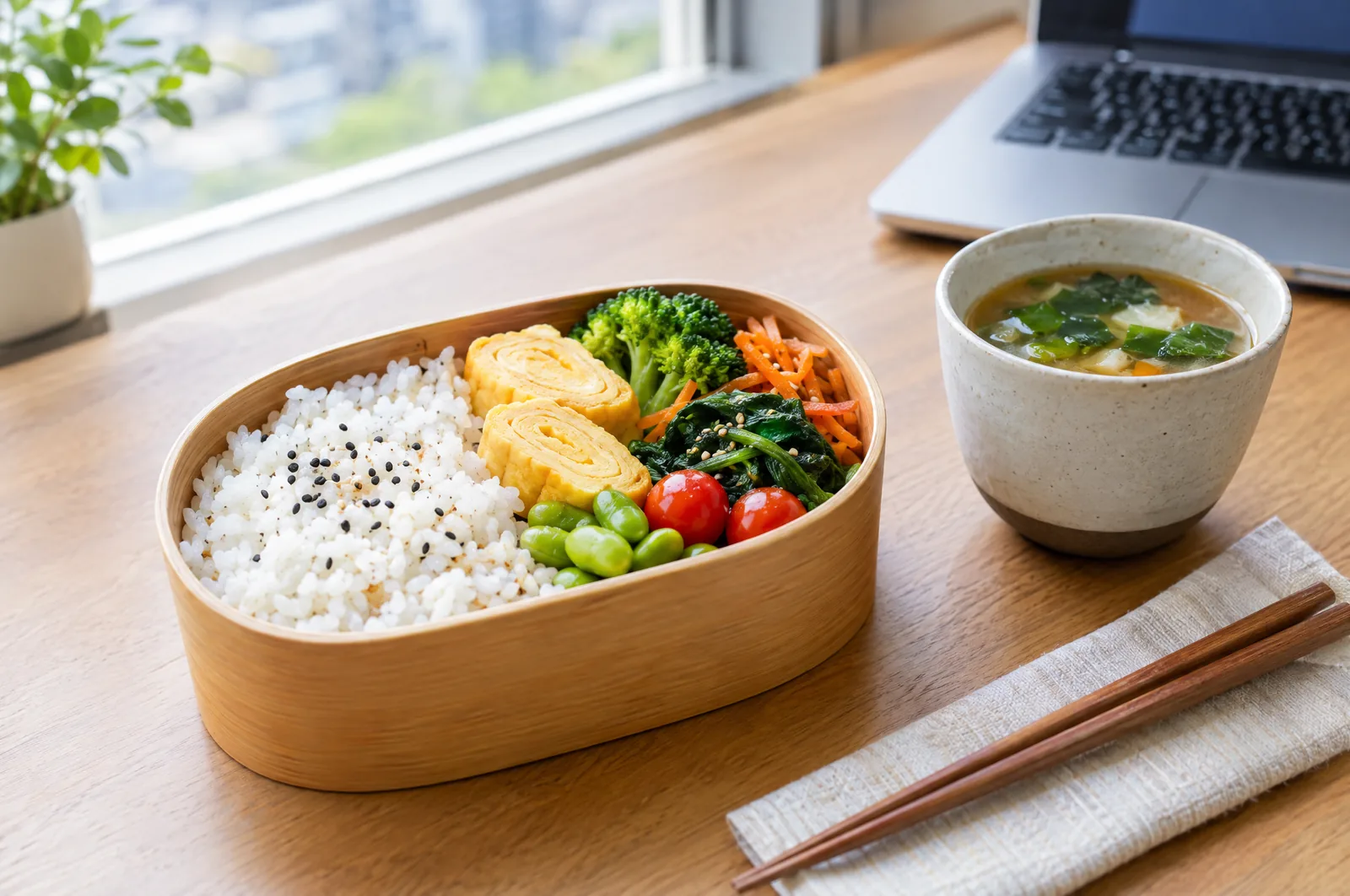
Small ideas, organized by situation.
- Breakfast: add just one item. Put a cherry tomato on toast or stir frozen leafy greens into miso soup, starting with whatever needs the least preparation. This is the first of the “1 at breakfast, 2 at lunch, 2 at dinner.”
- Lunch: one bowl of miso soup full of ingredients. In the Food Guide, miso soup full of ingredients is an example of 1 serving of side dish (one small dish).
- Convenience store: change how you choose. e-ヘルスネット recommends using ready-made dishes from supermarkets and convenience stores to combine “rice ball (staple)” + “grilled fish (main dish)” + “ohitashi (side dish).” When you choose a boxed lunch or noodles low in vegetables, it also writes about adding one side dish (a salad, a vegetable dressed dish and so on).
- Eating out: choose the restaurant. One sample goal in the nutrition guidance material is “外食時はサラダや野菜料理(野菜多めの惣菜・小鉢など)を食べられるお店を選ぶ。” (when eating out, choose a restaurant where you can have a salad or vegetable dishes).
- Evening: heat leafy greens to reduce their volume. e-ヘルスネット explains that leafy vegetables such as cabbage shrink and become easier to eat when heated in a microwave or boiled. Make an amount that is easy to eat and make sure you have one dish’s worth.
One more thing: pay attention to seasoning as well. e-ヘルスネット writes that people who eat 350 g or more of vegetables a day tend to have a healthier diet, but are also reported to have a higher sodium (salt) intake: 「野菜を1日350g以上摂取している人は、より健康的な食生活を送っている傾向がある一方で、ナトリウム(食塩)の摂取量が多いことも報告されています」. It advises being careful not to overuse high-salt seasonings, and using pepper and other spices or citrus such as lemon instead of dressing. When you increase vegetables, review the salt as well.
If you could add one small dish at lunch, the feeling in the afternoon of “did I get enough today?” may also get a little lighter. Even on days short on vegetables, aim for days when you can think “at least I have topped up a little today.” ※Not a substitute for vegetables. Count, add, and count again: that accumulation is a solid foundation.
When You Still Fall Short on Some Days
The basics are to go back to the ideas in the previous section (add one small dish). If you feel “there are still days when it is not enough,” another option is to use a nutritional supplement food such as a food with nutrient function claims (栄養機能食品).※Not a substitute for vegetables.
Everyone has times when it is hard to keep meals regular, such as business trips or busy seasons. At such times, there are things that can be used as support on top of your meals. For example, NEW スピルリナEX is a food taken with water or warm water, with 10 tablets a day as a guide, and it carries a nutrient function claim label for 10 vitamins. Details are set out in What Is Spirulina EX?. How to read the label is covered in What Is a Food with Nutrient Function Claims?.
On the Rakuten Ichiba product page of 美健サイエンス, there are customer comments like these.
「どうしても野菜不足になりがちなのでそういう面でも補充出来ればと、続けています。」(2025年3月・★4・楽天市場のレビューより一部抜粋・個人の感想です)
Translation: “I tend to run short on vegetables no matter what, so I keep taking it in the hope that it can help in that way too.” (March 2025 · ★4 · excerpt from a Rakuten Ichiba review · one customer’s personal impression)
「食生活が乱れがちなので助かっています。」(2026年4月・★5・楽天市場のレビューより一部抜粋・個人の感想です)
Translation: “My eating habits tend to get disrupted, so it helps.” (April 2026 · ★5 · excerpt from a Rakuten Ichiba review · one customer’s personal impression)
※Not a substitute for vegetables.
Reviews are only part of what buyers felt. How it feels differs from person to person, and it will not be the same for everyone. Whether to use it is for you to decide. If you take any medication, ask a doctor or pharmacist. If you take warfarin, refrain from taking it, as the box says. For details, see Does Spirulina Have Side Effects?.
To repeat: reviewing your meals comes first, and this is only support. ※Not a substitute for vegetables.
A Small Step Starting Today
There is only one thing to do. This week, add one small vegetable dish to one meal of the day. Then on Sunday evening, look back over the 7-day chart.
- Today: stick the 7-day chart on the fridge (paper or a phone note is fine).
- This week: add one small vegetable dish to one of breakfast, lunch or dinner. At a convenience store, simply putting ohitashi or a salad in the basket makes one dish.
- Sunday evening: look at the chart and count on how many of the 7 days you managed to add one. If there were days you could not, do not blame yourself; next week, just add one thing again.
The day you wonder “how many vegetables did I eat this week?” changes into “because I counted, I know.” Even on days short on vegetables, aim for days when you can think “at least I have topped up a little today.” ※Not a substitute for vegetables.
For how to take and keep up 10 tablets a day, see How to Take Spirulina EX.