
Searching “spirulina effects” or “how long until I notice anything”? Spirulina is a “food,” and this article cannot promise it “works.” Even on days short on vegetables, aim for days when you can think “at least I have topped up a little today.” ※Not a substitute for vegetables. It gives only the “known” and “not known” in national materials and studies.
Three common scenes (imagined)
- A friend recommended it and you bought it, but the box does not say “what will change,” and you feel a little uneasy.
- A few weeks after you started, you suddenly pause and wonder, “Is this right?”
- You come across the word “effect” online and want to know the real story.
It is natural to want to know whether it “works” and how long it takes until you notice anything. (These are not the voices of real customers; they are common scenes that have been imagined.)
On top of that, the Consumer Affairs Agency advises: “Do not trust only an advertisement’s catchphrase or users’ testimonials; look up for yourself the information on the safety and efficacy of the ingredients contained in the product.” (「広告のキャッチコピーや利用者の体験談のみを信用するのではなく、自分自身で製品に含まれている成分の安全性と有効性に関する情報を調べてみましょう。」) (excerpt). This article sorts out that “looking up” using public information from national materials and research.
As an ordinary food, spirulina cannot be labeled as something that “works” or “has efficacy.” What is on the outer box of NEW スピルリナEX is the labeling of the “functions of 10 vitamins” as a food with nutrient function claims (栄養機能食品). Human studies exist, but the stage has not been reached where one can say “if you take this product, ○○ will happen,” and no public document answers “how long until?” with a number either. This article separates what is known from what is not known.
What you will learn in this article
- The line between food and medicine, and why “works” cannot be written
- What a food with nutrient function claims can say and cannot say
- What research does and does not tell us (differences in amount, period and participants)
- How to think about “how long until I notice anything?”, and how to keep a record to check for yourself
This article is based on public materials from the Consumer Affairs Agency, the Ministry of Health, Labour and Welfare and the National Institutes of Biomedical Innovation, Health and Nutrition (NIBN), on research papers (2018 and 2024), and on the number of reviews on Rakuten Ichiba (checked October 22, 2026). It is not a substitute for a doctor’s diagnosis or for advice about an individual. How to read the labeling is sorted out in more detail in What Is a Food with Nutrient Function Claims?.
In short: spirulina is a food. It cannot be said to “work”
In Japan, spirulina is a food. A food that falls under none of foods for specified health uses (特定保健用食品), foods with nutrient function claims (栄養機能食品) and foods with function claims (機能性表示食品) cannot display the effects or functions a food has. And if one advertises the treatment or prevention of disease, it is regarded as a medicine (医薬品), not as a food. For that reason, for spirulina as an ordinary food, the answer to “What does spirulina work on?” is “it cannot be said to work.”
The Consumer Affairs Agency’s 「栄養機能食品について」 (About Foods with Nutrient Function Claims) writes: “Foods other than foods for specified health uses, foods with nutrient function claims and foods with function claims cannot display the effects or functions a food has. (Food Labeling Standards, Article 9)” (「特定保健用食品、栄養機能食品及び機能性表示食品以外の食品に、食品の持つ効果や機能を表示することはできません。(食品表示基準第9条)」)
The line between food and medicine is set out in a notice (通知) of the then Ministry of Health and Welfare, published by the Ministry of Health, Labour and Welfare (「無承認無許可医薬品の監視指導について」, On Supervision and Guidance of Unapproved and Unlicensed Medicines). If wording shows (or implies) the following kinds of efficacy and effects, it is treated as a “claim (標ぼう) of medicine-like efficacy and effects (医薬品的な効能効果).”
- Efficacy and effects aimed at the treatment or prevention of a disease
- Efficacy and effects whose main aim is the general strengthening or enhancement of the functions of body tissues (however, “this does not apply to expressions about nutritional supplementation, maintaining health and the like” (「栄養補給、健康維持等に関する表現はこの限りでない」))
The same notice says that it applies “whether explicit or implicit” (「明示的であると暗示的であるとを問わない」). And as the range that counts as a claim, besides a product’s container, flyers and internet advertisements, it also lists “letters of thanks and collections of testimonials from users” (「使用経験者の感謝文、体験談集」), as well as books and “excerpts from academic papers” (「学術論文等の抜粋」) (notice, p. 15). It further says that even if no specific product name is shown, if the material is used in connection with the explanation of a specific product, it is regarded as a claim about that product (p. 16).
For this reason, this article does not use expressions such as “works” or “gets better.” Nor does it introduce numerical values from research, or the content of the “effects” written in reviews.
The Ministry of Health, Labour and Welfare’s pamphlet 『健康食品の正しい利用法』 (Correct Use of Health Foods) says: “Health foods (健康食品) cannot be used to treat illness.” (「健康食品は病気の治療には使えません。」) (p. 13). The NIBN website likewise explains that neither foods with health function claims (保健機能食品) nor other health foods can be used to treat illness the way medicines are. If you have a medical condition or take medication, do not decide on your own; consult a doctor or pharmacist.
| Line drawn from national materials (a guide) | Content |
|---|---|
| What can be said | The functions of nutrients (as shown on the outer box), the nutrition facts, the suggested daily amount, and expressions about “nutritional supplementation” |
| What cannot be said | Assertions such as “works” or “has efficacy”; effects with a period, such as “in X months…”; the treatment or prevention of disease; expressions that name symptoms and recommend it “for people with ○○” |
※Summarized from the notice (pp. 15–19) and the Consumer Affairs Agency’s 「栄養機能食品について」. The expression “nutritional supplementation” itself does not fall under medicine-like efficacy, but it does if it specifies a deficiency caused by illness, such as “(nutritional supplementation) when strength is low during or after illness” (「病中病後の体力低下時(の栄養補給)に」) (p. 16). In addition, the notice says that claiming a specific product has an “effect” may fall under a claim of medicine-like efficacy and effects (標ぼう), giving “It has no effect unless you keep taking it for a month or more.” (「1か月以上飲み続けないと効果はありません。」) as an example (p. 19).
What can be shown: the labeling of a food with nutrient function claims
The outer box of NEW スピルリナEX carries labeling as a food with nutrient function claims (栄養機能食品), and what is permitted to be shown is “the functions of nutrients,” such as those of 10 vitamins. It is not labeling of an effect of spirulina itself. The state describes a food with nutrient function claims as “a food used for the supply of specific nutrients” (「特定の栄養成分の補給のために利用される食品」) (excerpt).
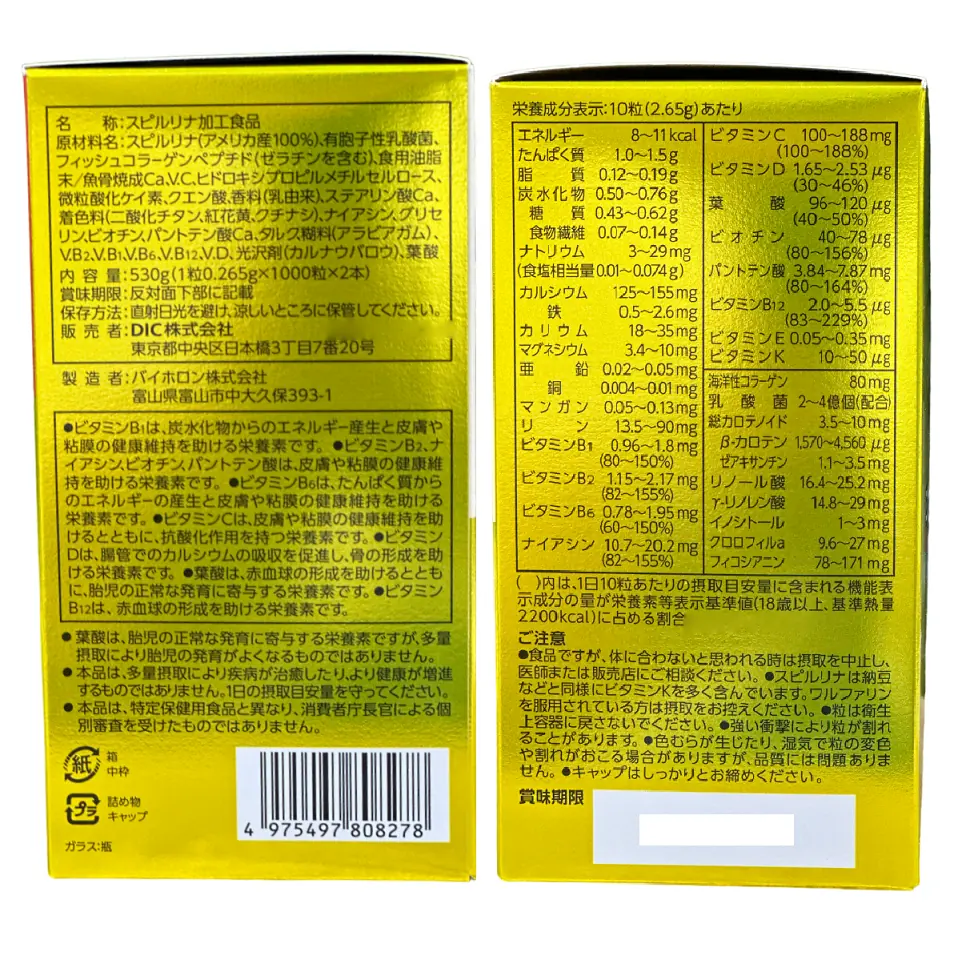
The Consumer Affairs Agency explains a food with nutrient function claims as “a food used for the supply of specific nutrients, which displays the functions of those nutrients” (「特定の栄養成分の補給のために利用される食品で、栄養成分の機能を表示するもの」) (excerpt). Its leaflet also advises: “A food with nutrient function claims is a food that can be used to supply the nutrients needed in a day (vitamins, minerals and so on) when they tend to fall short.” (「栄養機能食品は、1日に必要な栄養成分(ビタミン、ミネラルなど)が不足しがちな場合、その補給のために利用できる食品です。」) It is a system in which no individual review by the state is required, and in which a food that contains a set standard amount of a nutrient whose scientific basis has already been confirmed can display the function of that nutrient.
On the outer box of NEW スピルリナEX, the function of each nutrient is written in sentences like these (excerpt).
- “Vitamin B12 is a nutrient that helps in the formation of red blood cells.” (「ビタミンB12は、赤血球の形成を助ける栄養素です。」)
- “Vitamin B1 is a nutrient that helps in the production of energy from carbohydrates and in maintaining the health of the skin and mucous membranes.” (「ビタミンB1は、炭水化物からのエネルギー産生と皮膚や粘膜の健康維持を助ける栄養素です。」)
This is an explanation of “the work of the nutrient called vitamin B12.” It does not mean “if you take this spirulina, ○○ will happen.” The sentences for the other functions are introduced in full in What Is a Food with Nutrient Function Claims?. Note that the standards for foods with nutrient function claims were revised on October 1, 2026, and the Consumer Affairs Agency’s leaflet (October 2026 (Reiwa 8)) carries the revised wording. The wording on the outer box is labeling under the standards before the revision. Under the transitional provisions (附則 of the Food Labeling Standards), processed foods manufactured, processed or imported by March 31, 2030 may still be labeled under the earlier standards.
The outer box also carries the following notes.
- “This product is not one by which illness is cured or health is further improved by taking a large amount. Please keep to the suggested daily intake.” (「本品は、多量摂取により疾病が治癒したり、より健康が増進するものではありません。1日の摂取目安量を守ってください。」)
- “Unlike foods for specified health uses, this product has not undergone individual review by the Commissioner of the Consumer Affairs Agency.” (「本品は、特定保健用食品と異なり、消費者庁長官による個別審査を受けたものではありません。」)
So how far is it all right to say that something “supplements nutrition”? The national notice says: “Expressions whose purport is ‘nutritional supplementation’ do not immediately fall under medicine-like efficacy and effects.” (「「栄養補給」を目的とする趣旨の表現は、直ちに医薬品的な効能効果には該当しない。」) and gives “for people who tend to be picky eaters” (「偏食がちな方に」) and “for people short on vegetables” (「野菜の足りない方に」) as examples (p. 18; however, it also writes that false or exaggerated expressions may violate other laws).
In other words, what can be said about a food goes only as far as “supplementing nutrition.” Even on days short on vegetables, aim for days when you can think “at least I have topped up a little today.” ※Not a substitute for vegetables.
What is known and not known about research
Human studies of spirulina exist, but the participants, amounts, periods and products vary, and the stage has not been reached where one can say “if you take this product, ○○ will happen.” The paper also says that larger, higher-quality trials are needed. The results of research cannot be applied as they are to the one product you are holding now.
Let us start by checking how to “read” research. The NIBN site (basic knowledge) says that studies examining the efficacy of health foods come in several types, and that human studies with a comparison group (control group) are more reliable. A meta-analysis, which pools several results, is regarded as even more reliable information. Conversely, it also explains that testimonials and personal opinions may not be based on concrete research, and that results in animals or in test tubes do not necessarily produce the same effect in humans. Without a comparison group, a change cannot be told apart from a case of natural improvement or from a change due to the feeling of taking something (the placebo effect).
The Ministry of Health, Labour and Welfare’s pamphlet also explains: “Results of experiments on cells or animals cannot be applied directly to humans.” (「細胞や動物で行った実験結果をそのままヒトに当てはめることはできません。」) (p. 15). It also says: “‘Information on a specific ingredient’ and ‘information on a product’ are not the same.” (「「特定成分の情報」と「製品の情報」は同じではありません。」) (p. 15). Even if the raw material itself has efficacy, at the stage of becoming a product it is affected by the quality of the raw material and by other materials added at the same time. On testimonials, it says: “They are different from scientific experiments, so on their own they do not prove efficacy.” (「科学実験とは違いますのでそれだけで有効性の証明にはなりません。」) (p. 14, excerpt).
Next, let us look at what kinds of trials were collected in a 2018 paper (Huang et al.) that pooled 12 human trials of spirulina. We sort out only the differences in conditions, not the individual results.
| Point | What could be confirmed in the 2018 summary |
|---|---|
| Number of trials | 12 trials, published 1996–2017, conducted in India, Korea, the USA, Cameroon, Poland and Iran |
| Participants | 20–159 people per trial. Many of the trials were of people with an illness |
| Daily amount | 1–19 g |
| Period | 2–24 weeks |
| Compared with | Placebo 6, nothing 5, soybean 1 |
| Quality assessment | Risk of bias (偏り) low 5, high 6, unclear 1 |
※Figures follow Table 1 of the paper (risk of bias from the main text). Some numbers in the paper do not match between the abstract, main text and Table 1 (e.g. period: 2–48 weeks in the abstract, 2–24 weeks in the main text and Table 1). The form of the product also differs from trial to trial: tablet, capsule, freeze-dried, extract and so on.
What this table shows is these two points.
- The ranges of amount (1–19 g) and period (2–24 weeks) in the trials are wide, and Table 1 contains no trial at the same amount as the suggested intake of NEW スピルリナEX (10 tablets, 2.65 g a day).
- The participants include trials of people with illnesses. The Ministry of Health, Labour and Welfare explains that health foods are not meant for people with illnesses, and that use by people with illnesses carries risks (p. 13).
As limitations, the paper notes that the variation between trials (heterogeneity) was large and could not be fully resolved even after repeated analyses, and that many trials gave insufficient description of the method of random allocation, of blinding (a method of making it unknown which one a person is taking) and so on; it says that larger, higher-quality trials on long-term effects and risks are needed. A 2024 review (Spínola et al.) likewise says that much of the knowledge from cultured cells and animals has not been sufficiently confirmed in human clinical trials, and that the relationship between dose and effect, and safety, need to be confirmed in large human trials.
This article does not introduce the individual results reported in the research (figures or test items). The reasons are, as stated above, that the participants and amounts are not necessarily the same as for the product, and that the national notice regards excerpts from papers tied to the sale of a product as a claim. For those who want to check the results themselves, there is the option of using the NIBN’s “Safety and Efficacy Information on ‘Health Foods’” (「健康食品」の安全性・有効性情報). The Consumer Affairs Agency also introduces it as a reliable source where information on safety and efficacy in humans can be checked (use requires agreeing to the site’s 「ご利用にあたって」 (Terms of use); this article does not quote the contents of the database).
| Category | Content |
|---|---|
| What is known | Human trials have been conducted. The functions of nutrients (vitamins and so on) are set by national standards. Taking more than the suggested amount does not further improve health (outer box) |
| What is not known | What changes when this product is taken. The relationship between amount or period and change (the 2024 review also says this needs to be confirmed) |
The question “how long until I notice anything?”
Within the range checked this time, no public document was found that answers with a number such as “from X days” or “from X weeks.” How it feels differs from person to person. If you notice nothing, one approach is to first keep a record and decide for yourself whether to continue.
There are three reasons no number can be found.
- The research periods vary: In the 2018 summary the periods ranged from 2 to 24 weeks. It cannot be stated flatly “if it is X weeks.”
- Saying it “has an effect” can itself be a problem: The national notice says that claiming a specific product has an “effect” may fall under a claim of medicine-like efficacy and effects (標ぼう), giving “It has no effect unless you keep taking it for a month or more.” (「1か月以上飲み続けないと効果はありません。」) as an example (p. 19). Be careful of promotion that states a period clearly.
- Testimonials alone do not reveal the cause: The NIBN site explains that some people get better naturally even without taking anything, and that some people feel well just because they are taking something (the placebo effect), so information without a comparison group cannot make clear whether a change is due to having taken it. The Ministry of Health, Labour and Welfare’s pamphlet also says: “Testimonials have vague grounds, and there is a possibility that they have been fabricated.” (「体験談は根拠があいまいで、捏造(ねつぞう)されている可能性もあります。」) (p. 14).
On the Rakuten Ichiba product page for NEW スピルリナEX of 美健サイエンス there are 135 reviews (checked October 22, 2026). Reviews are the personal impressions of people who bought the product and, like testimonials, do not prove efficacy on their own. This article does not quote reviews with content about health. The overall trend of the reviews is tallied in Spirulina EX Reviews.

What should you do if you notice nothing? The Ministry of Health, Labour and Welfare’s pamphlet says that if you bought something expecting a health benefit but notice nothing and only the expenses pile up, “Making a clean break and stopping the health food is also one option.” (「思い切って健康食品をやめてみることも一つの方法です。」) (p. 11, excerpt). On top of that, it advises thinking carefully about both the benefit that can be gained and the harm (risk) that may arise.
The Consumer Affairs Agency advises: “Like a medication notebook (お薬手帳), keeping a record of how you use a health food is also a useful way to grasp for yourself whether it has a good effect on your condition.” (「お薬手帳のように、健康食品の利用状況を記録することは、自分自身で体調に良い効果があるかどうかを把握するためにも有効な方法です。」) So let us make the first step something you can do in one minute.
- Write today’s date and the number of tablets you took (on a day you did not take any, write “none.” You can start with just this)
- Roughly, one line on that day’s meals, sleep and exercise (so that a change is not attributed to the product alone)
- Write down what you notice (good things, and also days when “nothing changed.” If something troubles you, stop taking it and consult a doctor or pharmacist)
- Look back once a month (if you remember only the good days, you tend to feel that it “worked” more than your record shows. Keep the days when nothing changed with the same weight)
The record is for deciding whether to “continue or stop” from your own record, not from advertisements or testimonials.
How to avoid expecting too much
There are three tips for not expecting too much: (1) set the purpose of taking it on “supplementing nutrition”; (2) decide whether to continue from your own record; (3) build on meals, exercise and rest, and use it as an aid alongside them. The more the expectation exceeds reality, the bigger the feeling of “it’s not what I thought” becomes.
When there is a gap between expectation and reality, disappointment comes easily. There are two ways to think about it.
- Match the expectation to the range national materials can state: What can be said of a food goes only as far as supplementing nutrition. Instead of “something should change,” take the view that “I am adding the nutrition that is short on days when meals fall short.”
- If you are still not satisfied, review the way you do things: Before increasing what you take, review your meals, exercise and rest. The Consumer Affairs Agency advises: “Fundamentally, the basics of maintaining and improving health are ‘a nutritionally balanced diet, moderate exercise and sufficient rest.’” (「本来、健康の維持・増進の基本は、「栄養バランスのとれた食事、適度な運動、十分な休養」です。」) (excerpt)

Here are answers to three questions that often appear together in searches.
What are the risks of spirulina?: Even with foods, some people find that something does not suit them. The outer box of NEW スピルリナEX says: “It is a food, but if it does not seem to suit you, stop taking it and consult a doctor or the retailer.” (「食品ですが、体に合わないと思われる時は摂取を中止し、医師または販売店にご相談ください。」) Because it is high in vitamin K, people taking warfarin should refrain from taking it, as the cautions on the box say. The ingredients also include gelatin and milk-derived ingredients. Details are sorted out in Does Spirulina Have Side Effects?.
Spirulina or chlorella — which is better?: It cannot be said which one “works.” They differ in the organism they come from (a blue-green alga and a green alga) and in the feel and flavor of the tablet. Choose by purpose, preference and ease of keeping up. What was compared is in Spirulina vs Chlorella: How Do They Differ?.
Does it make you gain weight?: According to the nutrition facts on the outer box of NEW スピルリナEX, the energy per 10 tablets (2.65 g) is 8–11 kcal. Compared with the reference energy of 2,200 kcal in the nutrient reference values, 11 kcal is about 0.5% (this ratio is a calculation made in this article). 2,200 kcal is a reference value for labeling; the energy each person needs per day differs with age, build and activity. However, from this figure one cannot say that it “makes you gain weight” or that it “does not.” Body weight changes with many factors, such as the diet as a whole and exercise.
Finally, about NEW スピルリナEX. Given the limits described so far, there is also the option of “using a food that supplements nutrition on days when meals fall short.” NEW スピルリナEX is a food with nutrient function claims (栄養機能食品; 10 vitamins), taken with water or hot water, with 10 tablets (2.65 g) a day as a guide. It is not something that “works”; it is an aid built on meals. You can check what it contains in What Is Spirulina EX? and how to take it in How to Take Spirulina EX. If you take medication, check with a doctor or pharmacist. Even on days short on vegetables, aim for days when you can think “at least I have topped up a little today.” ※Not a substitute for vegetables.
How it feels differs from person to person. Whether to use it is for you to decide.
One small step from today
There is only one thing to do. Any one of the following is fine.
- □ Write today’s date and the number of tablets you took in a notebook or a phone memo (on a day you did not take any, write “none”)
- □ Read the “food with nutrient function claims” labeling and the “cautions” (ご注意) on the outer box once
- □ If you have a medical condition or take medication, consult a doctor or pharmacist once
- □ Add one small dish of vegetables to a meal (something you can do before taking anything)
If you manage any one of them, that is enough for today’s step. There is no need to hurry to decide whether it “worked.” As the records build up little by little, you can decide from your own record whether to continue. Even on days short on vegetables, aim for days when you can think “at least I have topped up a little today.” ※Not a substitute for vegetables.
You can check how to take and keep up NEW スピルリナEX in How to Take Spirulina EX.