Even on days short on vegetables, aim for days when you can think “at least I have topped up a little today.” ※Not a substitute for vegetables. When you start thinking about a tablet or powder food for days like that, questions like these may come up:
- “Spirulina or chlorella: which one suits me?”
- “The names and colors are similar. What actually differs?”
- “Which is easier to take, and easier to keep up?”
The short answer: spirulina is a “blue-green alga” (藍藻) and chlorella is a “green alga” (緑藻); they are different kinds of organism. The feel of the tablet, its flavor and the growing environment also differ, but it is not a matter of which is better: choose by purpose and preference.※Perception differs from person to person. This article lines up the differences in order, based on public materials and a raw-material maker’s table.
What you will learn in this article
- What spirulina and chlorella have in common, and how they differ as organisms
- Differences in size, tablet feel and flavor, growing environment and the pigment phycocyanin, excerpted from DIC Corporation’s comparison table
- How many customer reviews describe “switching” between chlorella and spirulina, and why
- How to look at the choice by purpose, and a note for people taking medication
This article is based on public materials from the National Institute for Environmental Studies, Kyoto University, the University of Tokyo (JST), and PMDA, on DIC Corporation’s comparison table, and on Rakuten Ichiba reviews (checked October 10, 2026). It is not a substitute for a doctor’s diagnosis or for advice about an individual.
Both are algae, but different organisms
Spirulina and chlorella are both microalgae used as food, both contain the green pigment chlorophyll, and both are sold as powder or tablets. As organisms, however, they belong to different groups: spirulina is a blue-green alga (cyanobacteria) and chlorella is a green alga.
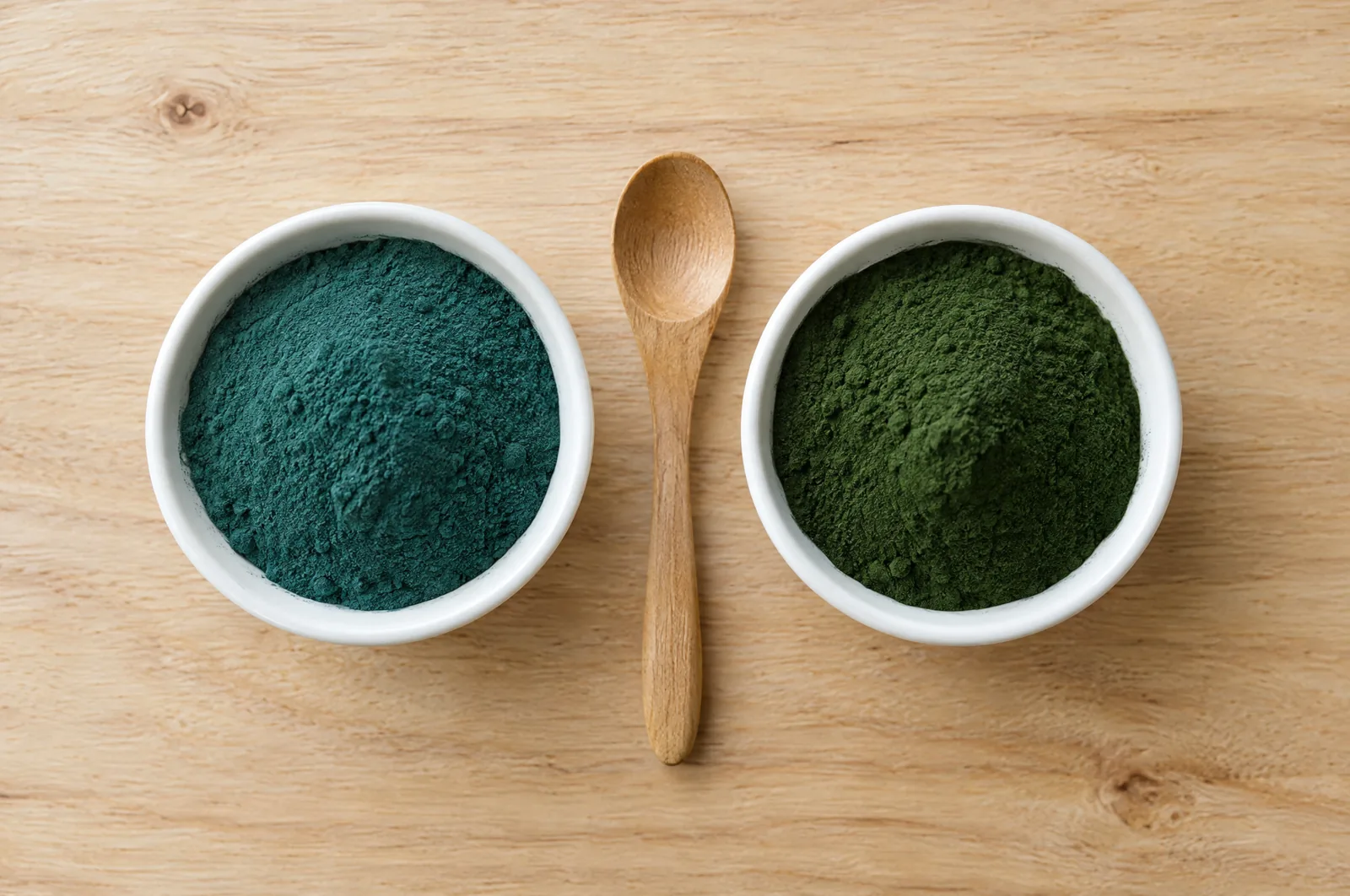
First, what they share.
- Both are “microalgae” used as food or food ingredients. Kyoto University describes spirulina as an “edible microalga”, and the University of Tokyo and JST describe chlorella as a “freshwater single-celled green alga”
- Both contain chlorophyll; in DIC Corporation’s comparison table both columns have a chlorophyll value
- Both are sold in forms that are easy to add to daily life, such as powder or tablets
Now the differences. On spirulina, the National Institute for Environmental Studies writes:
「シアノバクテリアは酸素発生型光合成を行う細菌の一種であり,藍藻(らんそう)とも呼ばれています。」(国立環境研究所 2021年11月1日公表資料「背景」より)
Translation: “Cyanobacteria are a kind of bacteria that perform oxygen-producing photosynthesis, and are also called blue-green algae (らんそう).” (National Institute for Environmental Studies, published November 1, 2021, “Background”)
「スピルリナは食用の微細藻で、培養や収穫が簡単にできることから、食品や食品添加物の原料として世界中で利用されています。」(京都大学 2023年1月20日公表「食用藍藻スピルリナの完全長ゲノム塩基配列」より)
Translation: “Spirulina is an edible microalga; because it is easy to cultivate and harvest, it is used around the world as a raw material for foods and food additives.” (Kyoto University, published January 20, 2023, from the researcher’s comment)
On chlorella, the University of Tokyo and JST write:
「クロレラはトレボウクシア藻綱に分類される淡水産の単細胞の緑藻です。」(東京大学・JST 2016年1月26日公表資料より)
Translation: “Chlorella is a freshwater single-celled green alga classified in the class Trebouxiophyceae.” (University of Tokyo · JST, published January 26, 2016)
The cell structure differs too. NIES’s 『環境儀』 calls cyanobacteria “prokaryotes” (an excerpt: 「アオコ現象は原核生物であるシアノバクテリアの大増殖のことをいい、…」). In other words, spirulina is a prokaryote with no cell nucleus, a point also touched on in What is spirulina?. The University of Tokyo and JST material, on the other hand, has a note saying 「藻類細胞には、核、葉緑体、ミトコンドリア、小胞体、ゴルジ体、液胞などがある。」 (algal cells have a nucleus, chloroplasts, mitochondria, endoplasmic reticulum, Golgi apparatus, vacuoles and so on), so chlorella is on the eukaryote side, with a nucleus.
So although both are called “algae”, whether it is a blue-green or a green alga, and even the cell structure, differ. That is the starting point.
Ingredients and features compared (table)
In a table, the two differ in classification, size, tablet feel and flavor, growing environment and the presence of phycocyanin. However, the amounts of protein and other ingredients vary with strain, cultivation and product, so the numbers need to be checked product by product.
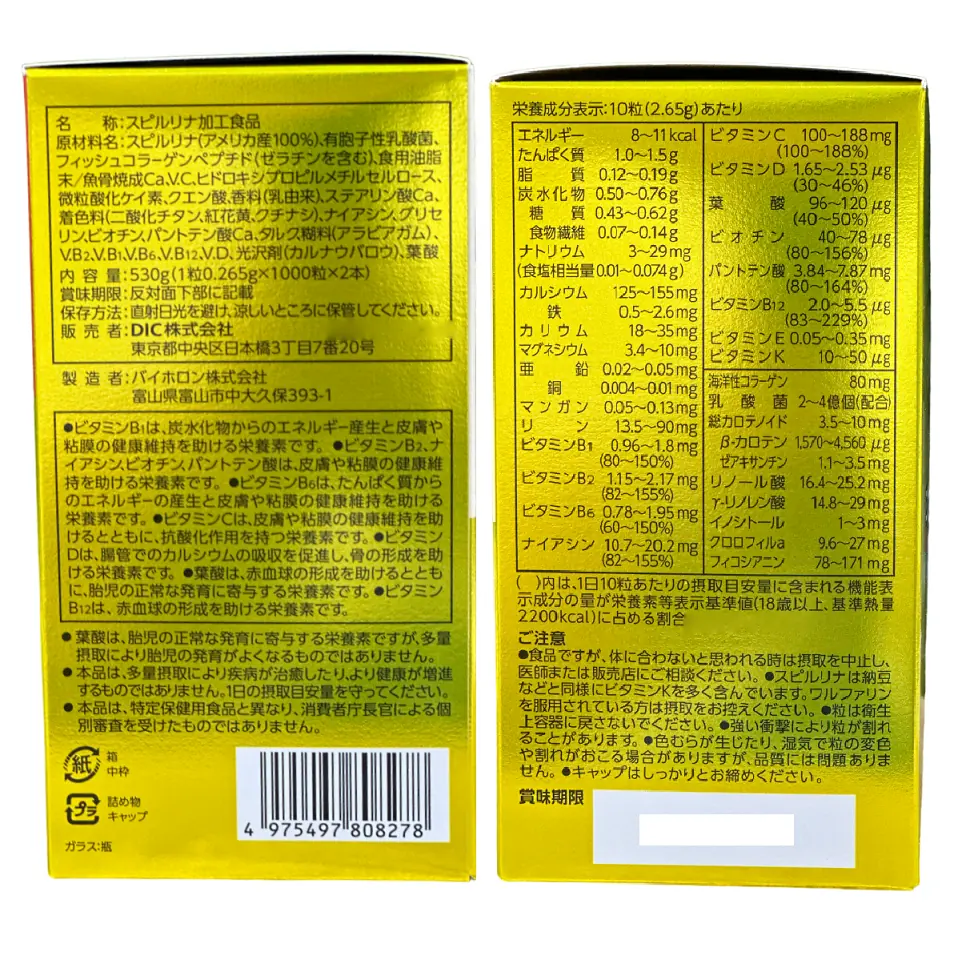
For any product, the quickest way to know what is inside and how much is the ingredient list (原材料名) and the nutrition facts (栄養成分表示) on the box. Getting into the habit of looking at that section before comparing makes the decision easier.
The table below is excerpted from the comparison table of DIC Corporation, a raw-material maker for spirulina (DIC Corporation, FAQ 「スピルリナvsクロレラ 比較表」, checked October 10, 2026). Please note that this is material from the spirulina side.
| Item | Spirulina | Chlorella |
|---|---|---|
| Classification | Blue-green alga (藍藻) | Green alga (緑藻) |
| Size | Length 1/2mm (500μm) | Diameter 1/200m (5μm) |
| Feel of the tablet | Tends to stick to teeth | Does not stick to teeth easily |
| Flavor of the tablet | Like nori seaweed | Like matcha |
| Growing environment: temperature | High | Moderate |
| Growing environment: culture water | Strongly alkaline | Mildly acidic |
| Phycocyanin (example ingredient, per 100 g) | 3.5–10 g | 0 |
※The size row is copied as DIC writes it (including “diameter 1/200m”, as written by DIC). How length is stated differs between sources; in What is spirulina? on this site, the length of the spiral filament is given as a range of 50–500 µm, and the 500 μm in DIC’s table is the upper end of that range. ※“Feel of the tablet” and “flavor of the tablet” are item names in DIC Corporation’s table. Perception differs from person to person.
In this table, phycocyanin is a blue pigment found in spirulina. DIC’s table lists chlorella as “0”. This item, too, is not used to say which is better or worse. Note also that, for chlorophyll, DIC’s table gives a larger number in the chlorella column. In an academic review (Bioengineering (Basel) 2023;10(8):955, Table 2), the pigment comparison likewise lists phycocyanin as “Absent” in chlorella and gives an amount for spirulina. So DIC’s table and a table in another paper point the same way.
Be careful with ingredient numbers. Protein and other components change with strain, cultivation and processing, so they differ from product to product. For reference, within the range we checked, the main table of the Ministry of Education’s 「日本食品標準成分表2020年版(八訂)」 (Standard Tables of Food Composition in Japan) has no entry for spirulina or chlorella. When you see a figure like “this much per 100 g”, check which product and which source it comes from.
Differences in the tablet’s form and smell
In DIC’s comparison table the flavor of the tablet is “like nori seaweed” for spirulina and “like matcha” for chlorella. As for feel, spirulina “tends to stick to teeth” and chlorella “does not stick to teeth easily”. ※Perception differs from person to person.
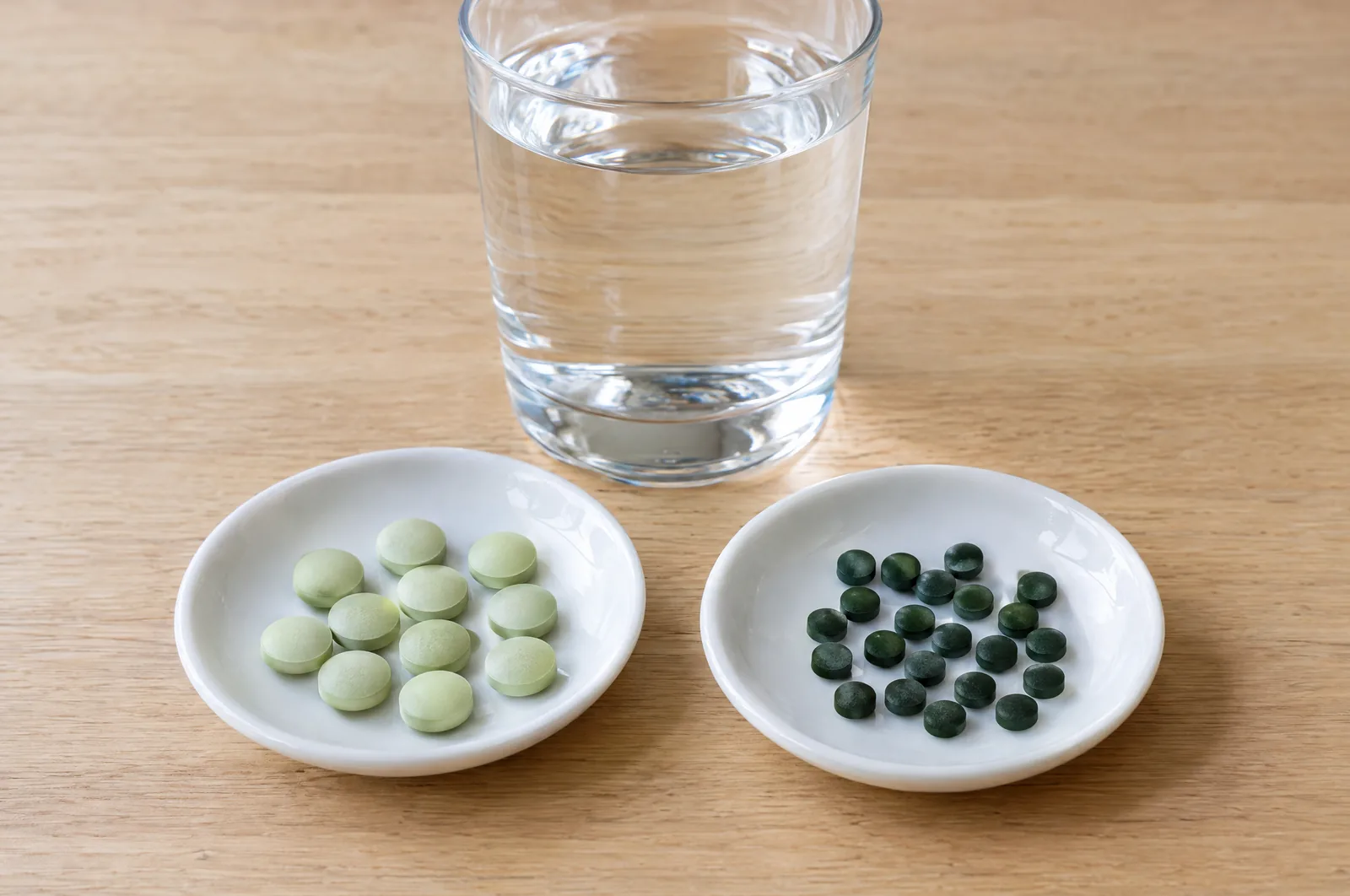
The shape, size and color of tablets differ by maker and by product. This article does not claim “this is what each tablet is like”; it takes the items in DIC’s table (feel and flavor) as a guide. On smell, For those bothered by the smell and taste of spirulina, which uses NEW スピルリナEX as its example, sorts out what the box and public materials can and cannot say.
Some chlorella products carry the words 細胞壁破砕 (cell wall disruption). This describes how the raw material is processed, which varies by product; check the label or the maker’s explanation.
Why people “switched”, in customer reviews
Of the 2,654 reviews collected for this site (reviews by people who bought spirulina, covering several shops and several products), 33 mention chlorella. Of those, 24 say the writer switched from chlorella to spirulina, or considered switching and then chose spirulina. Because these are voices of spirulina buyers, it is natural for the numbers to lean this way; they do not show which is better.
The voices of people who found chlorella a better fit are unlikely to appear here.
The reasons in these 24 reviews varied, including price and ease of keeping up (4–5 reviews) and tablet size or smell (2–3 reviews). Some reviews gave no reason, or described impressions about ingredients or the body; because the basis cannot be checked, this article does not cover them (counts may vary depending on how they are grouped).
The NEW スピルリナEX product page of 美健サイエンス on Rakuten Ichiba also has reviews from people who have taken it for a long time.
「もう20年以上継続中です。こんなに続くとは!!」(2026年1月・★5・楽天市場のレビューより・個人の感想です)
Translation: “I’ve been continuing for more than 20 years. I never thought I’d keep going this long!!” (January 2026 · ★5 · from a Rakuten Ichiba review · personal impression)
Reviews are a part of the impressions of people who bought the product. Perception differs from person to person, and it will not apply to everyone in the same way.
Choosing by purpose: a look by situation
Which to choose depends on what you are aiming for, your preference and how easy it is to keep up. The table below lists what to look at, situation by situation. It is not a ranking.
| Situation | What to look at | Next step |
|---|---|---|
| Short on vegetables for several days | First, add one small dish of vegetables to a meal. Tablets or powder are only a supplement built on top of meals | Count yesterday’s vegetable dishes in Signs You May Be Short on Vegetables? |
| Choosing by ease of taking, taste and smell | Tablet feel and flavor (table above). Perception differs from person to person | Try one serving first. See also the smell and taste article |
| Choosing by ease of keeping up | Tablets per day, and the cost per day calculated from the listed price | See how to calculate it in the cost-per-day article |
| Taking medication | Both chlorella and spirulina are mentioned as foods high in vitamin K | Do not decide on your own; ask a doctor or pharmacist |
A little more for people taking medication. PMDA’s Q&A for patients explains why people on warfarin are told to avoid natto and similar foods:
「また、納豆の他にも、クロレラ、青汁なども、納豆と同様にビタミンKを多く含むため、摂取を控えるように指導されています。」(PMDA 患者向けQ&A Q3より)
Translation: “Besides natto, chlorella and aojiru (green juice) are also high in vitamin K like natto, so patients are told to avoid them.”
The PMDA page does not name spirulina; the direct basis for spirulina is the caution printed on the box. The NEW スピルリナEX box says: 「スピルリナは納豆などと同様にビタミンKを多く含んでいます。ワルファリンを服用されている方は摂取をお控えください。」 (Spirulina, like natto, is high in vitamin K. People taking warfarin should refrain from taking it.)
Others may suit you better
- If chlorella’s tablet feel (does not stick to teeth) or its matcha-like flavor suits you better: chlorella is also an option, depending on your preference and how easy it is to keep up. Neither is “above” the other. ※Perception differs from person to person
- If you are very sensitive to the characteristic flavor of spirulina: please do not force yourself to keep going; consider other foods as well. ※Perception differs from person to person. When choosing, look at the ingredient list, nutrition facts and cautions on the box
- If you take medication or have a medical condition: check with a doctor or pharmacist before taking
Even on days short on vegetables, aim for days when you can think “at least I have topped up a little today.” ※Not a substitute for vegetables. For this kind of supplementary food, choosing by your own purpose, preference and ease of keeping up lasts longer than choosing by the name of the type.
If you are still unsure: a small next step
If you are still deciding, it is fine to pass for now. If you want to go on, take it in this order, starting with a small step.
- First, the label on the box: compare the ingredient list, nutrition facts and cautions of the products you are interested in.
- To learn more about the differences: read What is spirulina? or For those bothered by the smell and taste of spirulina.
- To see what is inside NEW スピルリナEX before deciding: read What is Spirulina EX?. It is a tablet-type food, with 10 tablets a day as the suggested amount, taken with water or hot water. It carries a nutrient function labeling for 10 vitamins.
It is not about which is better or worse, but about what suits you. Whether it suits you is for you to decide. Even on days short on vegetables, aim for days when you can think “at least I have topped up a little today.” ※Not a substitute for vegetables. ※Perception differs from person to person.