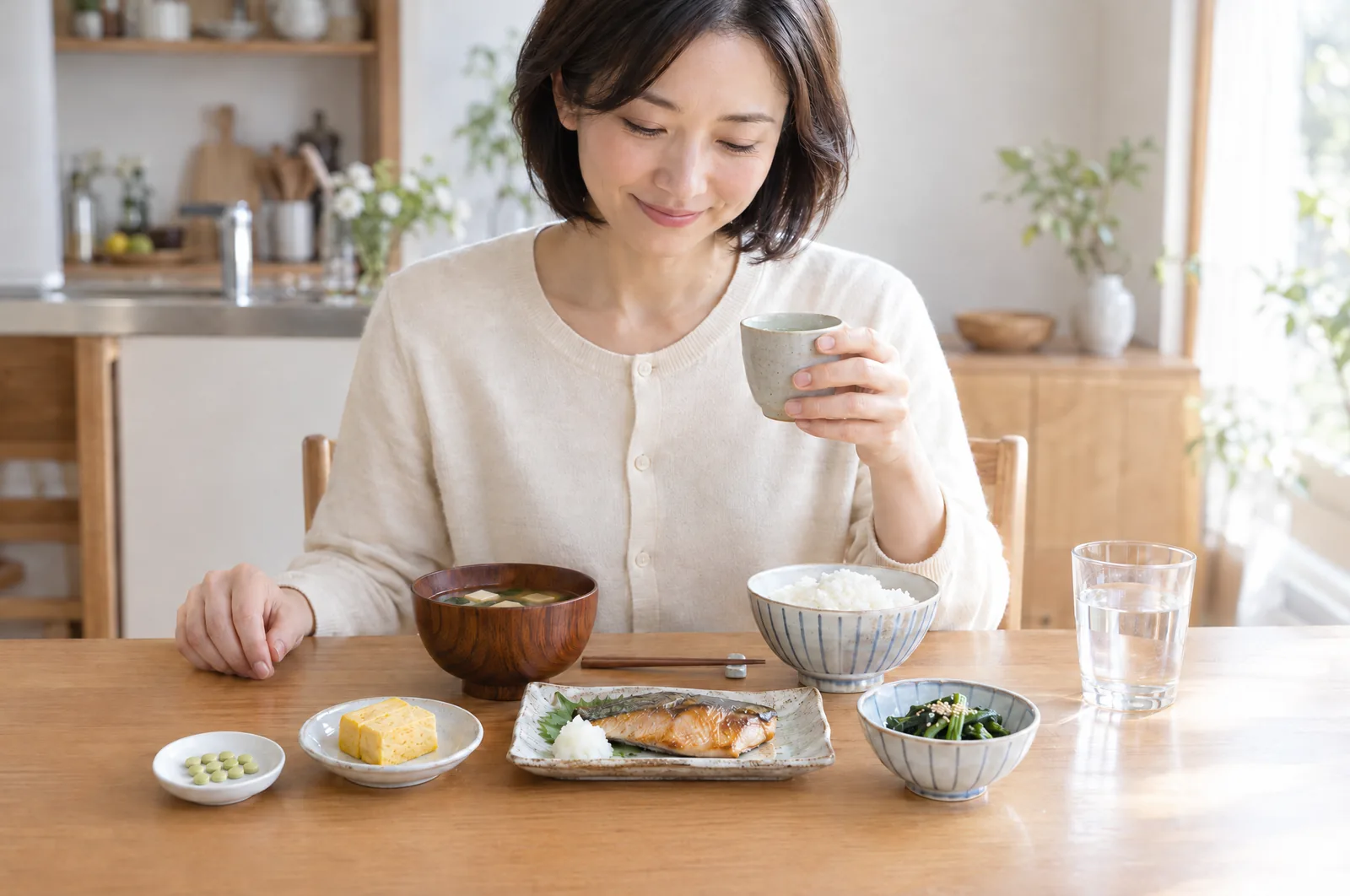
When you look into spirulina nutrition, a lot of figures per 100g line up, and it becomes hard to tell what it comes to at the amount you actually take each day. Even on days short on vegetables, aim for days when you can think “at least I have topped up a little today.” ※Not a substitute for vegetables. To get there, start by reading the “one day’s labeling” calmly.
This article lists the nutrition facts on the box of NEW スピルリナEX (10 tablets a day, 2.65g) and reads them beside guidelines such as the national “Dietary Reference Intakes for Japanese (2025 edition).” It is not an article that decides whether something “works” or “is enough.” First, the limits. 10 tablets come to 2.65g, and the figures in the tables do not show a replacement for daily meals; they are for checking the amount that sits alongside meals.
Spirulina nutrition comes in two separate kinds: “figures for the alga itself (per 100g)” and “the product’s labeling (per 10 tablets).” The labeling for the 10 tablets (2.65g) of NEW スピルリナEX is energy 8–11kcal, protein 1.0–1.5g, iron 0.5–2.6mg and so on, mostly written as ranges. This article is arranged in this order: how to read the table, how to read protein, iron, vitamins and B12, and where it sits within meals.
What you will learn in this article
- A list of the nutrition facts for 10 tablets (2.65g) (energy, protein, minerals, vitamins and so on), and how to read the table
- Why the figures in the table are not the nutrition of the alga spirulina alone
- How protein and iron compare with national guidelines and with meals
- How to read the vitamin B12 labeling (including the story of the alga’s “pseudovitamin B12”)
- Answers to “What does it work for?”, “Does it make you gain weight?” and “Which is better, compared with chlorella?”
This article is based on the labeling on the actual NEW スピルリナEX box, the Ministry of Health, Labour and Welfare’s “Dietary Reference Intakes for Japanese (2025 edition)” and “Reiwa 6 (2024) National Health and Nutrition Survey,” the Consumer Affairs Agency’s Food Labeling Standards and guidelines, the Ministry of Education, Culture, Sports, Science and Technology’s food composition tables, research by Yuri Tanioka of Tokyo University of Agriculture, an opinion of ANSES (the French Agency for Food, Environmental and Occupational Health & Safety), and so on (checked October 22, 2026). It is not a substitute for a diagnosis by a doctor or registered dietitian (管理栄養士), or for advice to an individual. The basics of spirulina itself are sorted out in What Is Spirulina? Basics of This Blue-Green Alga and Its Nutrients.
Nutrition Facts for 10 Tablets (2.65g) | Reading the Table on the Box
The box of NEW スピルリナEX gives the nutrition facts per 10 tablets (2.65g) a day. Energy is 8–11kcal and protein 1.0–1.5g, and most figures are shown as a range written ”○–○”. This section transcribes the table on the box in three parts, and gives 4 points to watch when reading it.
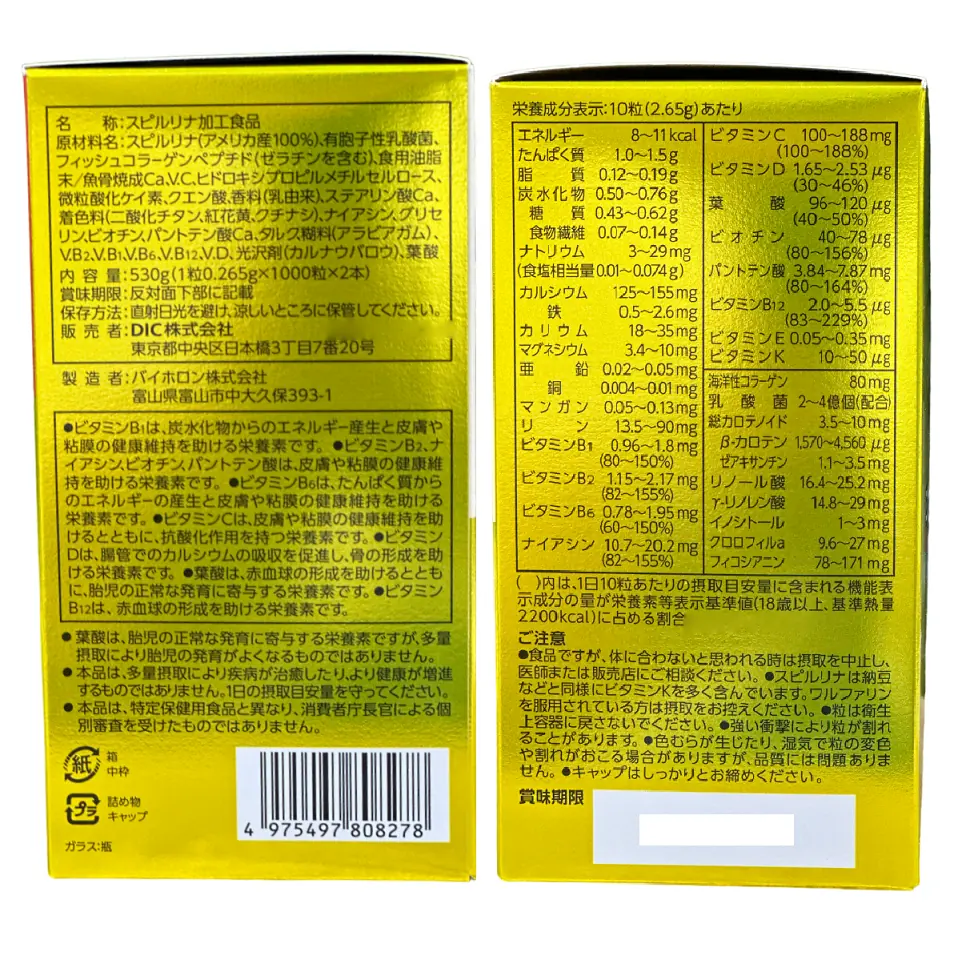
The tables below transcribe the nutrition facts on the box (per 10 tablets, 2.65g) as they are shown. One tablet is 0.265g. First, the 5 items that the Food Labeling Standards require to be shown (energy, protein, fat, carbohydrate and salt equivalent).
| Item | Per 10 tablets (2.65g) |
|---|---|
| Energy | 8–11kcal |
| Protein | 1.0–1.5g |
| Fat | 0.12–0.19g |
| Carbohydrate | 0.50–0.76g (breakdown: sugars 0.43–0.62g, dietary fiber 0.07–0.14g) |
| Salt equivalent | 0.01–0.074g (sodium 3–29mg) |
Next, the 8 minerals.
| Mineral | Per 10 tablets (2.65g) |
|---|---|
| Calcium | 125–155mg |
| Iron | 0.5–2.6mg |
| Potassium | 18–35mg |
| Magnesium | 3.4–10mg |
| Zinc | 0.02–0.05mg |
| Copper | 0.004–0.01mg |
| Manganese | 0.05–0.13mg |
| Phosphorus | 13.5–90mg |
Finally, the other ingredients. The vitamins are covered together in the later section “The 10 Vitamins (Nutrient Function Claims Labeling)”.
| Ingredient | Per 10 tablets (2.65g) |
|---|---|
| Marine collagen | 80mg |
| Lactic acid bacteria (spore-forming) | 200–400 million cells (blended) |
| Total carotenoids | 3.5–10mg |
| β-carotene | 1,570–4,560µg |
| Zeaxanthin | 1.1–3.5mg |
| Linoleic acid | 16.4–25.2mg |
| γ-linolenic acid | 14.8–29mg |
| Inositol | 1–3mg |
| Chlorophyll a | 9.6–27mg |
| Phycocyanin | 78–171mg |
There are 4 ways to read the table.
- Reading 1 | It is “per 10 tablets,” not “per 100g.” The “per 100g” figures you see online are the figures for dried spirulina itself. 10 tablets a day come to 2.65g, so they are not the same figures.
- Reading 2 | ”○–○” is a range. The Food Labeling Standards (Article 3) provide that the amounts of energy, protein, fat, carbohydrate and salt equivalent (sodium) are shown as 「一定の値又は下限値及び上限値」 (translation: “a fixed value, or a lower limit and an upper limit”) (excerpt). As an example calling for attention when considering whether a labeled value is within the range, the Consumer Affairs Agency’s guidelines give the case where 「原材料に個体差があり、同一商品であっても、栄養成分の量にバラツキがある」 (translation: “the raw materials vary individually, and even for the same product there is variation in the amount of nutrients”). The box does not state why it uses ranges. From the labeling alone, you cannot tell which figure within a range corresponds to your own 10 tablets. This article writes the ranges as they are and does not create averages or midpoints.
- Reading 3 | Each unit is 1/1,000 of the one before. A mg (milligram) is 1/1,000 of a g, and a µg (microgram) is 1/1,000 of a mg. For example, iron “0.5–2.6mg” is 0.0005–0.0026g.
- Reading 4 | The salt equivalent is a value calculated from sodium. The Food Labeling Standards define the salt equivalent as 「ナトリウムの量に二・五四を乗じたもの」 (translation: “the amount of sodium multiplied by 2.54”) (excerpt). For the upper limit of 29mg of sodium, 29 × 2.54 ÷ 1,000 comes to about 0.074g, which matches the figure in the table.
The Table’s Figures Are Not the Nutrition of “Spirulina Alone”
The table on the box is not figures for the alga spirulina alone; it is the labeling for the whole product of 10 tablets. The ingredient list (原材料名) names vitamins, calcium and others under separate names besides spirulina. Keep three separate yardsticks in view: “the nutrition of the alga,” “the product’s labeling” and “national guidelines and survey.”
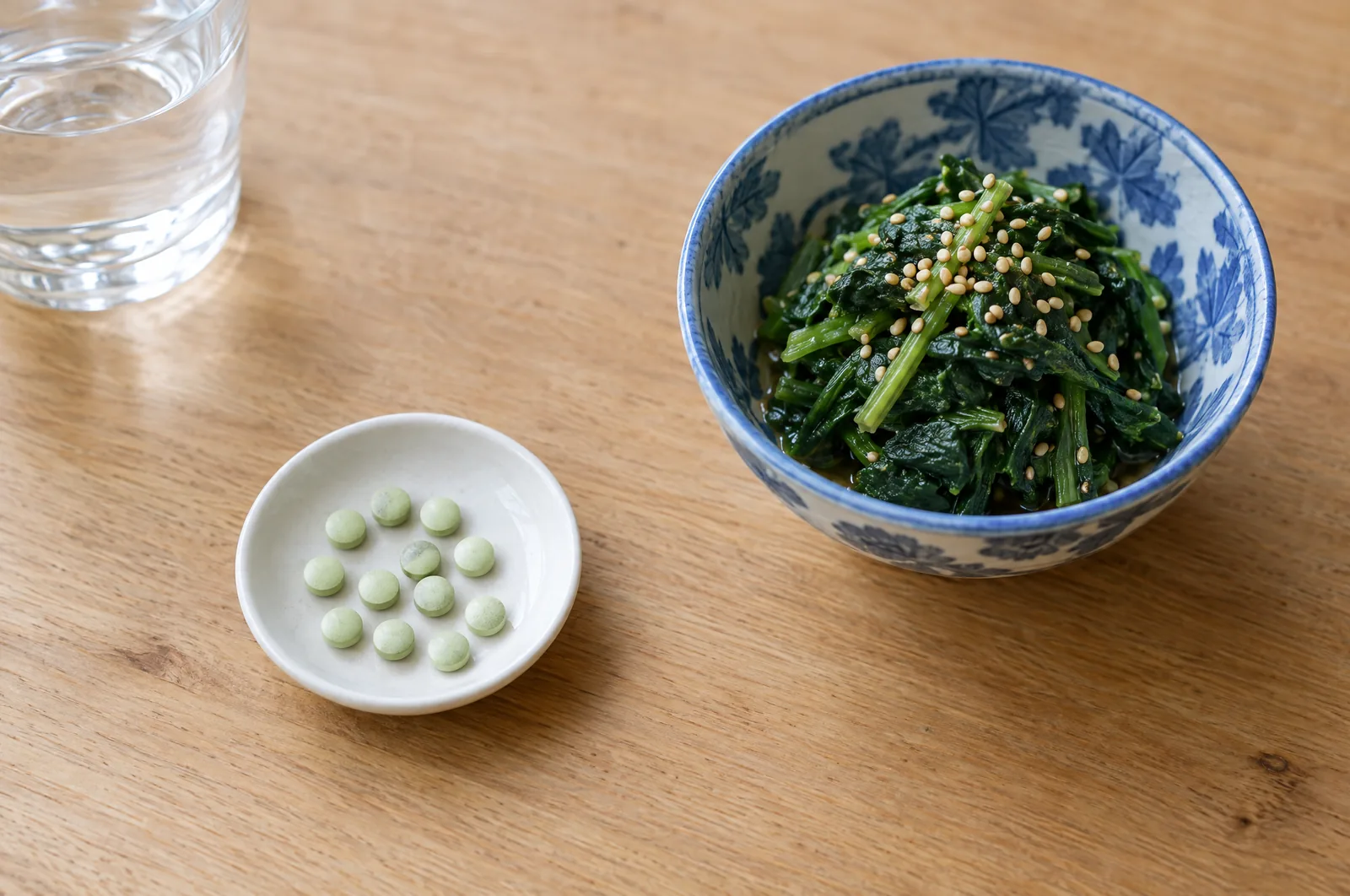
The three yardsticks are summarized in the table.
| Yardstick | What the figure is | What this article uses |
|---|---|---|
| ① The alga itself | Per 100g of dried spirulina. Varies with place of origin, how it is grown and so on | The FAO review (2008) and the USDA database |
| ② The product’s labeling | Per 10 tablets (2.65g) of the product. Figures for all the ingredients together | The nutrition facts on the box |
| ③ National guidelines and survey | Per day. Guidelines (Dietary Reference Intakes) by age and sex; the survey shows actual average intakes | The Ministry of Health, Labour and Welfare’s Dietary Reference Intakes and National Health and Nutrition Survey |
① The alga itself. In the data of Chapter 2 of the Ministry of Education, Culture, Sports, Science and Technology’s 「日本食品標準成分表(八訂)増補2023年」 (Standard Tables of Food Composition in Japan, 2020 edition (8th revision), 2023 supplement), spirulina could not be found (chlorella could not be found either). What can serve as a reference is the review by the Food and Agriculture Organization of the United Nations (FAO, 2008) and the database of the US Department of Agriculture (USDA). The FAO review writes that protein is 55–70% of dry weight and that the figure varies with its source. Even in Table 1 of the same review, the protein values differ by the facility examined: 60%, 61%, 65%, or 55–70%. The USDA’s “Seaweed, spirulina, dried” gives 57.47g of protein and 28.5mg of iron per 100g (US data).
② The product’s labeling. The ingredient list (原材料名) on the box names, besides spirulina (100% from the United States), spore-forming lactic acid bacteria and fish collagen peptide (contains gelatin), also calcined fish bone Ca, V.C, niacin, biotin, calcium pantothenate, V.B2, V.B1, V.B6, V.B12, V.D and folic acid under separate names (ingredients that shape the tablets, colorings, flavorings and so on are also listed). Vitamins E and K are not written under separate names in the ingredient list. For the figures in the nutrition facts, the box does not state a breakdown of which come from the alga and which from the added ingredients.
「スピルリナはたんぱく質が半分以上」 (“Spirulina is more than half protein”) is a statement about ①. 「10粒でたんぱく質1.0〜1.5g」 (“Protein of 1.0–1.5g in 10 tablets”) is a statement about ②. If you mix the two, the meaning of the figures changes.
Protein and Iron: “How Much”? | Setting Them Beside the Dietary Reference Intakes
The protein in 10 tablets is 1.0–1.5g and the iron is 0.5–2.6mg. Set beside the recommended dietary allowance for ages 30–49 (protein 65g for men and 50g for women; iron 7.5mg for men and 6.0–10.5mg for women), the amount in 10 tablets is a part of what you take in a day. The main entrance for protein and iron is the daily meal (staple, main dish, side dishes).
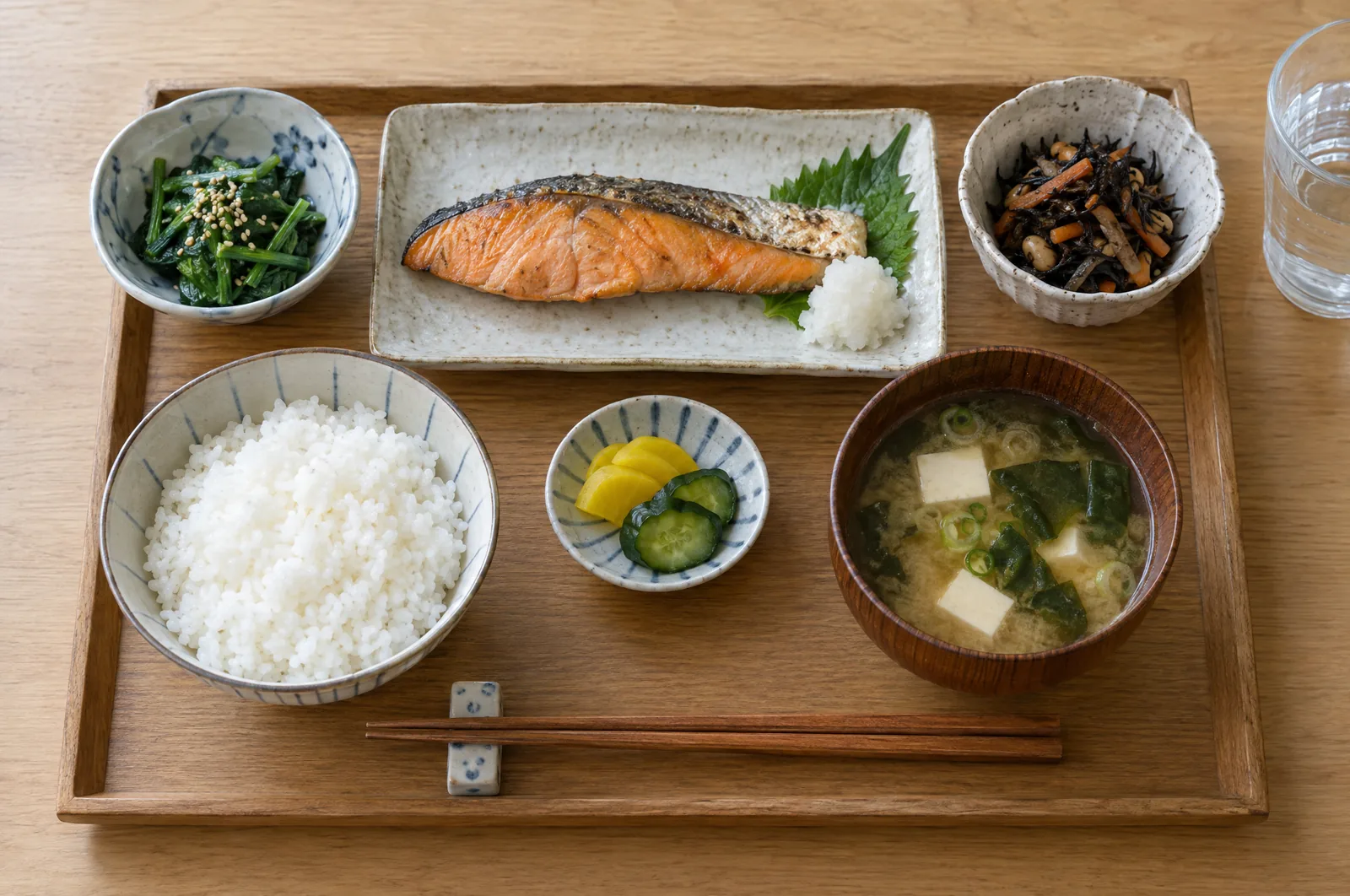
In the Dietary Reference Intakes for Japanese (2025 edition), the “recommended dietary allowance” (推奨量) is described as 「ほとんどの者が充足している量」 (translation: “an amount at which the requirements of nearly everyone are met”) (excerpt). It is a guideline for a group, not the needed amount for each individual. For indicators other than the tolerable upper intake level, the Dietary Reference Intakes say 「通常の食品からの摂取を基本とする」 (translation: “intake from ordinary foods is the basis”) (excerpt). Here, men and women aged 30–49 are used as examples. The recommended dietary allowances for other ages can be checked in the tables of the report (printed p. 103 for protein, printed p. 345 for iron).
Protein (per day)
| What is compared | Protein |
|---|---|
| Labeling for 10 tablets (2.65g) (on the box) | 1.0–1.5g |
| Recommended dietary allowance for a day (ages 30–49) | Men 65g, women 50g |
| Average intake in the national survey (age 20 and over) | Men 78.0g, women 65.9g |
| Labeling for 10 tablets ÷ recommended dietary allowance (self-calculated estimate) | Men approx. 1.5–2.3%, women approx. 2.0–3.0% |
Iron (per day)
| What is compared | Iron |
|---|---|
| Labeling for 10 tablets (2.65g) (on the box) | 0.5–2.6mg (the upper end of the range is about 5 times the lower end) |
| Recommended dietary allowance for a day (ages 30–49) | Men 7.5mg; women 6.0mg (without menstruation) or 10.5mg (with menstruation) |
| Average intake in the national survey (age 20 and over) | Men 8.1mg, women 7.3mg |
※The figures from the national survey come from a survey conducted in October–November of Reiwa 6 (2024) on an arbitrary single day excluding Sundays and public holidays, and are averages per person per day (nationally adjusted values). In the summary of that survey they are listed as “reference” items. They are not habitual intakes, and they differ greatly from person to person.
For reference, figures for foods are also set side by side.
| Food (per 100g of edible portion) | Protein | Iron |
|---|---|---|
| Cooked rice (polished rice) | 2.5g | 0.1mg |
| Hen’s egg (whole, raw) | 12.2g | 1.5mg |
| Natto (sticky fermented soybeans) | 16.5g | 3.3mg |
| Spinach (leaves, year-round average, raw) | 2.2g | 2.0mg |
※The source is the Standard Tables of Food Composition in Japan (8th revision), 2023 supplement (Ministry of Education, Culture, Sports, Science and Technology). The amount eaten differs by food, and this is not a table comparing foods at the same weight as 10 tablets.
How to read protein. 「スピルリナはたんぱく質が多い」 (“Spirulina is high in protein”) is a statement about the share of the dried weight (55–70% in the FAO review). 10 tablets a day come to 2.65g, so the amount of protein itself is 1.0–1.5g by the labeling. Protein is, in principle, taken from meals that combine a staple, a main dish and side dishes.
How to read iron. Iron is not a nutrient of which more is better. The Dietary Reference Intakes (2025 edition) do not set a tolerable upper intake level for iron, but they write 「推奨量を大きく超える鉄の摂取は、貧血の治療等を目的とした場合を除き、控えるべきである。」 (translation: “Iron intake greatly exceeding the recommended dietary allowance should be avoided, except where the purpose is the treatment of anemia and the like.”) (excerpt). The same report says that people who are not iron-deficient should avoid continuously adding iron from foods other than ordinary foods (so-called health foods and the like) on top of their meals (summary of printed p. 297). It also says that iron supplementation for iron deficiency or iron-deficiency anemia is to follow a doctor’s instructions, and that supplementing iron on one’s own judgment with foods other than ordinary foods should be avoided (summary of printed p. 298). The 10 tablets of NEW スピルリナEX also contain 0.5–2.6mg of iron by the labeling. If you use another nutritional supplement food that contains iron, or if anemia or a shortage of iron concerns you, please first consult a doctor or a registered dietitian (管理栄養士). The figures in this article do not decide whether it is enough or not enough.
The 10 Vitamins (Nutrient Function Claims Labeling)
The table on the box gives the amounts of 12 vitamins. Of these, the 10 covered by the labeling as a Food with Nutrient Function Claims (栄養機能食品) are vitamins B1, B2, B6, B12, C, D, niacin, folic acid, biotin and pantothenic acid. Vitamins E and K are not covered.
| Vitamin | Per 10 tablets (2.65g) | Percentage of the Nutrient Reference Value (栄養素等表示基準値) |
|---|---|---|
| B1 | 0.96–1.8mg | 80–150% |
| B2 | 1.15–2.17mg | 82–155% |
| B6 | 0.78–1.95mg | 60–150% |
| B12 | 2.0–5.5µg | 83–229% |
| C | 100–188mg | 100–188% |
| D | 1.65–2.53µg | 30–46% |
| Niacin | 10.7–20.2mg | 82–155% |
| Folic acid | 96–120µg | 40–50% |
| Biotin | 40–78µg | 80–156% |
| Pantothenic acid | 3.84–7.87mg | 80–164% |
| E | 0.05–0.35mg | Not shown |
| K | 10–50µg | Not shown |
The sentences on the function of each vitamin (as written on the box) and the standards revised in October 2026 are sorted out in What Is a Food with Nutrient Function Claims? How to Read the Spirulina EX ‘10 Vitamins’ Label. Here, the focus is only on how to read the “percentage” in the table.
- The percentage is against the “Nutrient Reference Value” (栄養素等表示基準値). The box writes that it is the share of the 「栄養素等表示基準値(18歳以上、基準熱量2200kcal)」 (translation: “Nutrient Reference Value (age 18 and over, reference energy 2,200kcal)”). About the Nutrient Reference Value, the Consumer Affairs Agency’s guidelines write 「表示を目的として、食事摂取基準の基準値を日本人の人口に基づき加重平均したものであり、必ずしも個人が目指すべき1日当たりの栄養素等摂取量を示すものではありません。」 (translation: “For the purpose of labeling, it is the reference values of the Dietary Reference Intakes weighted-averaged on the basis of the Japanese population, and it does not necessarily indicate the daily intake of nutrients that an individual should aim for.”) (excerpt). Whether a percentage is above or below 100% is not a figure that decides whether it is enough or not enough.
- The reference values were revised in 2025. For example, protein changed from 81g to 85g, iron from 6.8mg to 6.5mg, and vitamin B12 from 2.4µg to 4.0µg (Food Labeling Standards, Appended Table 10 (別表第十)). The pre-revision reference values can be used for the labeling of processed foods manufactured, processed or imported by March 31, 2028 (supplementary provisions). The box does not say which version the percentages were calculated with.
- The box carries a caution about vitamin K. The box says 「スピルリナは納豆などと同様にビタミンKを多く含んでいます。ワルファリンを服用されている方は摂取をお控えください。」 (translation: “Spirulina, like natto, is high in vitamin K. People taking warfarin should refrain from taking it.”). For details, see Spirulina and Warfarin: Why People Taking Warfarin Are Asked to Avoid It (the Vitamin K Story).
About the Vitamin B12 Labeling
The box gives vitamin B12 as 2.0–5.5µg (83–229% of the reference value). On the other hand, the B12 compound contained in the alga spirulina is reported to be 「ヒトで栄養学的に無効なシュードB12」 (pseudovitamin B12, which is nutritionally inactive in humans). Read the labeling on the box and the story of the alga itself separately.
What is written on the box. The ingredient list on the box has “V.B12” written separately from spirulina. The box does not state a breakdown of whether the 2.0–5.5µg of B12 in the nutrition facts comes from the alga or from the “V.B12.” The sentence of the nutrient function claim is 「ビタミンB12は、赤血球の形成を助ける栄養素です。」 (translation: “Vitamin B12 is a nutrient that helps form red blood cells.”) (as written on the box).
What has been reported in research about the B12 of the alga. In an explanatory article (2016) by Yuri Tanioka of Tokyo University of Agriculture, about the B12 of edible cyanobacteria she writes 「食用ラン藻はシュードB12のみが検出された」 (translation: “only pseudovitamin B12 was detected in edible cyanobacteria”) (excerpt). Her review paper (Vitamins [ビタミン], Vitamin Society of Japan, Vol. 93, No. 2, 2019) writes 「原核藻類(ラン藻)にはB12ではなく、ヒトで栄養学的に無効なシュードB12が含まれていることが報告された。」 (translation: “It was reported that prokaryotic algae (cyanobacteria) contain not B12 but pseudovitamin B12, which is nutritionally inactive in humans.”) (reference numbers omitted). The explanatory article is not a peer-reviewed paper, and the review paper is a summary centered on the author’s own research.
The 2017 opinion of ANSES (the French Agency for Food, Environmental and Occupational Health & Safety) also states that spirulina is not a reliable source of vitamin B12 for people who do not eat foods of animal origin, and that most of the B12 is in the form of an inactive analogue (opinion p. 26). The opinion states clearly that its purpose is the assessment of risk, not an assessment of effects or nutritional value (p. 1).
How to read it. It cannot be read as 「スピルリナ(藻)だからB12が多い」 (“because it is spirulina (an alga), it has a lot of B12”). Read the amount of B12 on the box as the labeling of the product of 10 tablets. It is important not to mix the nutrition of the alga with the story of ingredients added to the product.
The percentage, and the national guideline. The percentage “83–229%” is a figure that fits when calculated with the pre-revision reference value (B12 2.4µg) (2.0 ÷ 2.4, 5.5 ÷ 2.4). The pre-revision values can be used for the labeling of processed foods manufactured, processed or imported by March 31, 2028 (supplementary provisions of the Food Labeling Standards). The vitamin B12 in the national Dietary Reference Intakes (2025 edition) is an adequate intake (目安量), not a recommended dietary allowance, and is 4.0µg a day for both men and women aged 18 and over (as cyanocobalamin equivalent). The adequate intake is described as 「一定の栄養状態を維持するのに十分な量」 (translation: “an amount sufficient to maintain a certain nutritional status”) (excerpt).
If you eat hardly any foods of animal origin, or are otherwise concerned about whether you are getting enough B12, please consult a doctor or a registered dietitian (管理栄養士).
Its Place Within Meals | Energy, Chlorella and “What Does It Work For?”
10 tablets come to 2.65g, and the energy is 8–11kcal. Set beside the average daily energy intake in the national survey (for age 20 and over, 2,090kcal for men and 1,689kcal for women), the center of the amount is the daily meal. The nutrition facts can be read as a table for checking the amount that sits alongside meals, not in place of them.
Does it make you gain weight? The Ministry of Health, Labour and Welfare’s e-Health Net explains 「摂取エネルギーが消費エネルギーを上回り、過剰分が体脂肪として蓄積される」 (translation: “energy intake exceeds energy expenditure, and the excess is stored as body fat”) (excerpt). That is a statement about the diet as a whole. Within the range checked this time, no material was found that says you gain weight, or do not gain weight, just by taking spirulina. In the reference table of the Dietary Reference Intakes, the estimated energy requirement for ages 30–49 at a “normal” level of physical activity is 2,750kcal for men and 2,050kcal for women (these are reference figures, not recommended dietary allowances). These are figures set side by side; they do not decide whether you gain weight or not.
「クロレラとどちらがいい?」 (Which is better, compared with chlorella?) Neither spirulina nor chlorella could be found in the Standard Tables of Food Composition in Japan, so the national tables cannot place them side by side. The differences in classification, ingredients, form and how to choose are sorted out in Spirulina vs Chlorella: How Do They Differ? Comparing Ingredients, Form and How to Choose.
What does it work for? This article does not say that spirulina “works” or “does not work” for anything. About so-called health foods in general, the Ministry of Health, Labour and Welfare and the National Institute of Health and Nutrition’s 『健康食品の正しい利用法』 (Correct Use of Health Foods, 2013) writes 「健康食品で病気が治ったということを明確に示した研究結果は現時点ではありません。」 (translation: “At present there are no research results that clearly show that a disease was cured by a health food.”). This is not a statement singling out spirulina. The same material also writes, about personal accounts, 「それだけで有効性の証明にはなりません」 (translation: “that alone does not amount to proof of effectiveness”) (excerpt). As for Foods with Nutrient Function Claims, the Consumer Affairs Agency explains them as 「1日に必要な栄養成分(ビタミン、ミネラルなど)が不足しがちな場合、その補給のために利用できる食品です。」 (translation: “foods that can be used to supply the nutrients (vitamins, minerals and so on) needed in a day, when they tend to run short.”). The Food with Nutrient Function Claims labeling on the NEW スピルリナEX box consists of sentences explaining the general functions of vitamins, and does not describe the function of spirulina itself.
Knowing the figures in the table is the foundation for days when you can think you have “topped up.” But the figures alone do not put your days in order. With a meal that combines a staple, a main dish and side dishes as the base, the place of a nutritional supplement food is to be added alongside meals on days when the meal has been disrupted. Even on days short on vegetables, aim for days when you can think “at least I have topped up a little today.” ※Not a substitute for vegetables.
Amount, Cost and Cautions for NEW スピルリナEX (Box and Product Page)
One box of NEW スピルリナEX holds 2 containers of 1,000 tablets (2,000 tablets, 530g), which at 10 tablets (2.65g) a day is about 200 days’ worth. The distributor listed on the box (販売者) is DIC Corporation and the manufacturer is バイホロン株式会社 (as shown on the box). On the Rakuten Ichiba product page of 美健サイエンス, the price of one box is 10,100 yen (tax and shipping included), which works out to about 50.5 yen per day (calculated from the listed price; checked October 22, 2026).
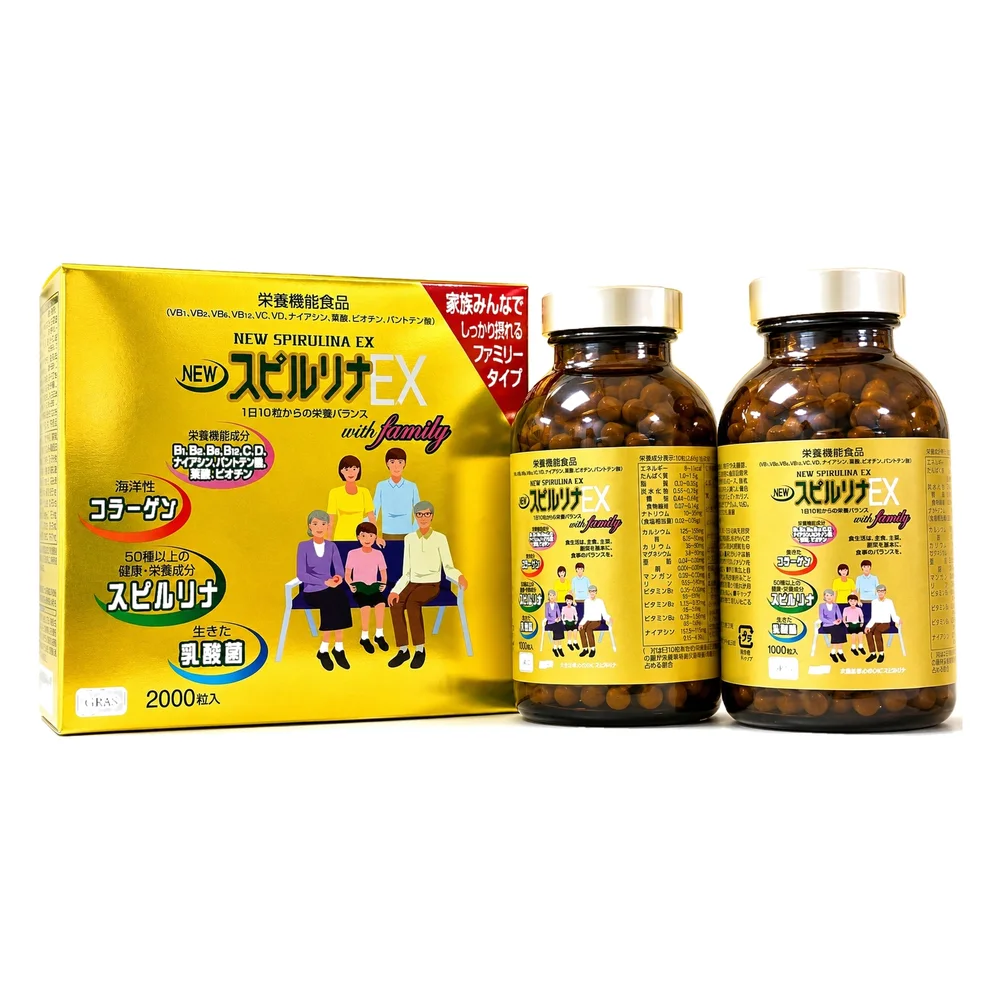
The box says to take 10 tablets a day as a guide, with water or hot water. As cautions, it says to stop taking it and consult a doctor or the retailer if it does not seem to suit you, and that it contains a lot of vitamin K, so people taking warfarin should refrain from taking it. The ingredients include gelatin (fish collagen peptide), a milk-derived flavoring and calcined fish bone calcium. Prices change, so please check the product page before buying. How to think about the amount is sorted out in How Much Does Spirulina EX Cost per Day? A 2,000-Tablet Box Lasts About 200 Days.
The same product page has 135 reviews (checked October 22, 2026). Of these, 8 contained the word 「栄養」 (nutrition). The number of reviews that touched on individual figures such as vitamins, protein, iron, B12 or calories was 0 (counted by keywords). This only shows that the figures in the table are not the center of the impressions of those who bought it; it does not show whether the figures are good or bad. Here is one example of a review.
「食生活が乱れがちなので助かっています。」(2026年4月・★5・楽天市場のレビューより一部抜粋・個人の感想です)
Translation: “My eating habits tend to get disrupted, so it helps.” (April 2026 · ★5 · excerpt from a Rakuten Ichiba review · one customer’s personal impression)
A review is a part of the impressions of people who bought the product. Perception differs from person to person, and it will not necessarily apply to everyone in the same way. If you are taking medication, please check with a doctor or pharmacist. NEW スピルリナEX itself is sorted out in What Is Spirulina EX? A 10-Tablet Habit for Days Short on Veggies.
Summary | A Small Next Step After Reading the Numbers
The nutrition facts are easier to read calmly if you keep three points in hand: “per 10 tablets,” “ranges” and “figures for the whole product.” The next step is to compare the table on the box with today’s meals.
- 1. Look at the table on the box (2 minutes): check “per how many grams,” “whether it is written as a range,” and “whether the ingredient list names other ingredients under separate names” (「原材料名に、ほかの成分が別の名前で書かれているか」)
- 2. Write down today’s meals (3 minutes): jot down in a few words whether you had a staple, a main dish and side dishes
- 3. If something concerns you, consult someone: people taking medication, people who are pregnant or breastfeeding, people with a medical condition, and people concerned about a shortage of iron or B12 should consult a doctor, pharmacist or registered dietitian (管理栄養士)
Even on days short on vegetables, aim for days when you can think “at least I have topped up a little today.” ※Not a substitute for vegetables.
How to take NEW スピルリナEX and how to keep up 10 tablets a day can be checked in How to Take Spirulina EX: 10 Tablets a Day, and When?.