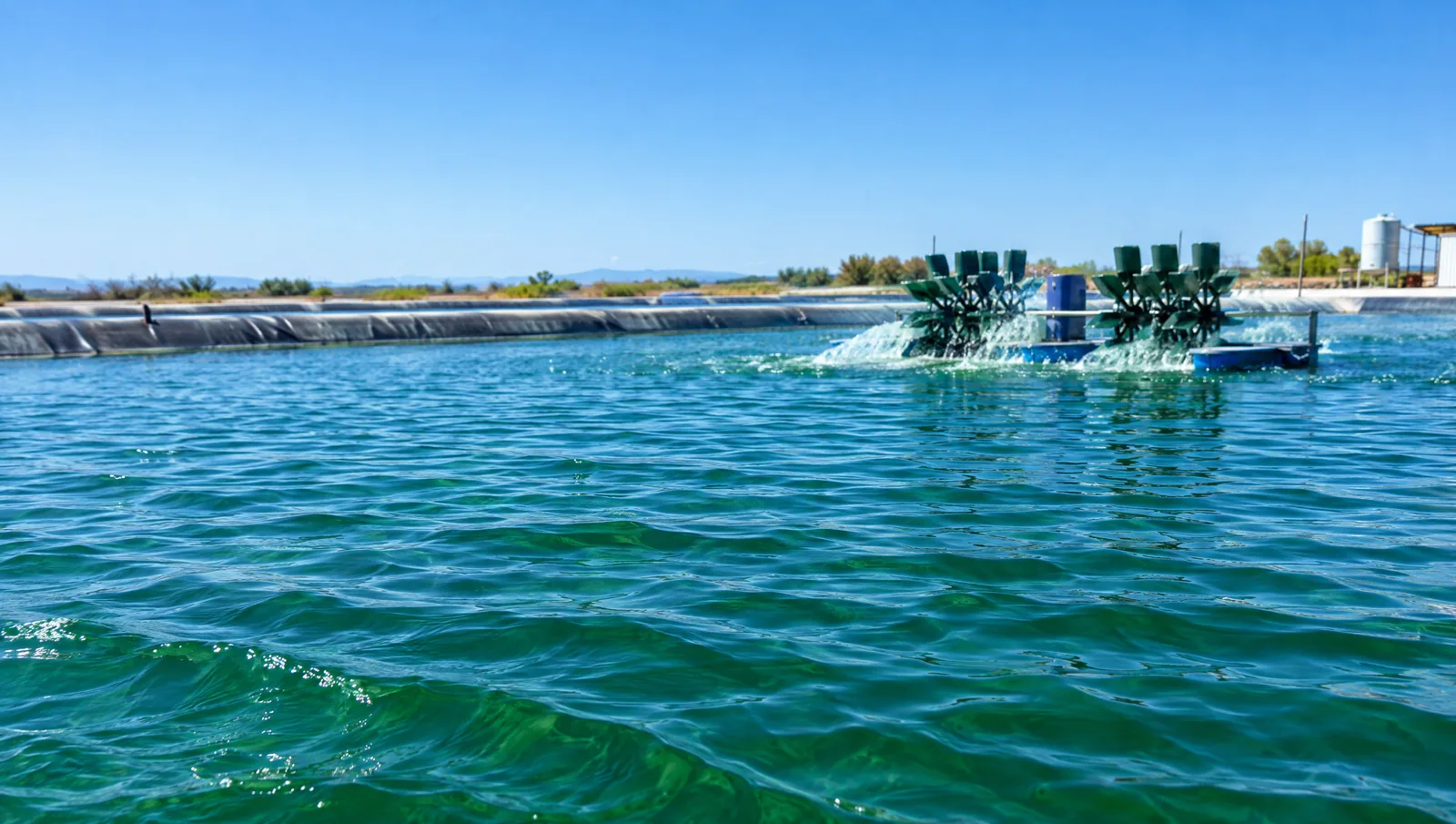
「スピルリナって、結局なんだろう」 — “So what exactly is spirulina?” It’s a name you keep running into when you stand in front of the food supplement shelf, worried about not eating enough vegetables. You may have heard it’s a kind of alga, but how is it different from kombu or wakame, or from chlorella and aojiru? Many people aren’t quite sure. This article sets out the basics of spirulina based on materials from the Food and Agriculture Organization of the United Nations (FAO) and other public bodies in Japan and abroad.
Spirulina is a kind of alga
Spirulina is a cyanobacterium (blue-green alga). It grows by photosynthesis, but it is a “prokaryote” whose cells have no nucleus, so biologically it is classed with the bacteria. Under a microscope it looks like fine threads twisted into a spiral, and the name comes from the Latin “spira” (spiral) (per FAO).
In nature it thrives in strongly alkaline lakes (pH 8.5–11), where few other microorganisms can grow, under strong sunlight and water temperatures of 30–37 °C (per FAO and DIC). As a food it is generally called “spirulina,” but scientifically it belongs to the genus Arthrospira, and research published in 2019 proposed moving it to the genus Limnospira. You don’t need to remember these when choosing a food.
Spirulina has a long history as food. On the shores of Lake Chad in Africa, “dihé,” spirulina gathered from the lake, dried and pressed into cakes, has traditionally been eaten. In 16th-century Mexico, too, there are records of people scooping a green substance from the lake and pressing it to eat. These eating customs were reported by researchers from the 1940s onward, especially in the mid-1960s, and in the 1970s large-scale production began at Lake Texcoco in Mexico and elsewhere (per FAO). In Japan, DIC株式会社 (DIC Corporation) states that it began cultivation research in 1970 and started industrial-scale production in 1977 (per DIC’s official site).
What nutrients does it contain? Protein, vitamins, minerals and pigments
Dried spirulina is more than half protein by weight. FAO’s material puts protein at 55–70% of dry weight. It also contains iron, magnesium, B vitamins such as B1, B2 and niacin, vitamin K, and the pigments phycocyanin, chlorophyll and carotenoids.
Note that spirulina is not listed in the Standard Tables of Food Composition in Japan from the Ministry of Education, Culture, Sports, Science and Technology. For reference, here are the main values per 100g of “spirulina, dried” in the U.S. Department of Agriculture (USDA) food database.
| Component (per 100g dried spirulina) | Value |
|---|---|
| Energy | 290kcal |
| Protein | 57.5g |
| Fat | 7.7g |
| Carbohydrate | 23.9g (of which dietary fiber 3.6g) |
| Iron | 28.5mg |
| Calcium | 120mg |
| Magnesium | 195mg |
| Vitamin B1 | 2.38mg |
| Vitamin B2 | 3.67mg |
| Niacin | 12.8mg |
| Vitamin K | 25.5µg |
※Source: USDA FoodData Central, “Seaweed, spirulina, dried” (U.S. values). Values vary with where and how the raw material is grown. 100g is not a daily serving; it is a reference amount for comparing components.
Spirulina’s bluish tint comes from a blue pigment called “phycocyanin.” Phycocyanin is a pigment-bearing protein, and together with chlorophyll (green) and carotenoids it produces that distinctive color (per FAO). Phycocyanin extracted from spirulina is listed as “spirulina pigment,” a food colorant, in the List of Existing Food Additives (既存添加物名簿) of Japan’s Ministry of Health, Labour and Welfare (厚生労働省).
On the other hand, vitamin B12 needs a caution. The B12 compounds in edible cyanobacteria such as spirulina are reported to be mainly “pseudo-vitamin B12,” which is largely inactive in the human body (per research by Yuri Tanioka of Tokyo University of Agriculture). France’s food safety agency (ANSES) also states that spirulina is not an adequate source of vitamin B12 for people on a plant-based diet.
Powder, tablets, drinks: the forms it takes as food
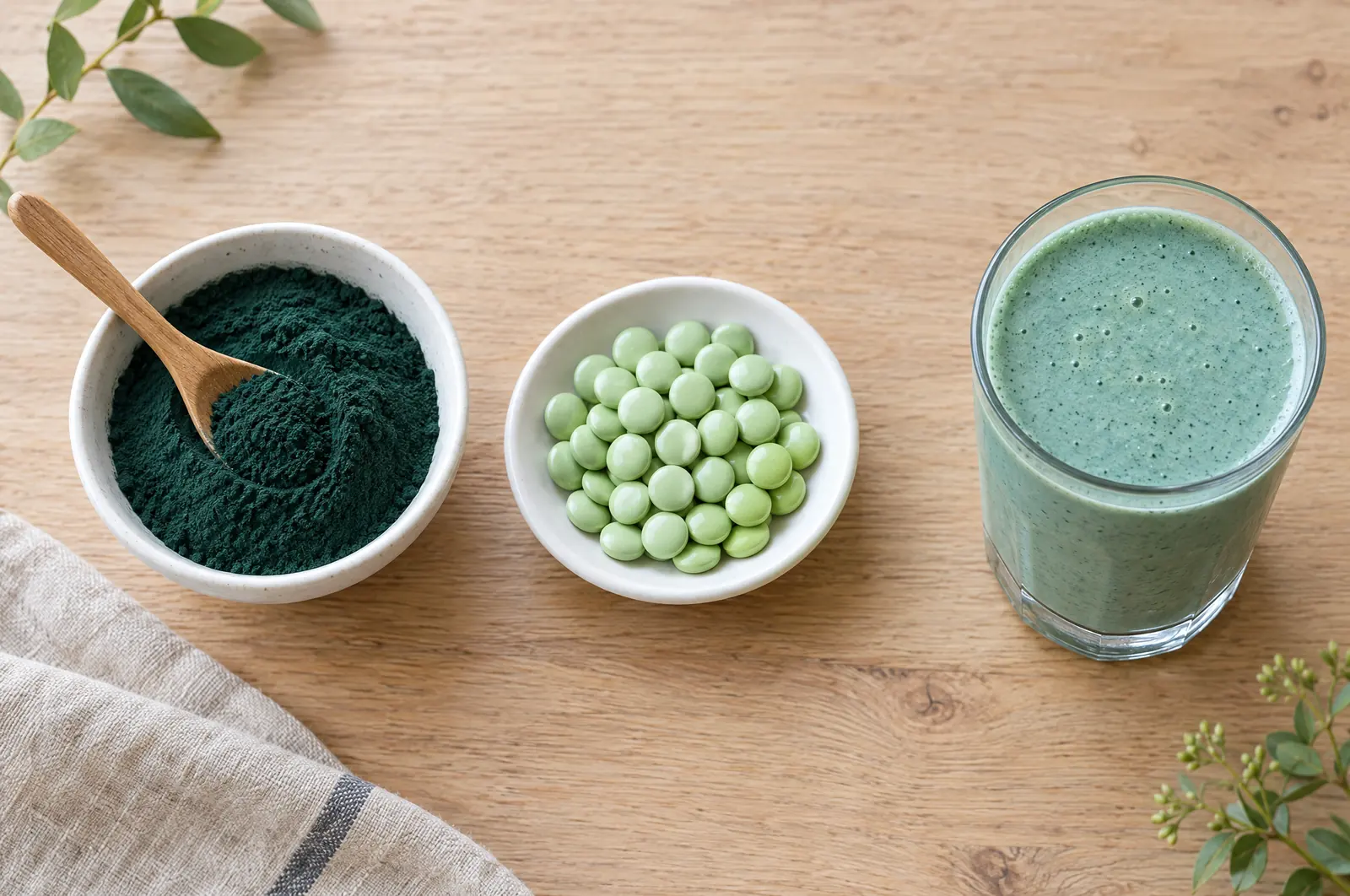
Spirulina is used in food mainly as powder and tablets.
- Powder: dried spirulina ground into a powder, mixed into drinks or dishes. It is deep green.
- Tablets: powder pressed into tablets. Since you count the daily amount in tablets, it is easy to keep track of how much you take.
- Extracts and drinks: there are also beverages made with spirulina and products combined with aojiru.
- Blue food coloring: “spirulina pigment,” extracted from phycocyanin, is used for the blue in confectionery and ice cream. It is an ingredient for coloring, separate from the tablets taken for nutrition.
The Japan Health and Nutrition Food Association sets three standards according to protein content and other factors: “spirulina food,” “processed spirulina food,” and “processed spirulina compound food.” The name on the NEW スピルリナEX package is “スピルリナ加工食品” (processed spirulina food).
How it differs from chlorella and aojiru, in a nutshell
Spirulina is a “cyanobacterium,” chlorella is a “green alga,” and aojiru is “leafy vegetables.” All three are often lined up on the shelf as green health foods, but the organisms they come from are entirely different.
| Spirulina | Chlorella | Aojiru | |
|---|---|---|---|
| What it comes from | Cyanobacterium (blue-green alga) | Green alga (single-celled) | Leafy vegetables such as kale and young barley leaves |
| Cell structure | Prokaryote, no nucleus | Eukaryote, has a nucleus | Plant leaf |
| Shape | Spiral filament (50–500µm long) | Round single cell | ― |
| Where it grows | Strongly alkaline lakes | Generally fresh water | Fields |
Rather than asking which is better or worse, it helps to think of the difference as “what each is made from.” Like chlorella and aojiru, spirulina is also a food that contains vitamin K. A detailed comparison of ingredients is planned for separate articles on how spirulina differs from chlorella and from aojiru.
The basics of taking it as a food
Spirulina is a food, not a medicine. Take it as a nutritional aid on days you fall short, with your regular meals as the foundation. When you take it, please check the following.
- Stay within the suggested amount on the product: more is not better. For example, ANSES points out that taking 5g of spirulina a day gives a β-carotene intake of 7–8.5mg, which reaches or exceeds the guideline upper limit for intake from food supplements (7mg a day).
- Avoid it if you are taking warfarin (ワーファリン): spirulina contains vitamin K, and DIC, the seller, also states that like natto it is rich in vitamin K. Vitamin K can weaken the effect of warfarin (PMDA), so please do not take it while on warfarin, and consult your doctor or pharmacist.
- Avoid it if you have phenylketonuria or an allergic constitution: ANSES advises these people not to take products containing spirulina.
- Consult a doctor if you are pregnant or breastfeeding, have an existing condition, or are taking medication: there is not yet enough information to judge its safety.
- Check where you buy and the label: ANSES notes that, depending on the environment where spirulina is grown, toxins produced by other algae (microcystins) or metals may be mixed in, and advises choosing products from supply channels that are appropriately controlled by the authorities. Before buying, check the label on the package (name, ingredients, seller, manufacturer).
Spirulina’s safety and how to think about it if it doesn’t suit you is looked at in more detail in Does Spirulina Have Side Effects? 5 Things to Check Before You Take It.
Examples of Foods Made with Spirulina as the Main Ingredient
Foods made with spirulina as the main ingredient plus added vitamins include, for example, NEW スピルリナEX, a Food with Nutrient Function Claims (栄養機能食品) sold by DIC株式会社 (DIC Corporation). The suggested daily amount is 10 tablets (2.65g); its contents and suggested amount are covered in What Is Spirulina EX?.
Even on days short on vegetables, aim for days when you can think “at least I’ve topped up.” ※It is not a substitute for vegetables. Knowing what spirulina is comes first when choosing what suits you.