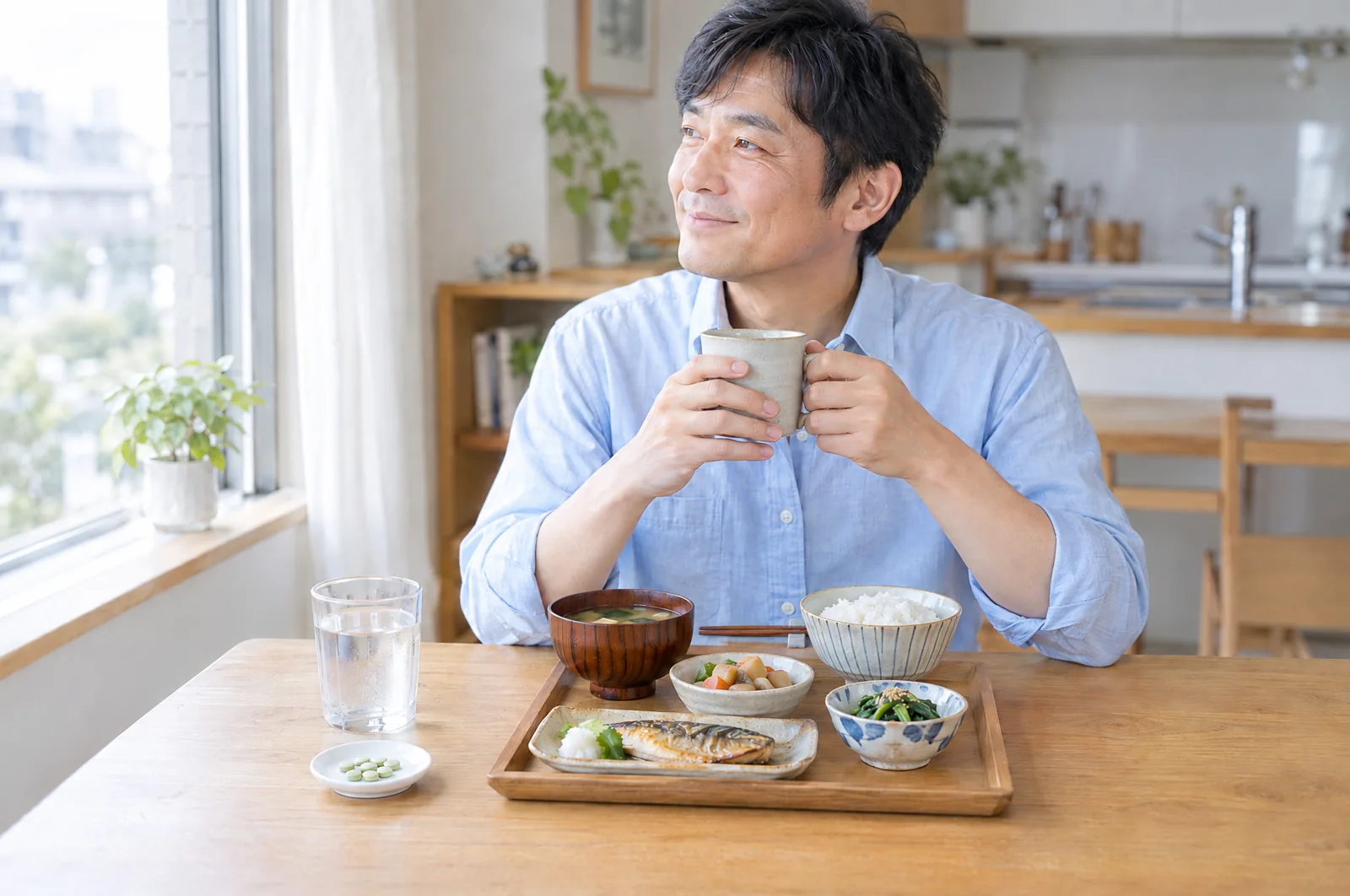
Powdered aojiru (青汁, green juice made from leaves such as kale and barley grass) or spirulina tablets on a short day? Here are the differences, from public materials and surveys. Even on days short on vegetables, aim for days when you can think “at least I have topped up a little today.” ※Not a substitute for vegetables.
Three common questions (illustrative)
- “What exactly is the difference between aojiru and spirulina?”
- “Dissolving it in a drink or taking tablets: which is easier to keep up?”
- “Vegetable juice or aojiru: which one is better?”
(These are not real customers’ voices; they are common questions imagined for this article.)
Both aojiru and spirulina are one “means” for days short on vegetables. What you may want to settle first is not which one to choose, but on what kind of day, and what, you want to add.
The short answer: spirulina is a microscopic alga called a “blue-green alga” (藍藻, cyanobacteria), while aojiru is a food made from the “leaves” of plants such as kale and barley grass, so the source material differs. In form, both come in powder and tablets. Neither can stand in for vegetables, and people taking warfarin (ワルファリン) need to check with a doctor or pharmacist first for either one. It is not a matter of which is above the other: choose by purpose and preference.※Perception differs from person to person.
What you will learn in this article
- How spirulina and aojiru differ in source material (what they are made from)
- Differences in powder and tablet forms, the amount per day, how to take them and how to handle them after opening
- Why they cannot stand in for vegetables, and how they differ from vegetable juice
- A caution for people taking warfarin, and what to look at when choosing
This article is for people who are concerned about not getting enough vegetables and are torn between aojiru and spirulina, to sort out the differences, the limits and how to choose. It is based on public materials from the National Institute for Environmental Studies, Kyoto University, the Japan Health and Nutrition Food Association, the Nagoya City Consumer Center, the Ministry of Education, Culture, Sports, Science and Technology, the Ministry of Agriculture, Forestry and Fisheries, the Ministry of Health, Labour and Welfare and PMDA, and on reviews on Rakuten Ichiba (checked October 22, 2026). It is not a substitute for a doctor’s diagnosis or for advice about an individual. How to count small bowls (小鉢) of vegetables is sorted out in more detail in Signs You May Be Short on Vegetables?.
Spirulina and Aojiru: The Difference in Ingredients
Spirulina is a microscopic alga called a “blue-green alga” (藍藻, cyanobacteria), while aojiru is a food made from the “leaves” of kale, barley grass, ashitaba, mulberry leaf and others. It is not a question of which is good or bad: the organism it comes from, and how it is treated as a food, differ.
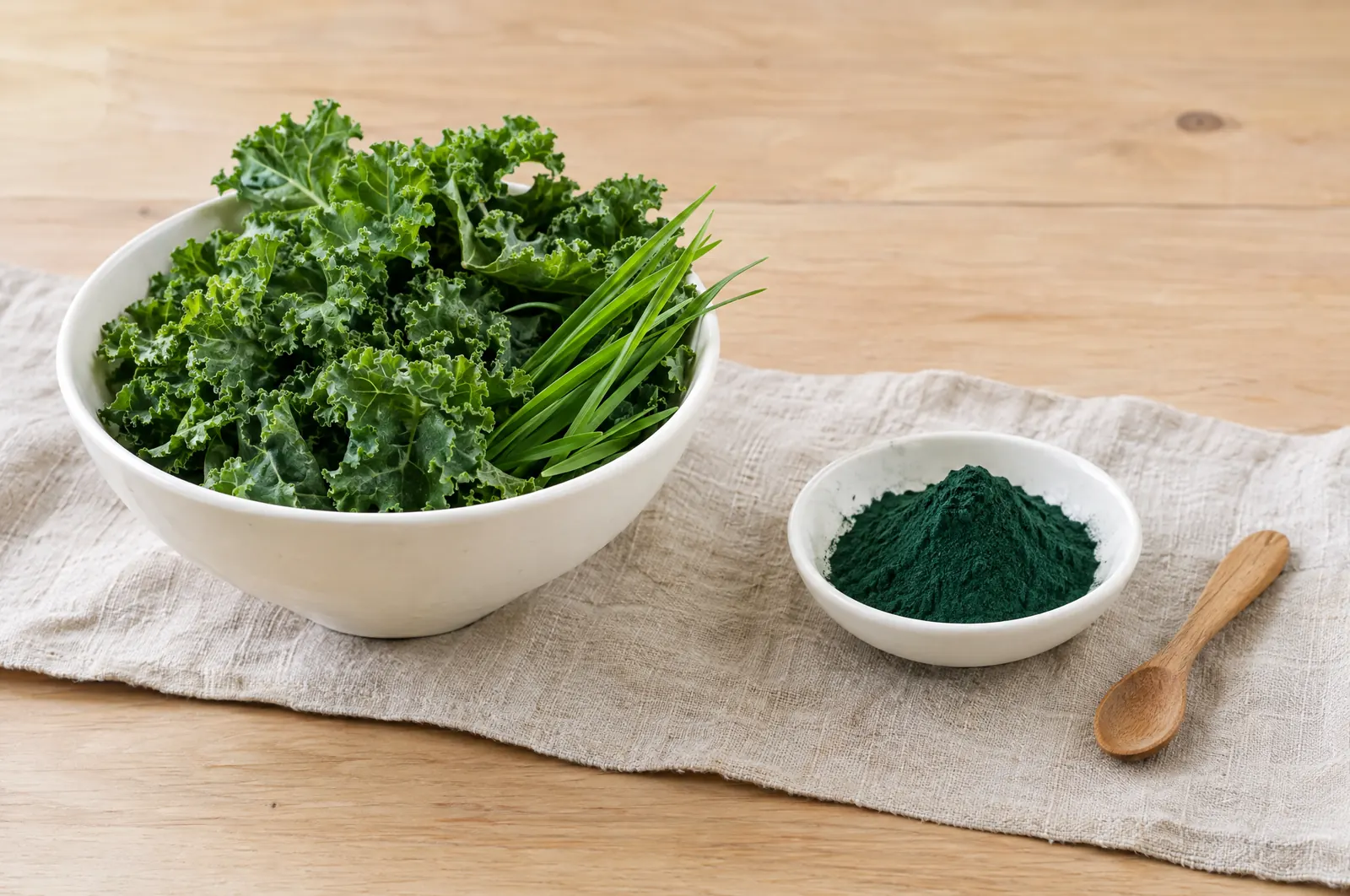
First, spirulina. On cyanobacteria, the National Institute for Environmental Studies writes:
「シアノバクテリアは酸素発生型光合成を行う細菌の一種であり,藍藻(らんそう)とも呼ばれています。」(国立環境研究所 2021年11月1日公表資料「背景」より)
Translation: “Cyanobacteria are a kind of bacteria that perform oxygen-producing photosynthesis, and are also called blue-green algae (らんそう).” (National Institute for Environmental Studies, published November 1, 2021, “Background”)
「スピルリナは食用の微細藻で、培養や収穫が簡単にできることから、食品や食品添加物の原料として世界中で利用されています。」(京都大学 2023年1月20日公表「食用藍藻スピルリナの完全長ゲノム塩基配列」、研究者のコメントより)
Translation: “Spirulina is an edible microalga, and because it is easy to culture and harvest, it is used around the world as an ingredient of foods and food additives.” (Kyoto University, published January 20, 2023, 「食用藍藻スピルリナの完全長ゲノム塩基配列」, from the researcher’s comment)
Next, aojiru. The outline of the standards for “aojiru foods” (青汁食品) set by the Japan Health and Nutrition Food Association lists 「ケール、大麦若葉、アシタバ、クワ葉、クマザサ、ボタンボウフウ」 (kale, barley grass, ashitaba, mulberry leaf, kumazasa, botanbofu) as the product standard for “processed aojiru foods” (青汁加工食品). This is a standard for the association’s certification mark system, not a legal definition that applies to all aojiru (the file was created in June 2015).
The Nagoya City Consumer Center’s product test, “Aojiru products” (商品テスト「青汁製品」), shows that even among aojiru, the main ingredient differs from product to product. Among the 12 aojiru brands tested, the main ingredient was barley grass in 4, kale in 2, and one each of rice, bitter melon, spinach, molokhiya, wheat grass and alfalfa. The same material writes:
「今回テストした製品はすべて葉を乾燥・粉末にした製品であり、葉の搾り汁を乾燥、粉末にした製品ではない。」(名古屋市消費生活センター「商品テスト 青汁製品」より)
Translation: “All the products tested this time are products in which the leaves were dried and powdered, not products in which the pressed juice of the leaves was dried and powdered.” (Nagoya City Consumer Center, “Product test: aojiru products”)
The same material also states that products made by powdering the pressed juice are often expensive. This suggests that aojiru comes in a type that powders the leaves themselves and a type that powders the pressed juice. However, the test period is given only as 「14年9月〜15年2月」 (the 14th year, September, to the 15th year, February; no era name is given, and the file was created in August 2003), so it is a survey more than 20 years old. There may be differences from products today.
| Item | Spirulina | Aojiru |
|---|---|---|
| What it comes from | A microscopic alga called a blue-green alga (藍藻, cyanobacteria) | Leaves such as kale, barley grass, ashitaba and mulberry leaf (the main ingredient differs by product) |
| Standards of the Japan Health and Nutrition Food Association | Yes (「スピルリナ食品」, 「スピルリナ加工食品」, 「スピルリナ加工複合食品」) | Yes (「青汁食品」) |
| Standard Tables of Food Composition in Japan, 2020 edition (8th revision), 2023 supplement | Within the range checked, no entry | 「青汁 ケール」 (powder product) is listed. Classified under the beverages group (し好飲料類) |
※Whether an entry exists in the food composition tables does not indicate whether the ingredients or quality are good or bad. Because spirulina has no entry in the same table, figures cannot be lined up and compared under the same conditions.
※“Yes” means the association has set standards for that type of food; it does not mean that any individual product (including NEW スピルリナEX) is certified by the association.
Some aojiru products blend in other ingredients besides the main one (the Nagoya City test also included products that were not 100% main ingredient, and none stated how much of the main ingredient they contained). This article compares spirulina-only tablets with aojiru made from leaves. For blended products, check the contents in the “ingredient list” (原材料名) on the box. The difference between the blue-green alga and chlorella, a green alga, is sorted out in Spirulina vs Chlorella: How Do They Differ?.
Let us also list the good points of aojiru first. Aojiru made by powdering whole leaves contains dietary fiber (「青汁 ケール」 (powder product) in the food composition tables has 28.0g per 100g; how to read the figure is explained in a later section). For the pressed-juice type, check the nutrition facts. There are also aojiru (powder) that have received permission as a “Food for Specified Health Uses” (特定保健用食品), listed in the Safety and efficacy information on “health foods” of the National Institutes of Biomedical Innovation, Health and Nutrition (the labeling and the functional ingredients differ from product to product). NEW スピルリナEX, on the other hand, is a food with nutrient function claims (栄養機能食品), and unlike a Food for Specified Health Uses (トクホ) it has not undergone individual review by the Commissioner of the Consumer Affairs Agency. The categories differ, so this article does not rank them against each other.
Powder, Tablets and How to Take Them
Both aojiru and spirulina come in powder and tablet products. In the Nagoya City Consumer Center’s product test conducted more than 20 years ago, a single serving of powdered aojiru was around 3g. NEW スピルリナEX is 10 tablets (2.65g) a day. The difference in form is a difference in effort, preference and ease of keeping up, not a matter of one being above the other.※Perception differs from person to person.
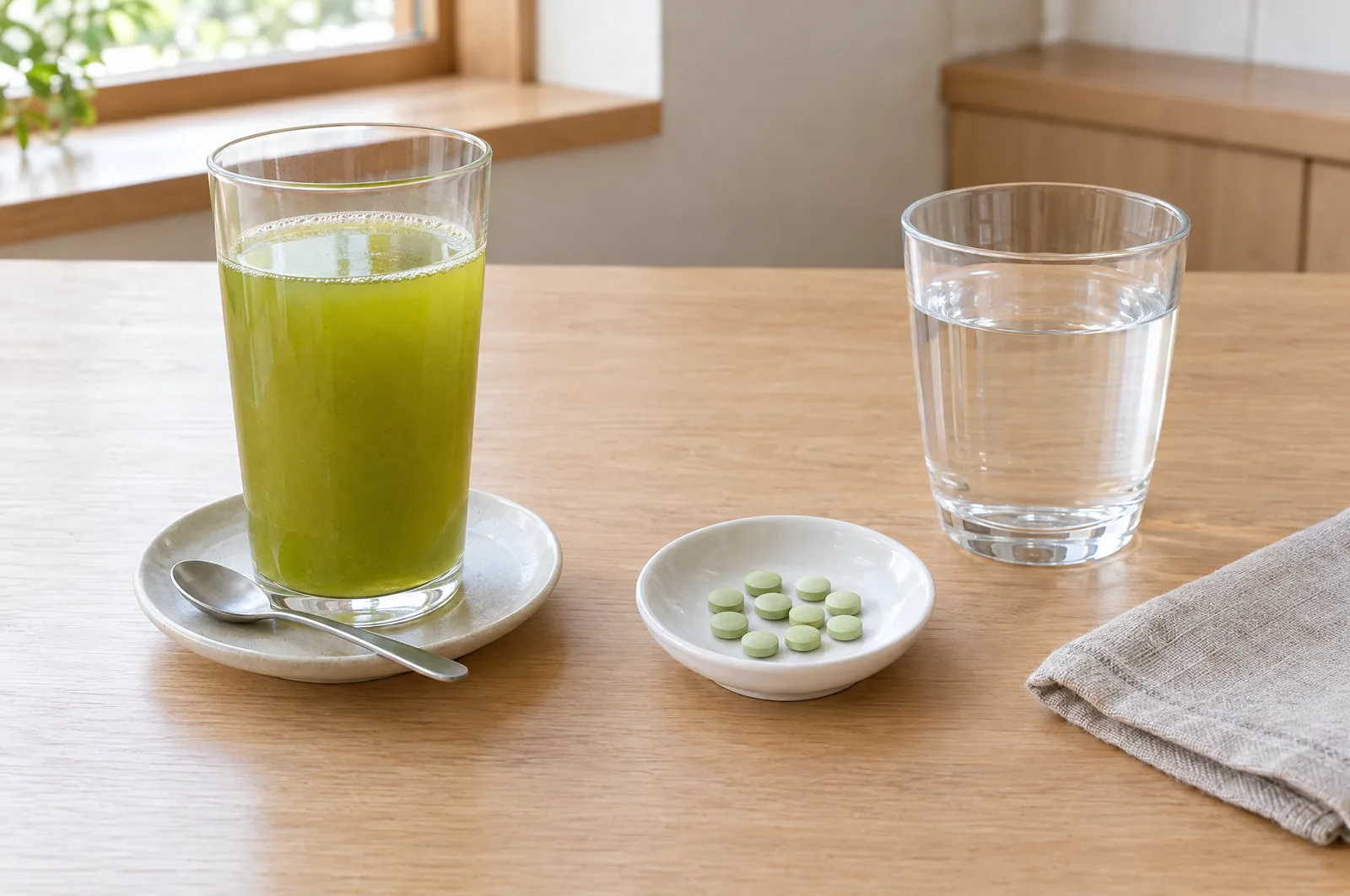
On the forms of aojiru, the outline of the association’s standards divides the water standard into “in the case of powder, granules and the like” (「粉末状、顆粒状等の場合」), the disintegration standard into “tablet or capsule type” (「粒状、カプセル型」), and the total chlorophyll standard into “liquid and other products drunk as they are” (「液状など、そのまま飲用するもの」). In other words, aojiru comes in forms such as powder, granules, tablets, capsules and liquid. Spirulina also comes as powder and tablets, as sorted out in What Is Spirulina? on this site.
Let us line them up following the steps a person goes through every day.
| Step | Aojiru (powder as an example) | NEW スピルリナEX (tablets) |
|---|---|---|
| Form | Powder, granules, tablets, capsules and liquid exist (outline of the association’s standards) | Tablets. 2 bottles of 1,000 tablets in 1 box |
| Per serving / per day | Powder is around 3g per serving (Nagoya City product test conducted more than 20 years ago; the tasting was done with 3g dissolved in 150ml of water) | 10 tablets (2.65g) a day as a guide, split into 1 to 3 times |
| How to take | Dissolve in water or the like and drink | With water or hot water. There is no set time of day (product page) |
| After opening | Because some components are easily affected by light and oxygen, use it up as soon as possible after opening. If the daily amount used is small, individually packed products are thought to be better (Nagoya City) | Close the cap firmly; keep away from direct sunlight in a cool place. Do not return a tablet to the container once taken out (as shown on the box) |
| Taste / smell | Even with the same barley grass, the taste differed considerably by product (panel of 9) | The tablets are film-coated. The smell and taste are hard to notice ※Perception differs from person to person |
| In a nutshell | There is the effort of dissolving it, but it is a powder made from leaves, with many choices of form and taste | Tablets that can be taken as they are with water, with little effort |
In the Nagoya City test, a panel of 9 people tasted 13 kinds of powder (12 aojiru brands and 1 powdered tea brand), each with 3g dissolved in 150ml of water, and scored them out of 10. It is reported that even with the same barley grass the taste differed considerably by product, and the scores differed as well. This can be read as aojiru differing in taste from product to product. For the smell and taste of spirulina tablets, Worried About the Smell or Taste of Spirulina? sorts out what can and cannot be said from the box and public materials.
Which is easier to keep up differs from person to person. Before the ingredients or the numbers, looking at whether it is a form you can manage without strain within your own day makes the choice easier.
Neither Is a “Substitute for Vegetables”
Neither aojiru nor spirulina can stand in for vegetables. The national target is 350g of vegetables a day (average), but powder and tablets are dry foods with almost no water, and the amount per serving or per day is only a few grams. Think of them as a back-up for short days, and use them together with the effort of adding a small bowl of vegetables.※Not a substitute for vegetables.
Wanting to “just drink something and be done with it” on a busy day is natural. With that in mind, let us line up the numbers.
Health Japan 21 (Third Term) sets the target of bringing the average vegetable intake to 350g (FY2032 (Reiwa 14)). This does not mean 350g every single day. In the Reiwa 6 (2024) National Health and Nutrition Survey (Ministry of Health, Labour and Welfare), the average vegetable intake was 258.7g (aged 20 and over). The vegetables group (野菜類) in this survey includes vegetable juice and pickles. e-Health Net (e-ヘルスネット) explains that one plate of an ordinary vegetable dish contains about 70g of vegetables. 350g is about 5 plates when counted as small bowls.
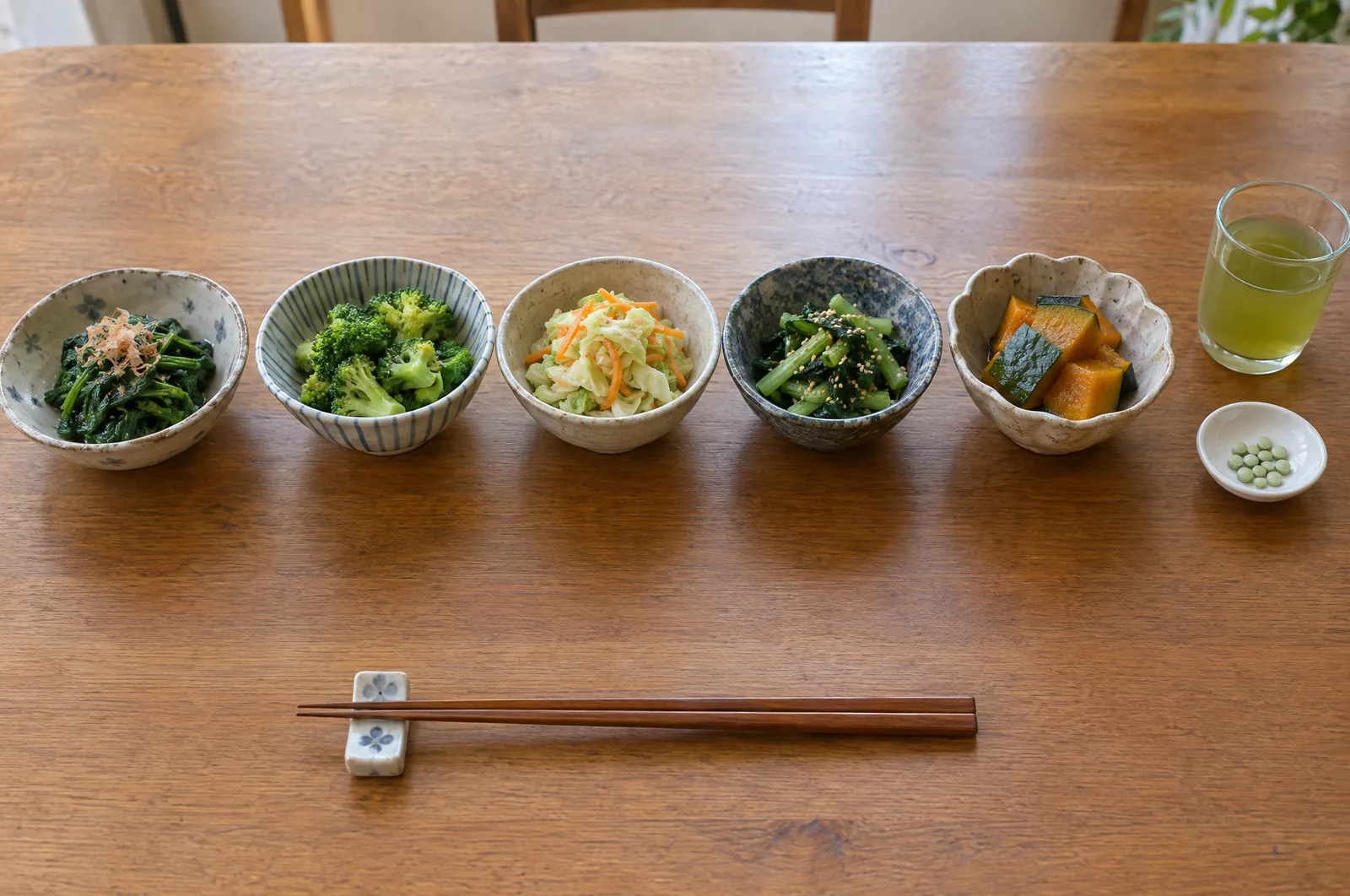
Comparing by weight, around 3g of powdered aojiru is about 0.9% of 350g, and the 2.65g of NEW スピルリナEX is about 0.8%. This is a comparison of weight only, not of the nutrition contained. Powder and tablets contain almost no water, so even at the same weight they cannot be compared directly with fresh vegetables (see the calculation from the food composition tables below). Still, it is certain that with aojiru or spirulina you are not taking in the amount of one small bowl.
Let us look more concretely at the figures in the food composition tables. The Ministry of Education, Culture, Sports, Science and Technology’s Standard Tables of Food Composition in Japan, 2020 edition (8th revision), 2023 supplement, lists 「ケール 葉 生」 (kale, leaf, raw) and 「青汁 ケール」 (aojiru, kale; powder product), both per 100g.
| Per 100g | Kale, leaf, raw | Aojiru, kale (powder product) |
|---|---|---|
| Water | 90.2g | 2.3g |
| Total dietary fiber | 3.7g | 28.0g |
Because powder has almost no water, the per-100g figures look far larger than those of the raw leaf. But what you drink in one serving is not 100g but around 3g. At 3g, that is 3% of the 100g figure, and the dietary fiber comes to about 0.84g (28.0 × 0.03). If you eat one small bowl (about 70g) of kale, it is about 2.6g (3.7 × 0.7) (both are guides from the figures in the table; actual products differ by ingredient and manufacturing method). Read the “per 100g” figure by converting it to the amount you actually take in one serving.
Even if you take aojiru, even if you take spirulina, even if you drink vegetable juice, none of them stands in for vegetables. The foundation of eating is still the daily meal. Even if there are days when you fall short, you can start again from adding one small bowl of vegetables. Even on days short on vegetables, aim for days when you can think “at least I have topped up a little today.” ※Not a substitute for vegetables.
Vegetable juice or aojiru: which is better?
In the way of counting in the Japanese Food Guide Spinning Top (食事バランスガイド) of the Ministry of Agriculture, Forestry and Fisheries, for commercial 100% vegetable juice, half the weight drunk counts as “vegetables”, and one paper carton (200ml) is one side-dish serving (SV). On the other hand, the Ministry of Agriculture, Forestry and Fisheries says 「あくまでも補助的なものとして考えてください。」 (please think of it strictly as supplementary). Within the range checked this time, no government document was found that shows how many servings (SV) aojiru counts as. In the Ministry of Education, Culture, Sports, Science and Technology’s food composition tables, mixed vegetable juice is listed under the vegetables group (野菜類) and aojiru (kale) under the beverages group (し好飲料類) (a difference in classification, not an indication of which is better). No government document was found that decides which is better. When choosing, compare the ingredient list, the nutrition facts, how easy it is to drink and how easy it is to keep up.
On nutrition-aid products, the Ministry of Agriculture, Forestry and Fisheries’ page for young people living alone explains 「食べ物が含有する多様な栄養素とその相互作用までを、体内にとり入れることはできません」 (it is not possible to take into the body the diverse nutrients that food contains, down to their interactions) (partial excerpt; this sentence does not name aojiru or spirulina). The NEW スピルリナEX product page, too, answers the question 「野菜の代わりになりますか。」 (Can it stand in for vegetables?) with 「なりません。栄養機能食品であり、食事の代わりになるものではありません。」 (No. It is a food with nutrient function claims (栄養機能食品) and is not something that stands in for a meal.) (Rakuten Ichiba, 美健サイエンス product page, checked October 22, 2026).
If You Take Warfarin, Be Careful With Both
If you take warfarin (ワルファリン), please do not take aojiru or spirulina on your own judgment; check with a doctor or pharmacist first. PMDA explains that people are told to avoid not only natto but also chlorella and aojiru, because they are high in vitamin K. For spirulina, the NEW スピルリナEX box carries a caution asking people to refrain.
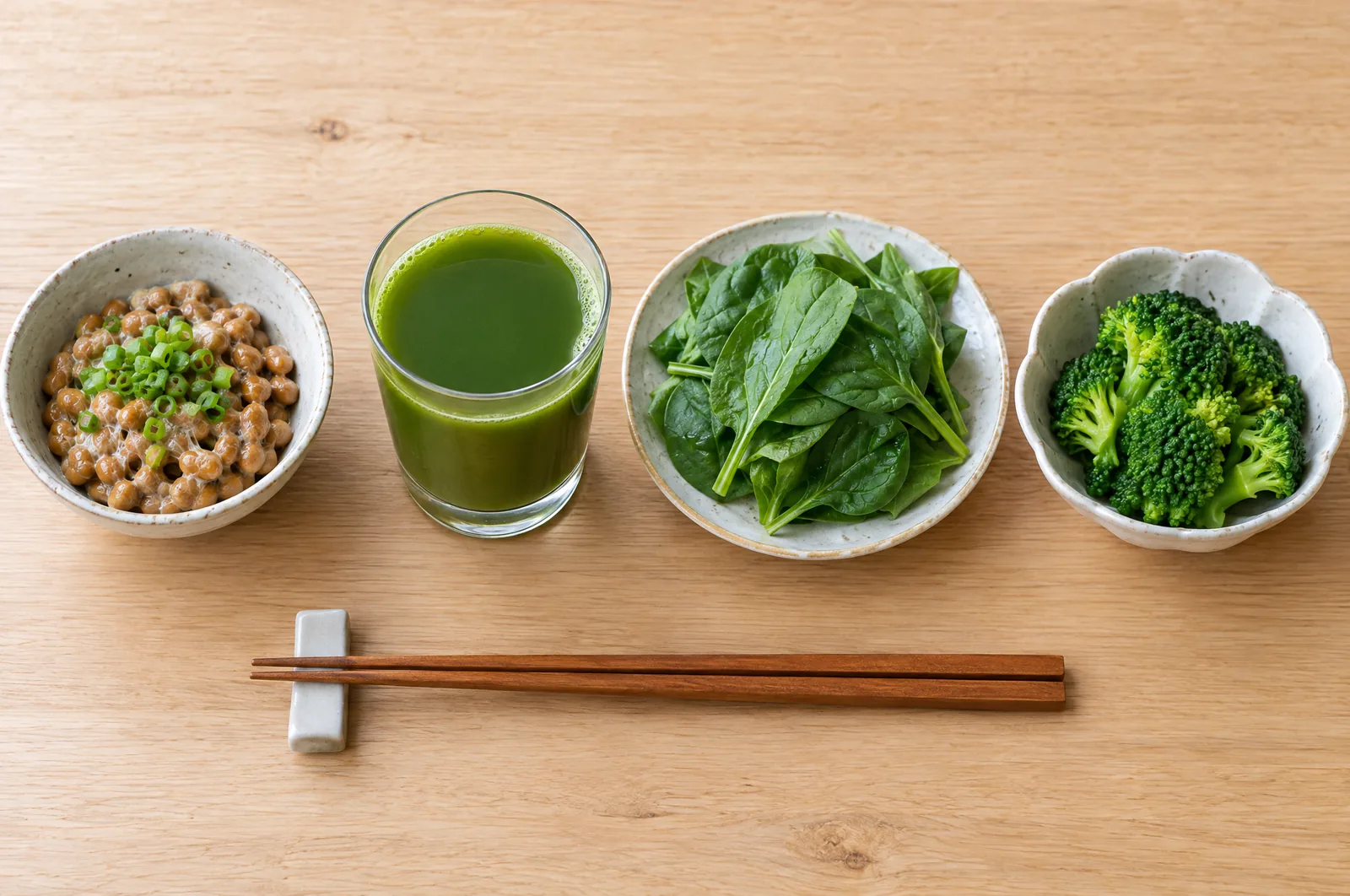
Warfarin is a drug that makes blood harder to clot and prevents blood clots from forming. On aojiru, PMDA’s 「くすりQ&A」 writes:
「また、納豆の他にも、クロレラ、青汁なども、納豆と同様にビタミンKを多く含むため、摂取を控えるように指導されています。」(PMDA「くすりQ&A」Q3より)
Translation: “Besides natto, chlorella and aojiru are also high in vitamin K like natto, so people are told to refrain from taking them.” (PMDA 「くすりQ&A」, Q3)
「納豆、クロレラ、青汁などの摂取について疑問、不安がある場合には、医師または薬剤師に相談しましょう。」(PMDA「くすりQ&A」Q3より)
Translation: “If you have questions or worries about taking natto, chlorella, aojiru and the like, consult a doctor or pharmacist.” (PMDA 「くすりQ&A」, Q3)
The same page also says 「また、ビタミンKを多く含む緑葉野菜をたくさん食べ続けることは控えてください。」 (Also, please avoid continuing to eat large amounts of green leafy vegetables high in vitamin K.) If you take warfarin, check the amount and type of the small bowls of vegetables suggested in this article with your doctor or pharmacist, too.
In the table on page 8 of the Ministry of Health, Labour and Welfare’s 『健康食品の正しい利用法』 (Correct Use of Health Foods; February 2016), too, the combination of vitamin K (including aojiru and chlorella) and warfarin (an anticoagulant) is listed as an example of “reduced drug action” (「薬効の減弱」). For spirulina, the NEW スピルリナEX box writes:
「スピルリナは納豆などと同様にビタミンKを多く含んでいます。ワルファリンを服用されている方は摂取をお控えください。」(NEW スピルリナEX 外箱の表示より)
Translation: “Spirulina, like natto, is high in vitamin K. People taking warfarin should refrain from taking it.” (as shown on the outer box of NEW スピルリナEX)
The PMDA page does not mention spirulina by name, and the direct basis for spirulina is the caution on the box. On the other hand, within the range checked this time, no public document was found that compares which of aojiru and spirulina contains more vitamin K. The amount contained changes with the product and the amount taken, so it cannot be said that “this one is fine.” For more on warfarin, see Spirulina and Warfarin: Why People Taking Warfarin Are Asked to Avoid It.
There are cautions beyond warfarin. The Ministry of Health, Labour and Welfare’s 『健康食品の正しい利用法』 (page 7) writes 「天然・自然由来成分を原料とする製品でもアレルギーの原因となり、因果関係が明確でない報告も含め、被害報告が多数あります」 (even products made from natural ingredients can cause allergies, and there are many reports of harm, including reports in which the causal relationship is not clear), and gives as examples 「三七人参、ローヤルゼリー、コリアンダー、ウコン、エキナセア、コロハ、ザクロ、スピルリナ、ゼラチン、プロポリスなど」 (sanchi ginseng, royal jelly, coriander, turmeric, echinacea, fenugreek, pomegranate, spirulina, gelatin, propolis and others) (partial excerpt; aojiru is not given as an example, but that does not mean it is safe). NEW スピルリナEX contains gelatin and milk ingredients as part of its raw materials. Aojiru, too, may need other cautions depending on the raw materials and blend. For either, read the “ingredient list” (原材料名) and the “cautions for use” (使用上の注意) on the box.
The same document says, about people who have a disease and people who take medication, 「健康食品を自己判断では使わない。使うときは必ず医師・薬剤師に伝える。」 (Do not use health foods on your own judgment. When you use them, be sure to tell your doctor or pharmacist.) Even if it is not warfarin, if you take medication or are under treatment at a clinic, tell your doctor or pharmacist the name of the food you want to take before taking it.
Choosing by Purpose and Preference
Neither is above the other: you can choose by purpose and preference. The table lists what to look at, for each sticking point. If you take medication, check with a doctor or pharmacist first.
Before “which one,” thinking about “on what kind of day, and what, do I want to add” settles what to look at.
| Sticking point | What to look at |
|---|---|
| Want to choose the leaf ingredient | The “ingredient list” (原材料名) of the aojiru: what the main ingredient is (kale, barley grass, ashitaba, mulberry leaf and so on) and what else is in it |
| Want to take tablets quickly | The number of tablets per day, the size of the tablets, the smell and taste (aojiru also comes in tablets and capsules) |
| Want to dissolve it in a drink / concerned about taste | The taste of powders differs by product (Nagoya City tasting). Individually packed or large bag, and whether you can use it up after opening |
| Concerned about dietary fiber | The dietary fiber in the nutrition facts. Mind the difference between “per serving” and “per 100g” |
| Ease of keeping up / cost | How to look at the cost per day is sorted out in How Much Does Spirulina EX Cost per Day? |
| Taking medication / have a medical condition | Check with a doctor or pharmacist first (previous section) |
What do customer reviews say?
On the NEW スピルリナEX product page of 美健サイエンス on Rakuten Ichiba there are 135 reviews (checked October 22, 2026). None of them mentioned “aojiru,” “kale,” “barley grass” or “vegetable juice.” Of the 2,654 spirulina product reviews collected by this site (reviews on Rakuten Ichiba and elsewhere; posted up to September 2026), 19 mentioned “aojiru.” None of those 19 is a review on a 美健サイエンス product page (17 are for other companies’ spirulina products, 1 is from a person who bought NEW スピルリナEX at a different shop, and 1 is a review of the 2005 earlier version). Sorted by reading, about 7 could be read as having stopped aojiru or switched from aojiru to tablets, about 4 were taking them alongside aojiru, about 5 wrote that tablets were easier to take than aojiru and the like, and about 3 wrote that aojiru suited them better (the numbers vary depending on how they are divided). The reasons given for switching were mostly about ease of keeping up, such as drinking it being a bother, not being able to keep it up, getting tired of it, and the effort of dissolving it. On the other hand, there are also voices saying aojiru suits them better, and it differs from person to person. Because these are reviews of other products and other shops, only the numbers are given here. They are personal impressions and do not necessarily apply to everyone.
For people already drinking aojiru
People who already drink aojiru may think of adding spirulina as well. Within the range checked, no public document was found that looked into the safety of taking them together. The Ministry of Health, Labour and Welfare’s 『健康食品の正しい利用法』 (page 10) cautions:
「一度に多種類の健康食品を摂取することは、健康被害の可能性を高め、被害の原因究明も困難にします。」(厚生労働省『健康食品の正しい利用法』より)
Translation: “Taking many kinds of health foods at one time raises the possibility of harm to health and also makes it difficult to find the cause of the harm.” (Ministry of Health, Labour and Welfare, “Correct Use of Health Foods”)
Check with a doctor or pharmacist first, and if you do take them, keep to the suggested daily amount on each box and check the nutrition facts to see that the same ingredient is not overlapping. It does not mean you should switch from aojiru to spirulina.
Having read this far, you will have confirmed that neither can stand in for vegetables. With that in mind, some people choose a tablet type as a back-up for short days. For example, NEW スピルリナEX is a food taken at 10 tablets a day as a guide, with water or hot water and the like, and it carries labeling as a food with nutrient function claims (栄養機能食品) for 10 vitamins. Even on days short on vegetables, aim for days when you can think “at least I have topped up a little today.” The foundation of meals for that, as in the earlier sections, is a small bowl of vegetables. ※Not a substitute for vegetables.
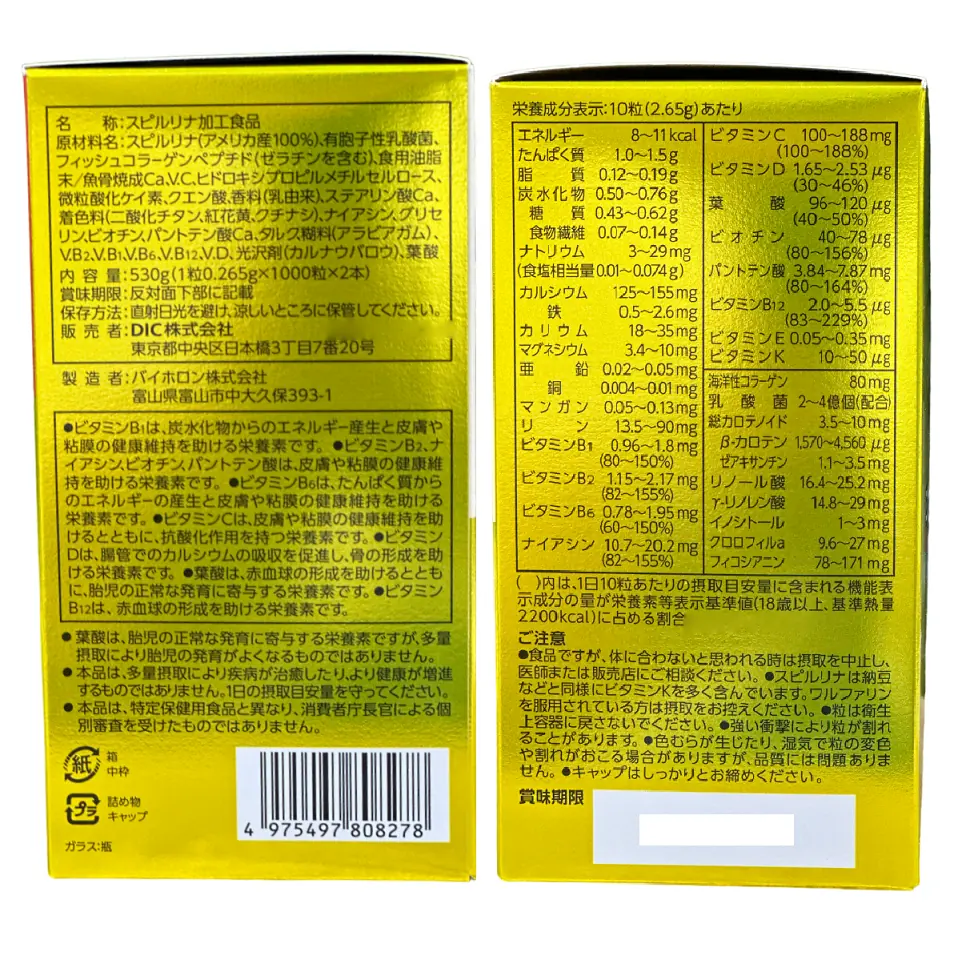
The details are sorted out in What Is Spirulina EX?. For how to read the labeling, see What Are Foods with Nutrient Function Claims?, and for how to take it, How to Take Spirulina EX. The cautions are gathered in Does Spirulina Have Side Effects?.
A Small Step From Today
There is only one thing to do. Any one of the following is enough.
- □ Add one small bowl of vegetables to today’s meal
- □ Look at the box of the aojiru or spirulina you are curious about, and compare the “ingredient list” and the “per day” section
- □ If you take medication or have a medical condition, bring your medication notebook (お薬手帳) and tell your doctor or pharmacist the name of the food you want to take
- □ If you already take another health food, check the nutrition facts to see that the same ingredient is not overlapping
If you manage any one of them, that is enough as today’s step. “Today I managed to add a small bowl.” “I compared the boxes.” That is a step toward feeling “topped up.” Even on days short on vegetables, aim for days when you can think “at least I have topped up a little today.” ※Not a substitute for vegetables.