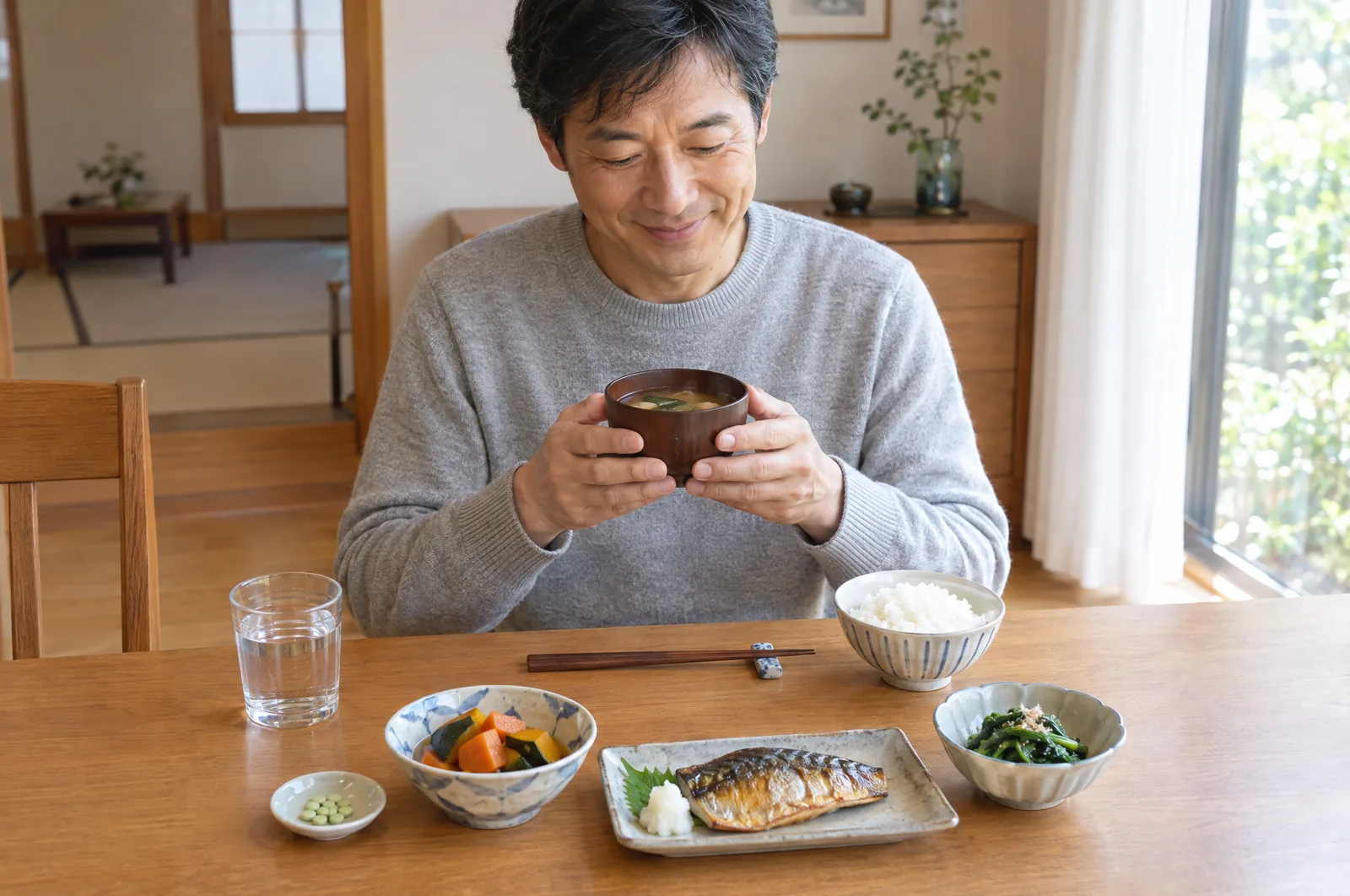
If days short on vegetables keep coming, the way in is “one more dish.” The target of 350g and the average of 258.7g differ by about 91g, a little over one small side dish (小鉢) of vegetables (about 70g). Even on days short on vegetables, aim for days when you can think “at least I have topped up a little today.” ※Not a substitute for vegetables.
Three common scenes (illustrative)
- On Monday you decide, “This week I will really eat vegetables.” By Wednesday you are back to your usual meals.
- Even when you bring vegetables home, some nights you have no energy left to wash and cut them.
- You add vegetables to the family’s dinner, but for your own lunch alone you get by with bread and coffee.
Not keeping it up even though you decided is not necessarily a matter of willpower. Often it is simply that several circumstances that make it hard to keep going, such as time, effort and shopping, pile up (these are not the voices of real customers; they are common scenes that have been imagined).
Fixing a vegetable shortage can start with adding one small dish in which vegetables are the main ingredient to any one meal of the day. In government materials, one vegetable dish is about 70g, and 5 to 6 dishes a day is given as a guide. This article lines up, in order, the gap between the target and reality, where to add the dish, how to keep it up, how to treat things said to be “a substitute for vegetables”, and how to make up for days when you fall short.
What you will learn in this article
- The gap between the 350g-a-day target and the actual average (numbers from the government survey)
- Which of breakfast, lunch and dinner to add “one more dish” to
- How to prepare for days with no vegetables, and how to use frozen, canned and dried foods, soups and make-ahead dishes
- How things said to be “a substitute for vegetables” (vegetable juice, fruit, mushrooms, supplementary foods (栄養補助食品) and so on) are treated
- How to think about days when it is still not enough
This article is based on public materials from the Ministry of Health, Labour and Welfare (MHLW), the Ministry of Agriculture, Forestry and Fisheries (MAFF), the Consumer Affairs Agency, the Ministry of Education, Culture, Sports, Science and Technology (MEXT) and PMDA (Pharmaceuticals and Medical Devices Agency), on WHO material, and on Rakuten Ichiba reviews (checked October 22, 2026). It is not a substitute for a doctor’s diagnosis or for advice to an individual. How to count small dishes and the kinds of meals that tend to leave you short on vegetables are covered in Signs You May Be Short on Vegetables?; how to add vegetables on convenience-store and eating-out days and how to use frozen vegetables are covered in a separate article on vegetables for people living alone (available in Japanese and Vietnamese). This article concentrates on the parts that do not overlap.
What Are the 350g-a-Day Target and the Actual Average?
350g a day is the target for the “average value of vegetable intake” in Health Japan 21 (Third Term) (健康日本21(第三次)) (FY Reiwa 14 (2032)). The average in the Reiwa 6 (2024) National Health and Nutrition Survey (aged 20 and over) is 258.7g, a gap of about 91g. In small dishes (about 70g), that is a little more than one dish. 23.9% of people ate 350g or more.
First, let us line up the numbers.
| Item | Number | In small dishes |
|---|---|---|
| Target (average value, FY Reiwa 14 (2032)) | 350g | about 5.0 dishes |
| Actual average (Reiwa 6 (2024), aged 20 and over) | 258.7g | about 3.7 dishes |
| Gap | about 91g | about 1.3 dishes |
※The number of small dishes is a guide, obtained by dividing by 70g. These are average values for a group and do not show a pass or fail for any one person (from the MHLW’s 「令和6年国民健康・栄養調査結果の概要」 [Summary of the Results of the Reiwa 6 (2024) National Health and Nutrition Survey], the Health Japan 21 (Third Term) notice, and e-ヘルスネット [e-Health Net, the MHLW’s health information site]).
Grams and dishes can be counted. Whether you can feel that you have “topped up” is a feeling that cannot be counted. This article separates adding the part that can be counted (one dish) from the part that is feeling. ※Not a substitute for vegetables.
The average varies quite a lot from person to person. In the same survey, the share of people by vegetable intake band (aged 20 and over, nationally adjusted values) is as follows.
| Daily vegetable intake | Under 70g | 70– 140g | 140– 210g | 210– 280g | 280– 350g | 350g or more |
|---|---|---|---|---|---|---|
| Share of people | 8.4% | 15.3% | 20.5% | 17.8% | 14.1% | 23.9% |
※From Table 7 of the Reiwa 6 (2024) National Health and Nutrition Survey Report (15,716 respondents). Shares are nationally adjusted values and differ from a simple ratio of head counts. The survey’s “vegetables” category also includes vegetable juice (average 14.4g) and pickles (7.7g) (Table 5, part 1). The mean is 258.7g and the median is 231.3g.
People who ate 350g or more were 23.9% (men 26.2%, women 22.0%), and the remaining 76% or so had not reached 350g. However, 14.1% of people are at 280–350g. The gap differs from person to person: some can reach the target with “one more dish,” while others would like to add a little more. The reasons vegetables are hard to increase are also not necessarily just one. The MHLW’s Nutrition Guidance Material (vegetables) (栄養指導用資料) cites the Reiwa 5 (2023) National Health and Nutrition Survey and lists 「仕事(家事・育児等)が忙しくて時間がないこと」 (being busy with work (housework, child-rearing, etc.) and having no time) and 「面倒くさいこと」 (it being a bother) as the main factors that get in the way of healthy eating habits (this is a statement about eating habits in general, not a survey about vegetables alone).
Some readers may be curious why the figure is 350g. The explanatory material for Health Japan 21 (Third Term) (compiled by committees of the Health Sciences Council) says that, taking into account the contribution of vegetables to the intake of dietary fiber, potassium and so on, the 350g target of the Second Term continues to be used. Here too, the indicator of the target is the “average value of vegetable intake.”
Because it is easy to mix up with overseas numbers, one more point. The WHO (World Health Organization) fact sheet (updated January 26, 2026) advises everyone over 10 years old to aim for at least 400g a day of fruit and vegetables combined. In Japan, the target is 350g of vegetables, with 200g of fruit as a separate target (both are average values, FY Reiwa 14 (2032)). Because the way of counting differs, the two cannot simply be compared.
Up to here, the numbers have simply been lined up. The gap is a little over one small dish. It is fine to change just one meal of the day.
Which Meal Should You Add “One More Dish” To?
On average, vegetables come to about 46g at breakfast, about 65g at lunch and about 145g at dinner: more at dinner, less at breakfast and lunch (average for people aged 20 and over, including people who skipped the meal). Rather than starting something new, slipping one dish into a slot that already exists in your meals is easier to keep up, and what you add should be a dish in which vegetables are the main ingredient.
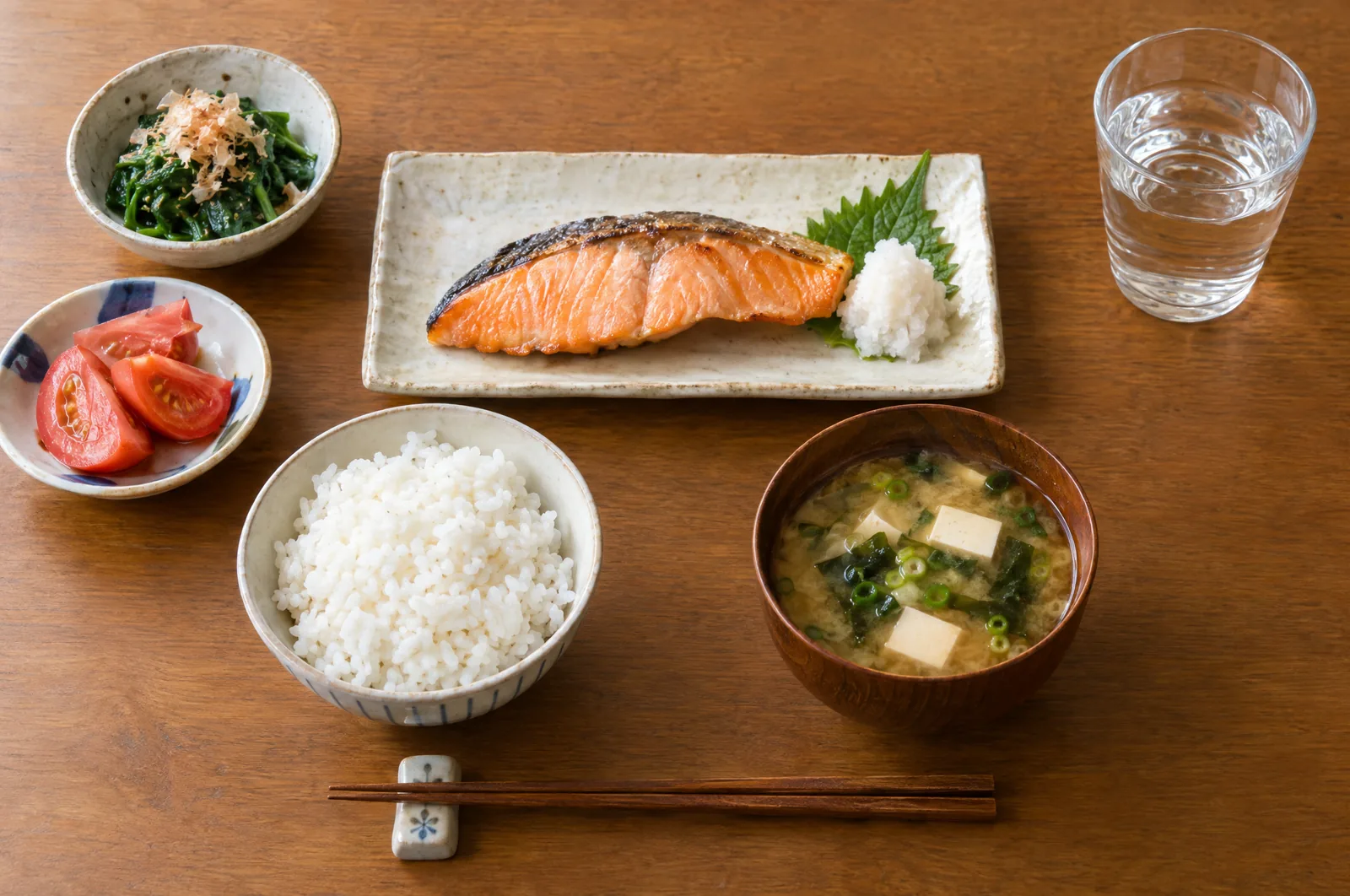
Vegetable intake from the Reiwa 6 (2024) National Health and Nutrition Survey, by breakfast, lunch, dinner and snacks, is as follows.
| Aged 20 and over | Average (g) | In small dishes | Median (g) |
|---|---|---|---|
| Breakfast | 46.4 | about 0.7 dishes | 11.1 |
| Lunch | 65.4 | about 0.9 dishes | 45.0 |
| Dinner | 144.9 | about 2.1 dishes | 127.3 |
| Snacks | 2.0 | — | 0.0 |
| Total | 258.7 | about 3.7 dishes | — |
※From Table 13 (by breakfast, lunch, dinner and snacks, aged 20 and over, total, nationally adjusted values). These are averages including people who skipped the meal, not figures for only those who ate breakfast. The number of small dishes is a guide, obtained by dividing by 70g. Adding the four gives the average of 258.7g. Dinner is about 56% of the total (this article’s calculation). The survey’s “vegetables” also include vegetable juice and pickles.
On average, vegetables are concentrated at dinner. But that does not mean “adding at breakfast is the right answer.” The easiest place to add differs from person to person. The guide for choosing is to place the dish next to “something that already happens every day.”
| When (an existing scene) | Example of the one dish to add | A word |
|---|---|---|
| Morning: when you prepare miso soup or soup | Add a handful of ingredients (frozen vegetables are fine) | The amount of ingredients reduces the amount of soup (see section 3) |
| Lunch: after choosing a staple at a bento shop or convenience store | Pick up one small dish of vegetables | How to choose at the shop is covered in a separate article for people living alone (available in Japanese and Vietnamese) |
| Night: when you serve the main dish | Put a dish of ohitashi or salad next to it | If you have make-ahead dishes, you just serve them |
Choosing just one from this table is enough. The MHLW’s Smart Life Project (スマート・ライフ・プロジェクト) sets the basic theme of the awareness campaign held every September in FY Reiwa 8 (2026) as 「まずは毎日、あと1皿ずつ野菜と果物をプラス」 (to begin with, add one more dish each of vegetables and fruit every day). The same page also says 「手に入りやすい野菜を上手に組み合わせて、もう1皿分取り入れてみましょう。」 (combine easily available vegetables well and try taking in one more dish).
It seems best to add not just any dish but one in which vegetables are the main ingredient. A message by Prof. Yukari Takemi (Kagawa Nutrition University; 女子栄養大学), posted in the same MHLW Smart Life Project, names 「野菜を主材料とする料理を食べる」 (eat dishes in which vegetables are the main ingredient) as the next step beyond “add one more dish,” and introduces a study (2013) by her laboratory. According to the abstract of the original paper, in 2-day food records of 384 people in their 30s to 50s in four cities of Saitama Prefecture, people who said they ate more vegetable dishes ate more 「単独料理」 (single dishes), in which vegetables are central, such as salad or simmered dishes (it examined an association at one point in time, not a follow-up of changing dishes). When you increase the amount of vegetables, choose dishes in which vegetables are the main ingredient: ohitashi, salad, vegetable soups and simmered dishes.
If you have been given dietary instructions, please check before adding. PMDA’s 「くすりQ&A」 (Drug Q&A) says, to people taking warfarin, 「ビタミンKを多く含む緑葉野菜をたくさん食べ続けることは控えてください。」 (please refrain from continuing to eat large amounts of green leafy vegetables high in vitamin K) (partial quote). The MHLW’s e-ヘルスネット also mentions potassium, which is abundant in vegetables and fruit, and then writes 「なお、医師から腎臓病と言われている方は必ず医師の指示にしたがってください」 (If you have been told by a doctor that you have kidney disease, be sure to follow the doctor’s instructions) (partial quote). If this applies to you, check the amount and types to add with a doctor or pharmacist.
Preparing for Days With No Vegetables: Frozen, Canned, Dried, Soups and Make-Ahead Dishes
On days without vegetables, you can add one dish with vegetables you can keep in stock, such as frozen, canned and dried ones, and with a soup packed with ingredients. The key to keeping it up is to decide as far as the last step of “buy → keep → eat”: the “eat.”
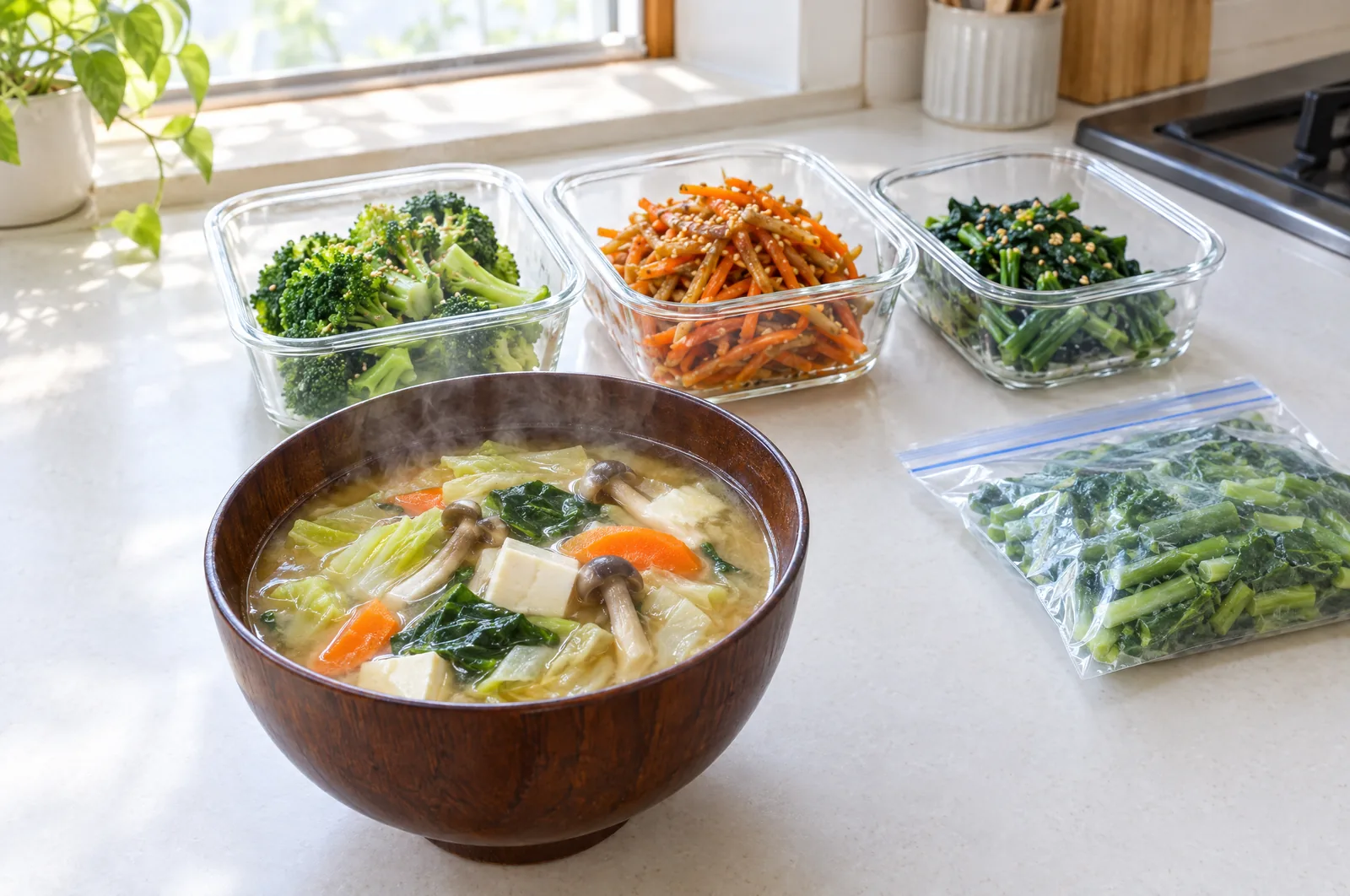
Buy → keep → eat. Do not stop at “I put it in the freezer” or “I put it on the shelf”; decide as far as “into your mouth.” For example, “a handful, straight from frozen, into the miso soup.” How to use frozen and cut vegetables is covered in a separate article on vegetables for people living alone (available in Japanese and Vietnamese). Here, the parts not covered there are dealt with.
Canned goods: look at the salt
In the MHLW’s Nutrition Guidance Material, canned goods (whole tomatoes, corn and so on) are examples of 「料理や食事に簡単に加えられる食品」 (foods that can easily be added to dishes and meals). The amount of salt differs from product to product in canned goods. In MEXT’s Standard Tables of Food Composition in Japan (2020 edition, 8th revision), 2023 supplement (日本食品標準成分表(八訂)増補2023年), the salt equivalent per 100g is 0g for canned whole tomatoes with no salt added and 0.7g for cream-style canned sweet corn (a comparison of two entries in the tables, not representative of all canned goods). When buying, look at the nutrition facts (栄養成分表示).
Dried foods can be kept at room temperature
MAFF’s public relations magazine (aff) explains dried foods (乾物) as follows.
「野菜や海藻類、魚介類などの食材を乾燥させて、水分をカラカラになるまで抜き、常温で数カ月以上の長期保存をできるようにした食品のことです。」(農林水産省 aff 2019年9月号より)
Translation: “Foods in which ingredients such as vegetables, seaweed and seafood are dried and drained of moisture until completely dry, so that they can be stored for a long period of several months or more at room temperature.” (MAFF aff, September 2019 issue)
For storage, it says to avoid 「高温になりやすいところ、直射日光があたりやすいところ、湿気の多いところを避けて保存。」 (store it avoiding places that easily become hot, places that easily get direct sunlight and places that are humid). Among dried vegetables, an illustration in the Nutrition Guidance Material shows kiriboshi daikon (dried shredded radish) (one small dish) as an example of 50–80g of vegetables. Note that seaweed such as hijiki and wakame is not counted as “vegetables” in the 350g target.
Soups are decided by the amount of ingredients
MAFF’s Practical Shokuiku Navi (実践食育ナビ, a food education practice site) explains soups like this.
「みそ汁やスープなどの汁ものは、具の種類と量によって、副菜にも主菜にもなります。」(農林水産省「SV計算の難しいもの」より)
Translation: “Soups, such as miso soup, can be either a side dish or a main dish, depending on the kind and amount of ingredients.” (MAFF, 「SV計算の難しいもの」 [Hard-to-Calculate Servings])
A miso soup made with plenty of vegetables and mushrooms counts as a side dish (副菜), whereas the same page also says 「しかし、具がほとんど入っていない汁ものは、どの料理区分にも該当しません。」 (however, a soup with almost no ingredients falls under none of the dish categories). Whether a soup counts as one dish changes with the amount of ingredients.
Packing it with ingredients also makes it easier to adjust the salt. A Kyoto Dietetic Association material posted on the Kyoto Prefecture site explains that when you use plenty of ingredients, 「汁の量が減り、自然と食塩摂取量が減ります。」 (the amount of soup decreases and salt intake naturally decreases). A Saitama Prefecture material explains that in the Reiwa 4 (2022) prefectural nutrition survey, miso soup was the number one source of salt intake for both men and women. A material posted on the Okayama Prefecture site shows that making miso soup or soup 「汁を少なめ・具だくさん」 (with less liquid and more ingredients) reduces salt by about 0.4g per bowl, and gives the salt in one bowl (150ml) of 1.2% miso soup as 1.8g. All of these are materials posted on local government sites, and the numbers are one example. The target amount of salt equivalent is under 7.5g/day for men aged 18 and over and under 6.5g/day for women (e-ヘルスネット, 「栄養・食生活と高血圧」 [Nutrition, Diet and Hypertension]).
Make-ahead dishes: “cool quickly, eat quickly”
Here is a summary of the guidance in government materials for making small vegetable dishes ahead of time.
- Divide into portions and cool quickly: The MHLW advises 「残った食品は早く冷えるように浅い容器に小分けして保存しましょう。」 (divide leftover food into shallow containers so that it cools quickly, and store it). MAFF also advises that stewed dishes be divided into single-meal portions in shallow-bottomed containers and stored in the refrigerator (10 degrees or below) or freezer (aff, December 2022 issue).
- Do not overtrust the refrigerator: MAFF says 「においや色、味では食中毒菌がどの程度いるか判断できない。」 (you cannot judge by smell, color or taste how many food-poisoning bacteria there are), and advises 「冷蔵庫を過信せず、なるべく早く食べるようにしましょう。」 (do not overtrust the refrigerator, and try to eat the food as soon as possible).
- Reheat when eating: The MHLW advises heating thoroughly when warming food up again, gives 75℃ or above as a guide, and says 「味噌汁やスープ等は沸騰するまで加熱しましょう。」 (heat miso soup, soup and the like until they boil).
- No guide for the number of days was found: In the government materials checked this time, no guide for how many days a make-ahead dish can be eaten was found. The MHLW says 「時間が経ち過ぎたら、思い切って捨てましょう。」 (if too much time has passed, resolutely throw it away).
It is easier to keep up if you make make-ahead dishes in small amounts, one serving at a time. Put what you cannot finish in the freezer.
For variety, change “just one thing”
If you eat the same vegetable every day, you may get tired of it. So change only one thing a week. For example, the “examples of goals” in the Nutrition Guidance Material include 「緑/赤・紫/黄・オレンジ/白色の野菜のどれかを毎食食べる。」 (eat a vegetable from one of the color groups green / red-purple / yellow-orange / white at every meal). It is a way of changing just one color group: green (spinach) this week, yellow-orange (carrot) next week. Changing the seasoning or the ingredients of the soup is fine too. (The way of changing is this article’s own suggestion.)
Examples of how to keep stock are in the table.
| Preparation | Days it suits | Points to watch |
|---|---|---|
| Frozen vegetables | Days you come home late. Straight from frozen into soups or stir-fries | The texture may differ from fresh |
| Canned goods | Days you want to keep food at room temperature. In soups or salads | Check the amount of salt in the nutrition facts |
| Dried foods (kiriboshi daikon and so on) | Days you want to keep a few months’ worth at room temperature | Avoid heat, direct sunlight and humidity. Seaweed is not counted in the 350g |
| Soups packed with ingredients | As one item at breakfast or dinner | With few ingredients it does not count as one dish. Watch the salt |
| Make-ahead dishes | A day of the week when you can make a batch | Divide into shallow containers and cool quickly. Eat early |
Just having them on hand does not count as having added. When, and at which meal, will you eat what you have kept? If you can decide that far, the “days with no vegetables” decrease. Even on days short on vegetables, aim for days when you can think “at least I have topped up a little today.” ※Not a substitute for vegetables.
Is There a “Substitute for Vegetables”?
By the way government materials count, nothing counts as a substitute for vegetables. Mushrooms, seaweed and fruit are separate categories; vegetable juice is described as 「補助的なもの」 (supplementary), and Foods with Nutrient Function Claims and the like as things to use on top of meals with a staple, main dish and side dish.※Not a substitute for vegetables.
Many people seem to wonder, “What should I eat on days short on vegetables?” Here, the things sometimes said to be a substitute are looked at by how government materials treat them. There are three reasons.
- The way of counting is divided: The “vegetables” in the 350g target are green and yellow vegetables and light-colored vegetables. The Nutrition Guidance Material states clearly 「いも類、豆類、きのこ類、海藻類は含みません」 (it does not include potatoes, beans, mushrooms or seaweed) (partial quote) (the “side dish (副菜)” of the Food Guide Spinning Top (食事バランスガイド) also includes dishes of potatoes, beans (except soybeans), mushrooms, seaweed and so on). Fruit has a separate target of 200g apart from vegetables (Health Japan 21 (Third Term)).
- Time and effort are the reasons given: In the Nutrition Guidance Material mentioned earlier, the main factors that get in the way of healthy eating habits are listed as 「仕事(家事・育児等)が忙しくて時間がないこと」 (being busy with work (housework, child-rearing, etc.) and having no time) and 「面倒くさいこと」 (it being a bother) (this is about eating habits in general). If the reason is time or effort, then even if you make up for it with something else, the number of “dishes” is unlikely to move (this is this article’s own way of thinking).
- Supplementary things are there so that vegetables themselves do not decrease: On vegetable juice, MAFF’s Practical Shokuiku Navi advises 「あくまでも補助的なものとして考え、野菜や果物そのものの摂取が減ることがないよう」 (think of it as only supplementary, so that intake of vegetables and fruit themselves does not fall) (a statement on a page for food-related businesses; partial quote).
| Things said to be a “substitute” | How government materials treat them | Counted in the 350g of “vegetables”? |
|---|---|---|
| Vegetable juice | One carton (200ml) counts as one side dish. Half the weight drunk is treated as “vegetables.” Supplementary | There is a counting rule, but it is supplementary |
| Mushrooms, seaweed, potatoes, beans | Ingredients of side dishes (Food Guide Spinning Top) | Not counted |
| Fruit | Separate category and separate target (200g) | Not counted |
| Aojiru (green juice) | A sentence directly saying whether it 「野菜の代わりになる」 (can substitute for vegetables) was not found within the range checked this time | Cannot be said from the materials |
| Supplementary foods (栄養補助食品) such as Foods with Nutrient Function Claims (栄養機能食品) | To be used on top of having a staple, main dish and side dish together (Consumer Affairs Agency). See the next heading | Not counted |
On aojiru, the PMDA material names it as something to avoid for people taking warfarin (because it is high in vitamin K). That is a separate matter from whether it can substitute for vegetables. The difference between aojiru and vegetable juice is covered in Spirulina vs Aojiru (Green Juice): How Do They Differ?.
Before wondering “can something else stand in?”, it is important not to overlook the most handy “one more dish.” If you choose with a “better than nothing” mindset, you easily overlook the small dish right in front of you (this is this article’s own way of thinking).
How to Make Up for Days When It Is Still Not Enough
The order is: ① add one dish to today’s meal, ② on days that are a hassle, use frozen vegetables, soups and so on, ③ on days when it is still not enough, use a supplementary aid built on meals. If the upper tier is enough, the lower tier is not needed.※Not a substitute for vegetables.
| Order of choice | What to do | Days it suits / Points to watch |
|---|---|---|
| ① | Add one dish in which vegetables are the main ingredient to today’s meal | Any time. The most handy option |
| ② | Add with frozen vegetables, canned goods, dried foods or a soup packed with ingredients | Days you do not want to put in effort. Watch the salt |
| ③ | Use supplementary foods (栄養補助食品) such as Foods with Nutrient Function Claims as support for meals | Days when you still feel it is not enough after ① and ②. Not a substitute for vegetables |
Rather than comparing with “a day of adding nothing,” choose by comparing with “a day of adding one more dish.” The table is an arrangement for that.
Looking at the flow over a week or a month, rather than at whether there was one short day, is closer to the thinking in the government material. The MHLW and National Institute of Health and Nutrition’s 『健康食品の正しい利用法』 (Correct Use of Health Foods; published March 2013), in the item 「健康食品を買う前に「本当に必要かどうか」考えてみましょう」 (before buying health foods, think about whether you really need them), explains that the required amount of a nutrient refers to 「習慣的な摂取量(約 1 カ月の平均値)」 (habitual intake; about a one-month average), and writes 「多く摂ったり、少なく摂ったりする日があっても構いません。」 (there is no problem if there are days when you take more or less) (a statement about nutrients, not an explanation of the amount of vegetables itself). The same item also writes 「バランス良く通常の食事を摂っていれば、栄養がそれほど不足することはありません。」 (if you eat normal meals in good balance, you will not become so short of nutrients) and 「足りない栄養素を気にするよりも、食事全体のバランスをチェックしましょう。」 (rather than worrying about the nutrients you lack, check the balance of the whole meal).
The Consumer Affairs Agency says of Foods with Health Claims (保健機能食品) (which include Foods with Nutrient Function Claims), 「保健機能食品は医薬品とは異なり、疾病の治療や予防のために摂取するものではありません。」 (unlike drugs, Foods with Health Claims are not taken to treat or prevent disease). It also advises 「一般的には、主食、主菜、副菜がそろっていると、色々な栄養素をバランスよく摂取することにつながります。」 (in general, having a staple, main dish and side dish together leads to taking various nutrients in good balance).
For the labeling of Foods with Nutrient Function Claims, Article 7 of the Food Labeling Standards (食品表示基準) requires the sentence 「食生活は、主食、主菜、副菜を基本に、食事のバランスを。」 (Build your diet on a staple, main dish and side dish, and keep your meals balanced.) to be written. After the revision of October 1, Reiwa 8 (2026) (Cabinet Office Order No. 89 of Reiwa 8 (2026)), this sentence has not changed. This sentence is also written on the label of the NEW スピルリナEX bottle.
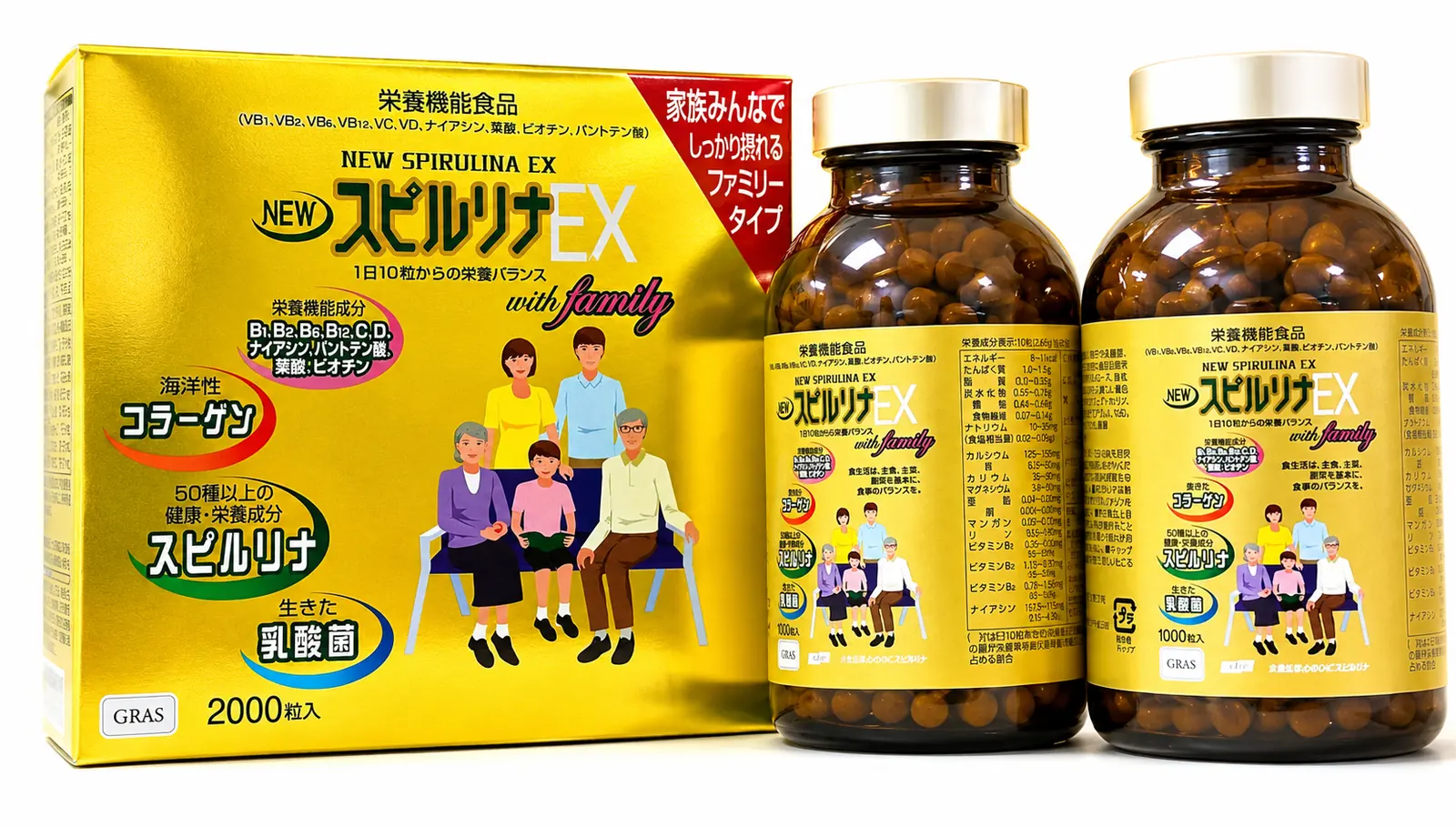
One example of a thing used as support, built on meals, is NEW スピルリナEX. It is a food taken with water or hot water, with 10 tablets (2.65g) a day as a guide, and it carries Nutrient Function Claims labeling for 10 vitamins. The raw materials include gelatin and milk ingredients. Details are sorted out in What Is Spirulina EX?, how to read the labeling in What Is a Food with Nutrient Function Claims?, and a guide to the cost per day in How Much Does Spirulina EX Cost per Day?.
Whatever you use, just having it on hand cannot be called “topped up.” Only when you take the decided amount on the decided days can you say you have “used” it. What you count is still the number of vegetable dishes. ※Not a substitute for vegetables.
On the Rakuten Ichiba NEW スピルリナEX product page of 美健サイエンス there are 135 reviews (checked October 22, 2026). Reviews using the word 「野菜」 (vegetables) number 6, and of these, 3 used the word 「野菜不足」 (vegetable shortage). Here is one example of a voice that wrote about eating habits.
「食生活が不規則になりがちなので続けています。」(2025年12月・★5・楽天市場のレビューより一部抜粋・個人の感想です)
Translation: “My eating habits tend to become irregular, so I keep taking it.” (December 2025 · ★5 · partial quote from a Rakuten Ichiba review · a personal impression)
※Not a substitute for vegetables.
Reviews are a part of the impressions of people who bought the product. Impressions differ from person to person and will not necessarily apply to everyone in the same way. Please decide for yourself whether to use it. If you are taking drugs, check with a doctor or pharmacist. The box says 「スピルリナは納豆などと同様にビタミンKを多く含んでいます。ワルファリンを服用されている方は摂取をお控えください。」 (Spirulina, like natto, is high in vitamin K. People taking warfarin should refrain from taking it.) People taking warfarin should refrain from taking it, as the cautions on the box say. Details are in Spirulina and Warfarin.
To confirm once more: reviewing your meals comes first, and this is only a supplementary aid. ※Not a substitute for vegetables.
A Small Step From Today
There is only one thing to do. Add one dish in which vegetables are the main ingredient to one of the “usual scenes” in today’s meals. Then, a week later, count how many days you managed to add it.
Any one of the following is fine.
- □ Add a handful of frozen vegetables to the morning miso soup
- □ At lunch, at a bento shop or convenience store, pick up one small dish of vegetables
- □ Put a dish of ohitashi or salad next to the main dish at dinner
- □ Buy one frozen or canned vegetable to keep in stock, and decide “when to eat it”
Then look at it over one week. Mark the days you managed to add a dish.
| Mon | Tue | Wed | Thu | Fri | Sat | Sun |
|---|---|---|---|---|---|---|
| □ | □ | □ | □ | □ | □ | □ |
The leaflet in the MHLW’s Nutrition Guidance Material also has a “5-day challenge” call: 「まずは5日間続けてみましょう。」 (first, let’s try keeping it up for 5 days). It does not have to be every day; look at it over the course of a week. If there is a week with no marks at all, do not blame yourself; try again the following week, just one thing. What can be counted is one dish, and before you know it, that becomes an ordinary meal (this is this article’s own way of thinking).
Even on days short on vegetables, aim for days when you can think “at least I have topped up a little today.” Day by day, days when you can think “I managed to add one dish today.” ※Not a substitute for vegetables.
How to take the 10 tablets a day and how to keep it up can be checked in How to Take Spirulina EX.