When you try to choose spirulina, there are so many kinds that you may stop and wonder, “Which one should I pick, really?” Rather than deciding by price or ranking alone, read the package in 5 points and choose in a way that makes sense to you. Even on days short on vegetables, aim for days when you can think “at least I have topped up a little today.” ※Not a substitute for vegetables.
This article does not rank any specific product. The answer to “which is best” changes with your purpose, the form you can keep up with, and your budget.
What you will learn
- What to decide before choosing spirulina
- The 5 points to check on the package: the order of the ingredient list, where the ingredients come from and who makes and sells it, tablet size and tablets per day, cost per day, and the type of labeling such as 栄養機能食品 (food with nutrient function claims)
- How to read words such as 「国産」 (domestic) and “additive-free”
- The order of checks that keeps you from deciding on rankings or review counts alone
This article is based on public materials from the Consumer Affairs Agency (消費者庁) and the Japan Health and Nutrition Food Association (日本健康・栄養食品協会), the information printed on the package, and reviews on Rakuten Ichiba and elsewhere (checked October 22, 2026). It is not a substitute for a doctor’s diagnosis or advice tailored to an individual. For spirulina itself, see What Is Spirulina?.
Decide what you want it for, then choose
“Which is best” has no single answer; it changes with your purpose (whether you want spirulina on its own or other ingredients as well), the form you can keep up with, and your budget. Comparison sites also list the blend ratio, the form, the price and whether additives are used, but their rankings change with each site’s criteria. This article sets out how to read the package in 5 steps so that you can apply those criteria yourself.
Three things are worth deciding first, so that you hesitate less:
- What you want to supplement: spirulina on its own, or other ingredients as well, such as lactic acid bacteria (乳酸菌) and vitamins
- A form you can keep up with: tablets (タブレット), powder and so on. People who find tablets hard to swallow and people who want to mix it into food will choose different forms
- A budget you can keep up with: think in cost per day, not the price of a single purchase (calculated in ④)
As one example from a comparison site, the spirulina buying guide on My-Best (September 2026 edition) lists the “blend ratio,” the “form,” the “price” and “no use of pesticides, preservatives or sweeteners” (checked October 22, 2026). This article covers points that overlap with those, and arranges them around labeling rules that can be checked in government materials.
Searches also include the question “euglena (ユーグレナ, midorimushi) or spirulina?” Spirulina (a blue-green alga), euglena and chlorella (クロレラ) are different materials, based on different organisms, and none is above the others. The differences are covered in How Do Spirulina and Euglena (Midorimushi) Differ? and How Do Spirulina and Chlorella Differ?.
The 5 points to check on the package are in the table below.
| Order | Where to look | What you learn |
|---|---|---|
| ① Ingredient list | 「原材料名」 in the combined label box | What is in it, and in what order |
| ② Origin, manufacturer | Origin written next to an ingredient; 「販売者」「製造者」 | Who makes it and who sells it |
| ③ Tablets, amount per day | Content amount, nutrition facts | How many grams and tablets per day |
| ④ Cost | Price ÷ days | Whether the amount is sustainable |
| ⑤ Type of labeling | 「栄養機能食品」 and so on | What may be stated, and the procedure |
① Ingredient list: read the “order” and what comes before and after 「/」
The ingredient list (原材料名) runs from the largest weight to the smallest (food additives are grouped separately, also from largest to smallest). You learn only the “order”; what percentage each ingredient makes up cannot be known from the list alone. If you read the parts before and after the 「/」 mark separately, you can read for yourself what has been added.
The Consumer Affairs Agency’s 「食品表示ガイド 早わかり」 (Food Labeling Guide at a Glance) says of the ingredient list: 「使用した原材料に占める重量の割合の高いものから順に、その最も一般的な名称をもって表示してください。」 (Please list them from the ingredient with the highest share of weight used, under its most common name). Food additives are listed by substance name, from the highest share of weight within the additives. The document also says: 「添加物については、事項欄を設けずに、原材料名の欄に原材料名と明確に区分して表示することができます。」 (For additives, you may omit a separate entry field and list them in the ingredient column, clearly separated from the ingredients). As an example of the separation, the same document shows a jam: 「いちご、砂糖/ゲル化剤(ペクチン)、酸化防止剤(ビタミンC)」 (strawberries, sugar / gelling agent (pectin), antioxidant (vitamin C)); what comes before the 「/」 is ingredients and what comes after is food additives.
When reading, look at these 3 points.
| What the ingredient list looks like | Purpose it suits | What to check |
|---|---|---|
| Only spirulina is listed | You want spirulina on its own | How many grams per day it contains (check in ③) |
| Lactic acid bacteria, collagen, vitamins and so on are listed besides spirulina | You want other ingredients as well | The amounts of the other ingredients, and the allergy labeling |
| Names of food additives follow 「/」 | ── | What they are used for (written as substance names or use names) |
If you have allergies, also read the parentheses ( ) after the ingredient names. For example, there are wordings such as 「(ゼラチンを含む)」 (contains gelatin) and 「(乳由来)」 (derived from milk). They may also be listed together at the end of the ingredient list as 「(一部に○○・○○を含む)」 (contains some ○○).
How to read a label that says “not used”
For labels such as 「〇〇不使用」 (“〇〇 not used”), what matters is whether the label clearly states what is not used (the target). The Consumer Affairs Agency’s 「食品添加物の不使用表示に関するガイドライン」 (Guideline on Labeling That Food Additives Are Not Used, March 30, 2022) says that for labeling that does not name a target, because 「何を添加していないのかが不明確であるため、添加されていないものについて消費者自身が推察することになり」 (it is unclear what has not been added, so consumers have to guess what has not been added), it may mislead them where what consumers guess differs from the business’s intent (excerpt). The same guideline also says it does not prohibit labeling that something is not used across the board.
On food additives themselves, the guideline explains that 「食品安全委員会で安全性が評価され、厚生労働省での審議を経て食品衛生法…に基づき成分規格や使用基準が設定され」 (safety is evaluated by the Food Safety Commission, and after deliberation at the Ministry of Health, Labour and Welfare, composition standards and usage standards are set under the Food Sanitation Act…) (excerpt; as described when the guideline was drawn up in 2022). On that basis, it also names as background that 「食品添加物の不使用表示がある食品を購入する際に一括表示欄を確認しない消費者が存在する」 (there are consumers who do not check the combined label box when buying food that carries a “no additives” label) (excerpt). The leaflet for consumers urges: 「どのような食品添加物が使用されているか確認したい場合は、一括表示枠内にある食品添加物表示をよく確認して購入しましょう。」 (If you want to know which food additives are used, check the food additive entries in the combined label box carefully before you buy).
In other words, when you see the words “not used,” the quickest route is to check the ingredient and additive entries on the package with your own eyes.
② Origin and manufacturer: the meaning depends on where the label is written
Origin labels such as 「国産」 (domestic origin) or 「アメリカ産」 (US origin) mean different things depending on which ingredient in the list they are attached to. For processed foods made in Japan, the rule is to state the origin of the ingredient with the highest share of weight; if that ingredient is itself a processed food, a manufacturing place such as 「国内製造」 (processed in Japan) is written. That does not mean the raw material is of domestic origin. Clues about the manufacturer are the 「販売者」 (seller) and 「製造者」 (manufacturer) entries and published certification lists.
How to read origin
According to the Consumer Affairs Agency, all processed foods made in Japan are subject to raw-material origin labeling, and the origin of the ingredient with the highest share of weight must be stated (for products made and sold from April 2022 onward it is mandatory; there are exceptions such as eating on the premises, sales without packaging, and small labeling areas). Imported products show the 「原産国名」 (country of origin) instead of raw-material origin. The materials also warn: 「対象の原材料が国内で製造された加工食品の場合は、「国内製造」と表示しますが、当該加工食品の原材料として使われた生鮮食品が「国産」であるという意味ではありません。」 (When the target ingredient is a processed food made in Japan, it is labeled 「国内製造」 (processed in Japan), but this does not mean that the fresh food used as a raw material of that processed food is 「国産」 (domestic origin)).
Within an ingredient list, 「国産」 (domestic origin) shows where a fresh ingredient came from, while 「国内製造」 (processed in Japan) shows where a processed ingredient was made. When you see 「国産」 or 「国内製造」 elsewhere on the package, check which ingredient (or which product) it refers to. This article does not judge which origin is better or worse.
“Seller (販売者)” and “manufacturer (製造者)”
The “Food Labeling Guide at a Glance” mentioned above explains that when the party responsible for the label is the manufacturer, the basic labeling is 「製造者」, and that 「製造業者、加工業者又は輸入業者との合意等により、これらの者に代わって販売業者が表示することも可能です。この場合、事項名は「販売者」となります。」 (by agreement with the manufacturer, processor or importer, a seller may display the label in their place. In this case, the item name is 「販売者」). The seller and the manufacturer can be different companies, so noting both makes it easier to inquire or look things up later.
Answering “Which spirulina manufacturer is good?”
Searches also include the question “Which spirulina manufacturer is good?” In the public materials checked this time, none ranks manufacturers. One clue is the 「GMP認定製造所一覧」 (List of GMP-Certified Manufacturing Sites) published by the Japan Health and Nutrition Food Association. Under the association’s rules, “manufacturing-site GMP certification” means the chairman of the association certifies that a site manufactures health supplement foods in line with the GMP guideline; it is a system you apply to be certified under. The certification is valid for 3 years and lapses unless renewed every 3 years. If you search by the manufacturer’s name on the package, you can check whether it appears on the list.
However, certification is a system for manufacturing sites and does not show which product is better. There is also a separate 「GMP製品マーク」 (GMP product mark) system that approves the mark product by product for products made entirely at certified sites; products from a certified site do not necessarily carry the mark. Not being certified does not mean low quality, either. An introduction to a manufacturer and whether it holds certification are pieces of information supplied by the selling side, so it is a good idea to compare information published by a third party, such as this list, with what is printed on the package.
③ Tablet size: compare by “amount per day” and “tablets per day”
Tablet size differs from product to product, and for the same daily amount, smaller tablets mean more of them. When comparing, look at the “recommended amount per day (g)” and the “number of tablets per day” rather than “per tablet,” and you can compare on equal terms.
The content amount is sometimes written in a form that shows the weight per tablet, such as 「530g(1粒0.265g×1000粒×2本)」 (530 g; 0.265 g per tablet × 1,000 tablets × 2 bottles). According to the Consumer Affairs Agency’s materials, the content amount must be stated as weight (grams and so on), volume or count, with a clear unit. When only the number of tablets is given, a nutrition-facts line such as 「1日○粒(○g)あたり」 (per ○ tablets (○ g) a day) is a clue. Nutrition facts are written per a “food unit” such as 100 g or one serving. If the reference amount is not the same, lining up the numbers does not let you compare them.
An example calculation (made-up numbers):
- Product A: 0.2 g per tablet, 10 tablets a day → 2 g a day
- Product B: 0.1 g per tablet, 20 tablets a day → 2 g a day
The daily amount is the same 2 g, but the number of tablets you take a day differs: 10 and 20. “Small tablets that are easy to swallow” and “a large number of tablets” often go together.
On Foods with Health Claims (保健機能食品), the Consumer Affairs Agency says: 「1日当たりの摂取目安量よりも多く摂取することで、より高い効果が得られるものではありません。」 (Taking more than the recommended daily amount does not give a stronger effect). Follow the recommended daily amount on the label, and then see whether that number of tablets is easy to keep up with. If you find tablets hard to swallow, you can also choose another form, such as powder.
④ Cost per day: calculate it with the same formula
If you divide “total tablets ÷ tablets per day” to get the number of days, then “price ÷ days” to get the cost per day, you can compare on equal terms. However, cost per day is a guide for comparing prices, not a figure that shows whether quality is good or bad.
There are 3 steps.
- From the content amount on the package, check the total number of tablets (example: 300 tablets)
- Divide by the recommended amount per day to get the number of days (example: 5 tablets a day gives 60 days)
- Divide the price by the number of days (example: 1,500 yen ÷ 60 days = 25 yen)
The numbers in this example are made up for practice. When you actually compare, also put the following on equal terms.
- Shipping, points, coupons: if shipping is charged separately, add it; look at points separately and do not mix them into the price
- Amount bought at one time: buying in bulk can lower the cost per day, but also check whether you can finish it before the date printed on the outer box
- Date: prices change, so note the day you looked
If you know a cost per day that you can keep up with, it becomes easier to consider it as a daily habit without strain. Even on days short on vegetables, aim for days when you can think “at least I have topped up a little today.” ※Not a substitute for vegetables.
⑤ Labels such as 「栄養機能食品」: a difference in procedures with the government
Foods with Health Claims (保健機能食品) come in 3 types: 栄養機能食品, 特定保健用食品 (トクホ) and 機能性表示食品, and the procedures with the government differ. Foods other than these 3 may not state the effect or function of the food (Food Labeling Standards, Article 9). The type of labeling is sorted by the difference in procedure and what may be stated; no ranking of products is shown.
| Type | Relation to the government | What to check on the package |
|---|---|---|
| 栄養機能食品 | No separate application for permission is needed (self-certification). If the specified nutrient is contained within the standard range, the specified function may be stated | The function of the nutrient, and the cautions |
| 機能性表示食品 | The business notifies the Commissioner of the Consumer Affairs Agency before sale. The government does not review it | The notified content can be viewed by anyone on the Consumer Affairs Agency’s website |
| 特定保健用食品 | The government reviews each product and grants permission | The permitted wording |
| Foods without the 3 labels above | ── | Effects and functions may not be stated. Compare by the ingredient list and the nutrition facts |
For all 3, the Consumer Affairs Agency says: 「保健機能食品は医薬品とは異なり、疾病の治療や予防のために摂取するものではありません。」 (Foods with Health Claims, unlike medicines, are not taken to treat or prevent disease). It also explains: 「一般的には、主食、主菜、副菜がそろっていると、色々な栄養素をバランスよく摂取することにつながります。」 (In general, having a staple, a main dish and a side dish together leads to taking in various nutrients in good balance), and goes on to say 「その上で、保健機能食品を健康の維持増進のために上手に活用することもできます。」 (On that basis, you can also make good use of foods with health claims to maintain and promote health).
The standard for 栄養機能食品 (Appendix Table 11 of the Food Labeling Standards) was revised on October 1, 2026. Processed foods manufactured, processed or imported by March 31, 2030 may still be labeled under the standard before the revision, so for a while you may see both old and new labeling in stores. Details are covered in What Are 栄養機能食品?.
Ways of choosing to avoid, and who needs to check first
Avoid deciding on any one factor alone: ranking, number of reviews or price; line up the 5 points on the package and check them. People taking medication prescribed by a doctor, and people with allergies, need to check before choosing.
4 ways of choosing to avoid:
- Going by ranking alone: rankings change with each site’s criteria and the products it lists
- Going by “price per tablet” alone: if the weight per tablet differs, you cannot compare per tablet (③ and ④)
- Going by how strong the wording is: without 栄養機能食品, 機能性表示食品 or 特定保健用食品 labeling, such claims may not be made (⑤)
- Going by the words “not used” alone: check what is not used, and the food additives in the combined label box (①)
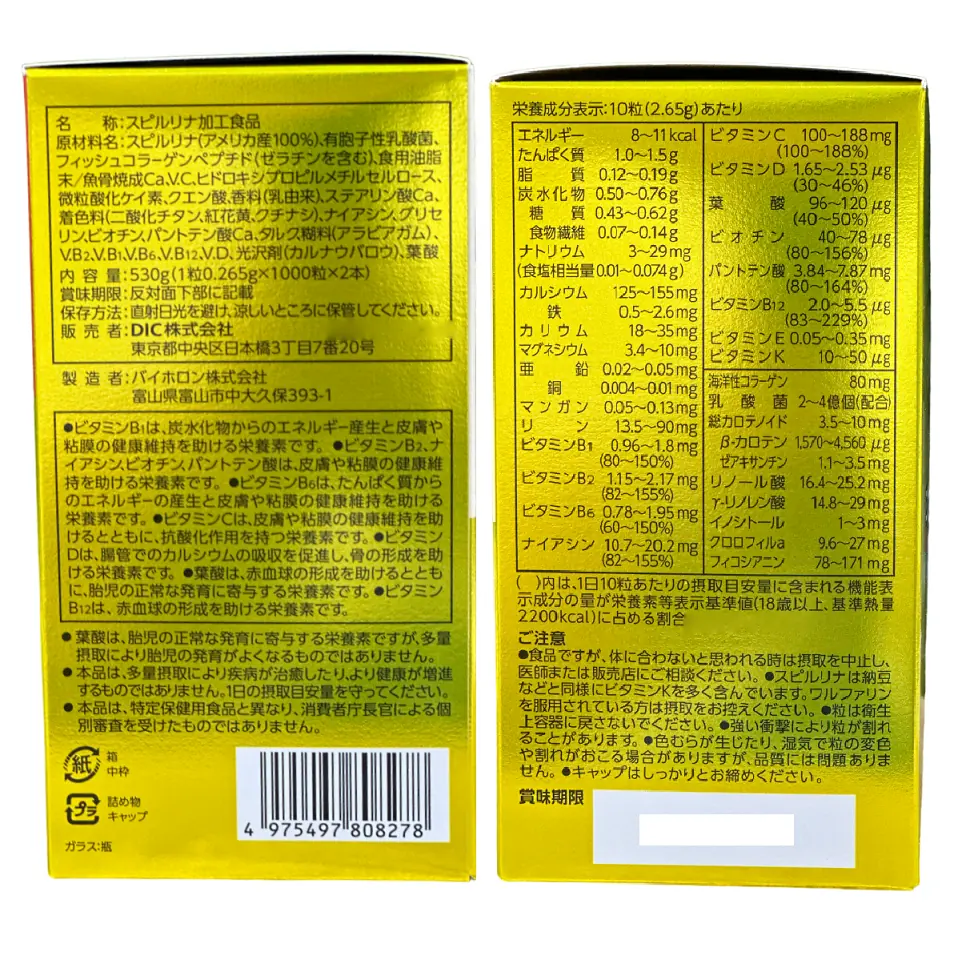
Some spirulina products state on the package that people taking warfarin (ワルファリン) should avoid them (the outer box of NEW スピルリナEX says 「スピルリナは納豆などと同様にビタミンKを多く含んでいます。ワルファリンを服用されている方は摂取をお控えください。」, that is: like natto, spirulina contains a lot of vitamin K, and people taking warfarin should avoid it). If you are taking medication, have allergies, or feel something does not suit you, ask a doctor or pharmacist before choosing or taking it. Details are in Spirulina and Warfarin: Why People Taking Warfarin Are Asked to Avoid It.
NEW スピルリナEX, seen through the 5 labels
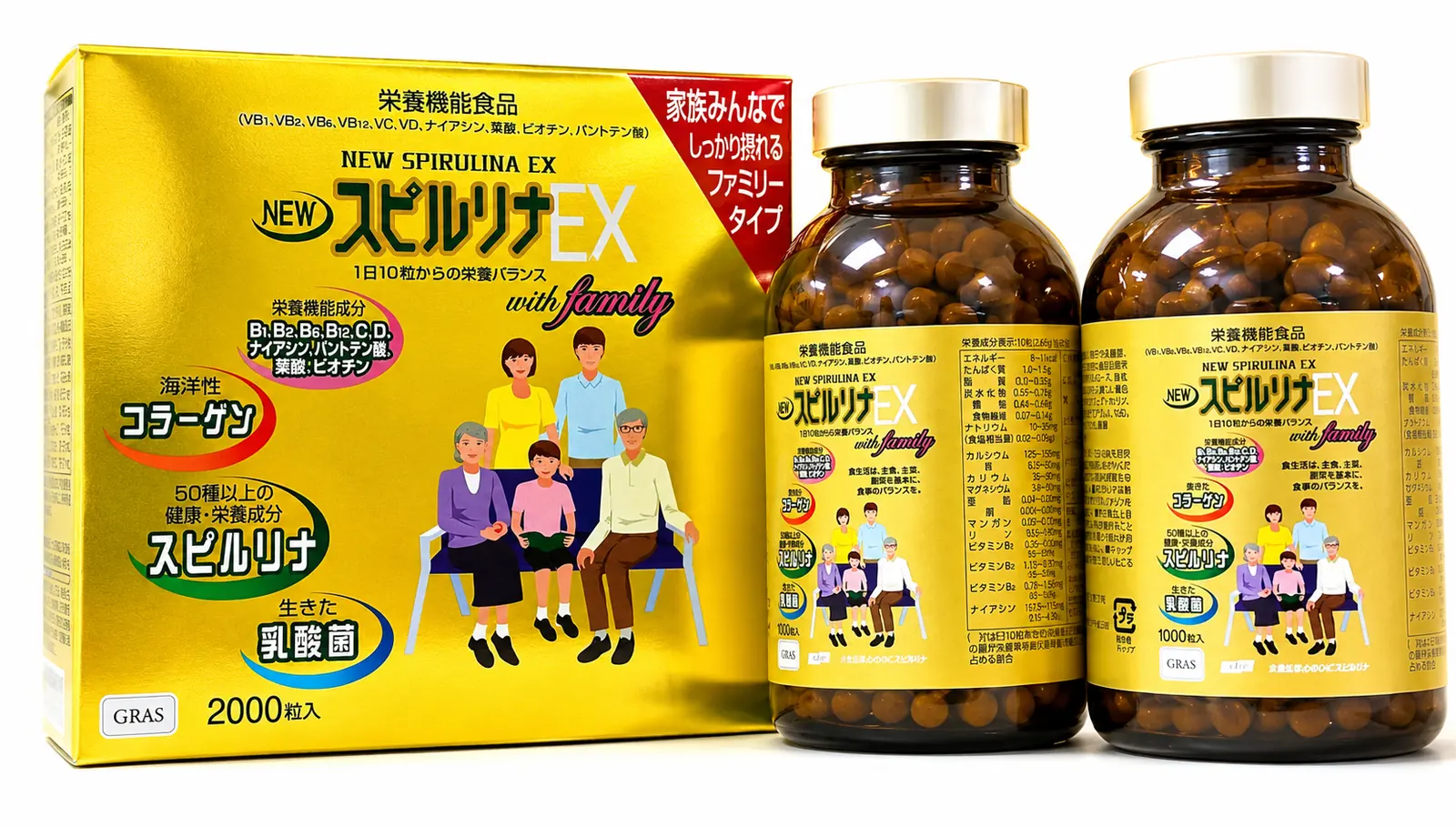
NEW スピルリナEX is not a product made of spirulina alone. It is a food with nutrient function claims that also contains lactic acid bacteria, collagen peptide and food additives, so it may not suit people who want only spirulina. With that said, here is what the outer box shows, point by point.
| What to check | NEW スピルリナEX outer box and sales page (checked October 22, 2026) |
|---|---|
| ① Ingredient list | The name is 「スピルリナ加工食品」. It begins with 「スピルリナ(アメリカ産100%)」 (「アメリカ産100%」 gives the share of the spirulina’s origin, not the share of spirulina in the product), followed by 有胞子性乳酸菌 (spore-forming lactic acid bacteria), フィッシュコラーゲンペプチド(ゼラチンを含む) (fish collagen peptide, contains gelatin) and 食用油脂末 (edible fat powder); after 「/」 come 魚骨焼成Ca (calcined fish-bone calcium), V.C (vitamin C), ヒドロキシプロピルメチルセルロース (hydroxypropyl methylcellulose), 微粒酸化ケイ素 (fine silicon dioxide), クエン酸 (citric acid), 香料(乳由来) (flavoring derived from milk), ステアリン酸Ca (calcium stearate), 着色料(二酸化チタン、紅花黄、クチナシ) (colorings: titanium dioxide, safflower yellow, gardenia)… and the food additives continue (including 糊料(アラビアガム) (thickener: gum arabic), 光沢剤(カルナウバロウ) (glazing agent: carnauba wax) and vitamins) |
| ② Origin, manufacturer | The seller is DIC株式会社 (Chuo-ku, Tokyo) and the manufacturer is バイホロン株式会社 (Toyama City, Toyama Prefecture). For the origin of the spirulina, see ① |
| ③ Tablets, amount per day | 10 tablets (2.65 g) a day is the guide. 0.265 g per tablet. Content is 530 g (0.265 g per tablet × 1,000 tablets × 2 bottles), or 2,000 tablets |
| ④ Cost per day | For a single unit at 10,100 yen (tax included) on Rakuten Ichiba: 10,100 yen ÷ 200 days ≈ 50.5 yen (about 5.05 yen per tablet) |
| ⑤ Type of labeling | 栄養機能食品 (10 vitamins). The outer box states 「特定保健用食品と異なり、消費者庁長官による個別審査を受けたものではありません」 (unlike foods for specified health uses, this product has not been individually reviewed by the Commissioner of the Consumer Affairs Agency) |
The price in ④ is the price on the day it was checked and may change. For a detailed worked example, see How Much Does Spirulina EX Cost per Day?.
When it may not suit you
- You want only spirulina: it also contains lactic acid bacteria, collagen peptide and food additives
- You are allergic to gelatin, milk components or fish: the ingredients include 「ゼラチンを含む」 and 「乳由来」, as well as fish collagen peptide and calcined fish-bone calcium
- You are taking warfarin: the outer box says to avoid it because it contains a lot of vitamin K
- You want to choose after looking at the names of additives: names such as colorings and thickening agents are listed in the ingredient list
What the reviews say
The Rakuten Ichiba page for NEW スピルリナEX from 美健サイエンス has 135 reviews (checked October 22, 2026). Of these, the number that mention origin labeling, ingredients or additives is 0. Even among 2,654 reviews of spirulina products (collected by this site, posted through September 2026 on Rakuten Ichiba, Amazon, @cosme and elsewhere; including other products), the number that mention words such as “origin,” “ingredients,” “additives,” “pesticides” or “domestic” is 21 (about 0.8%), and all of them are reviews of products other than NEW スピルリナEX. Reviews tell you little about what is printed on the package, so reading the package yourself is worthwhile.
The number of reviews that mention tablet size is 1 of 135.
「苦みなどもなく粒も小さいため、とても飲みやすいです。」(2025年4月・★5・楽天市場のレビューより一部抜粋・個人の感想です)
Translation: “There is no bitterness, and the tablets are small, so they are very easy to take.” (April 2025 · ★5 · excerpt from a review on Rakuten Ichiba · personal impression)
※How it feels differs from person to person. A review is just part of one buyer’s impression and does not necessarily apply the same way to everyone.
The content so far, including the ingredients and how to read the label, is covered in What Is NEW Spirulina EX?. Other people’s impressions are collected in NEW Spirulina EX Reviews and Reputation. If something does not seem to suit you, stop taking it and consult a doctor or the seller.
A small step from today
There is only one thing to do. Try one of the following with the product you have, or one you are interested in.
- □ Read the 「原材料名」, separating what comes before and after 「/」
- □ Note the grams and the number of tablets per day from the 「内容量」 and the recommended amount per day
- □ Divide the price by the number of days to get the cost per day
- □ Note the 「販売者」 and 「製造者」 names, and try searching for them on the Japan Health and Nutrition Food Association’s list
Being able to do just one is enough for today’s step. If you can read the package with your own eyes, without relying on rankings or the number of reviews, it becomes easier to choose one that makes you think, “I can keep this up.” Even on days short on vegetables, aim for days when you can think “at least I have topped up a little today.” ※Not a substitute for vegetables.
How to take it and how to keep it up can be checked in How to Take Spirulina EX.