Even on days short on vegetables, aim for days when you can think “at least I have topped up a little today.” ※Not a substitute for vegetables. When you start looking into foods made from algae for days like that, questions like these may come up:
- “Spirulina and euglena (ミドリムシ, midorimushi): both names are familiar, but what is the difference?”
- “Are midorimushi and euglena the same thing?”
- “Which one will suit me? Is it all right to take them together?”
The short answer: spirulina is a “blue-green alga” (藍藻), while euglena (midorimushi) is a single-celled organism that swims with a flagellum; they are different kinds of organism. Midorimushi is the name used for euglena in Japan. It is not a matter of which is better or worse: choose by form, ease of keeping up, preference and purpose.※Perception differs from person to person. This article lines up the differences in order, based on materials from public bodies and research institutions.
What you will learn in this article
- How spirulina and euglena (midorimushi) differ in classification, and how “midorimushi” and “euglena” are related
- Examples of characteristic ingredients (phycocyanin and paramylon), and how to read the numbers you see online
- Forms such as tablets and powder, how to look at ease of keeping up, and how to think about taking them together
- How to look at the choice by purpose, and a note for people taking medication
This article is based on public materials from the National Institute for Environmental Studies (NIES), Kyoto University, the National Institute of Advanced Industrial Science and Technology (AIST), the Ministry of Health, Labour and Welfare, the Consumer Affairs Agency and others, on the labeling on the outer box of NEW スピルリナEX, and on reviews posted on Rakuten Ichiba and elsewhere (checked October 15–16, 2026). The materials are read in three groups: those from public bodies, research institutions and universities; those from businesses (makers); and customers’ impressions. Where a material comes from a business, the article says so. It is not a substitute for a doctor’s diagnosis or for advice about an individual.
Both are algae, but different organisms: the difference in classification
Spirulina is a blue-green alga (cyanobacteria), while euglena (midorimushi) is a single-celled organism classified in the class Euglenophyceae (ミドリムシ藻綱); they are different kinds of organism. “Midorimushi” is the Japanese name (和名, the name used in Japan) for “euglena”, and both refer to the same organism.
First, what they share.
- Both are “microalgae” that can photosynthesize (about spirulina, Kyoto University writes 「食用の微細藻」 (an edible microalga); about euglena, the Journal of the Society for Biotechnology, Japan (Vol. 99, No. 8) writes 「微細藻類」 (microalgae))
- Both are used as food ingredients
- Both are processed into forms that are easy to take, such as powder or tablets, and sold that way
Next, the overall picture of the differences (the basis is given in each of the sections that follow).
| Item | Spirulina | Euglena (midorimushi) |
|---|---|---|
| Classification | Blue-green alga (藍藻) = cyanobacteria | A single-celled organism classified in the class Euglenophyceae (ミドリムシ藻綱) |
| Cell type | Prokaryote (no nucleus) | Eukaryote (has a nucleus); swims with a flagellum and also photosynthesizes |
| Example of a characteristic ingredient | Phycocyanin (a blue pigment) | Paramylon (a storage polysaccharide, a kind of β-1,3-glucan) |
| Form as food | Powder, tablets and so on | Powder, tablets, drinks and so on; differs by product |
Here are the differences, one by one. On cyanobacteria (blue-green algae), the group that spirulina belongs to, NIES writes:
「シアノバクテリアは酸素発生型光合成を行う細菌の一種であり,藍藻(らんそう)とも呼ばれています。」(国立環境研究所 2021年11月1日公表資料「背景」より)
Translation: “Cyanobacteria are a kind of bacteria that perform oxygen-producing photosynthesis, and are also called blue-green algae (らんそう).” (National Institute for Environmental Studies, published November 1, 2021, “Background”)
Kyoto University reported the full-length genome sequence of 「食用藍藻スピルリナ」 (edible blue-green alga spirulina) on January 20, 2023. As for the structure of the cell, NIES’s 『環境儀』 calls cyanobacteria 「原核生物」 (prokaryotes), as in this excerpt: 「アオコ現象は原核生物であるシアノバクテリアの大増殖のことをいい、…」 (the algal bloom phenomenon is the mass growth of cyanobacteria, which are prokaryotes, …). In other words, spirulina is a prokaryote with no nucleus. This is a point also touched on in What Is Spirulina?.
On euglena (midorimushi), on the other hand, an FY2024 (Reiwa 6) report by a research group including the National Institute of Health Sciences (NIHS), under the Health, Labour and Welfare Policy Research Program (厚生労働行政推進調査事業), writes:
「ミドリムシは、主に淡水域に分布するミドリムシ藻綱の一属の真核単細胞生物である」(厚生労働行政推進調査事業 分担研究報告書「グレーゾーン成分本質に関する研究 ミドリムシ」より一部抜粋)
Translation: “Midorimushi is a single-celled eukaryote of one genus in the class Euglenophyceae, found mainly in fresh water.” (excerpt from a co-investigator’s research report of the Health, Labour and Welfare Policy Research Program, 「グレーゾーン成分本質に関する研究 ミドリムシ」 [A Study on the Nature of Gray-Zone Ingredients: Midorimushi])
The Journal of the Society for Biotechnology, Japan (Vol. 101, No. 4) also describes euglena as follows:
「ユーグレナは単細胞の真核生物であり,光合成を行う植物の性質,鞭毛を波打たせて泳ぎ回る動物としての性質をあわせ持つ.」(生物工学会誌 101巻4号「ユーグレナ古今東西」より)
Translation: “Euglena is a single-celled eukaryote, and it has both the nature of a plant that photosynthesizes and the nature of an animal that swims about by waving its flagellum.” (Journal of the Society for Biotechnology, Japan, Vol. 101, No. 4, 「ユーグレナ古今東西」)
In other words, euglena is a eukaryote with a nucleus, and it has both the nature of photosynthesizing like a plant and the nature of swimming about with a flagellum. The NIES explanation also says that midorimushi 「緑色の葉緑体を持っていますが、系統的には異なるグループです。」 (has green chloroplasts, but is a different group in terms of lineage). This is said in comparison with green algae (excerpt).
“Midorimushi” and “euglena” are two names for the same organism. The National Museum of Nature and Science explains midorimushi as 「日本でのみ通用する名前(和名)」 (a name that is used only in Japan, that is, the Japanese name).
So although both are called “algae”, they differ even in cell structure, depending on whether the source is a blue-green alga or a member of the class Euglenophyceae. That is the starting point.
Differences in ingredients, and how to read the numbers
As examples of characteristic ingredients, spirulina is often cited for phycocyanin (a blue pigment) and euglena for paramylon (a storage polysaccharide, a kind of β-1,3-glucan). However, within the range checked, no public document was found that compares nutrient figures under the same conditions.
On phycocyanin, there is an FY2025 (Reiwa 7) research report on the food additive 「スピルリナ色素」 (spirulina pigment), under the Food Hygiene Standards Scientific Research Grant (食品衛生基準科学研究費補助金). It gives the definition in the government compendium of standards (公定書) as 「フィコシアニン(PYC)を主成分とするものである」 (a product whose main component is phycocyanin (PYC)), and explains phycocyanin as 「青色の発色団を分子内に有するタンパク質」 (a protein that has a blue chromophore in its molecule). Tokyo Institute of Technology (now Institute of Science Tokyo) explains phycocyanin as a pigment found in the light-harvesting structure of cyanobacteria (blue-green algae), the phycobilisome, with the blue bilin (phycocyanobilin) bound to it.
On paramylon, AIST explains paramylon as 「ベータ-1,3-グルカンという物質の仲間」 (a member of the family of substances called beta-1,3-glucan). The Journal of the Society for Biotechnology, Japan (Vol. 99, No. 8) calls paramylon 「ユーグレナ固有の貯蔵多糖」 (a storage polysaccharide specific to euglena).
What is known (confirmed in materials from public bodies and research institutions)
- Spirulina and euglena are organisms from different groups
- The main component of spirulina pigment is phycocyanin, and the storage polysaccharide of euglena is paramylon
- Within the range checked, neither spirulina nor euglena (midorimushi) is listed in the Ministry of Education, Culture, Sports, Science and Technology’s 「日本食品標準成分表(八訂)増補2023年」 (Standard Tables of Food Composition in Japan, 2020 edition (8th revision), 2023 supplement)
What is not yet known (things for which no public document was found, within the range checked)
- Nutrition material that compares spirulina and euglena under the same conditions
- Material that compares “digestibility” (「消化率」), “amino acid score” (「アミノ酸スコア」), “number of kinds of nutrients” (「栄養素の種類数」) and the like under common conditions
Online, figures such as “digestibility,” “amino acid score” and “number of kinds of nutrients” are introduced with different values from page to page. They come from various sources, such as figures shown on a company’s page and figures from older studies, and conditions such as the target (protein or the whole cell), the method and the age of the data are not aligned. Even when the same figure appears on several pages, it may come from the same original material. When you find a figure, check “who” gave it and “under what conditions.” This article does not line up figures whose conditions do not match in order to say which is better.
The amounts of ingredients change with the kind, the way it is grown, and the product. The quickest way to know what is actually inside and how much is the ingredient list (原材料名) and the nutrition facts (栄養成分表示) on the box.
Differences in form, how to take them and ease of keeping up
Both spirulina and euglena are sold in several forms, such as tablets and powder, and the form and the daily amount differ from product to product. To compare by ease of keeping up, look at the number of tablets (amount) per day and the cost per day calculated from the listed price.
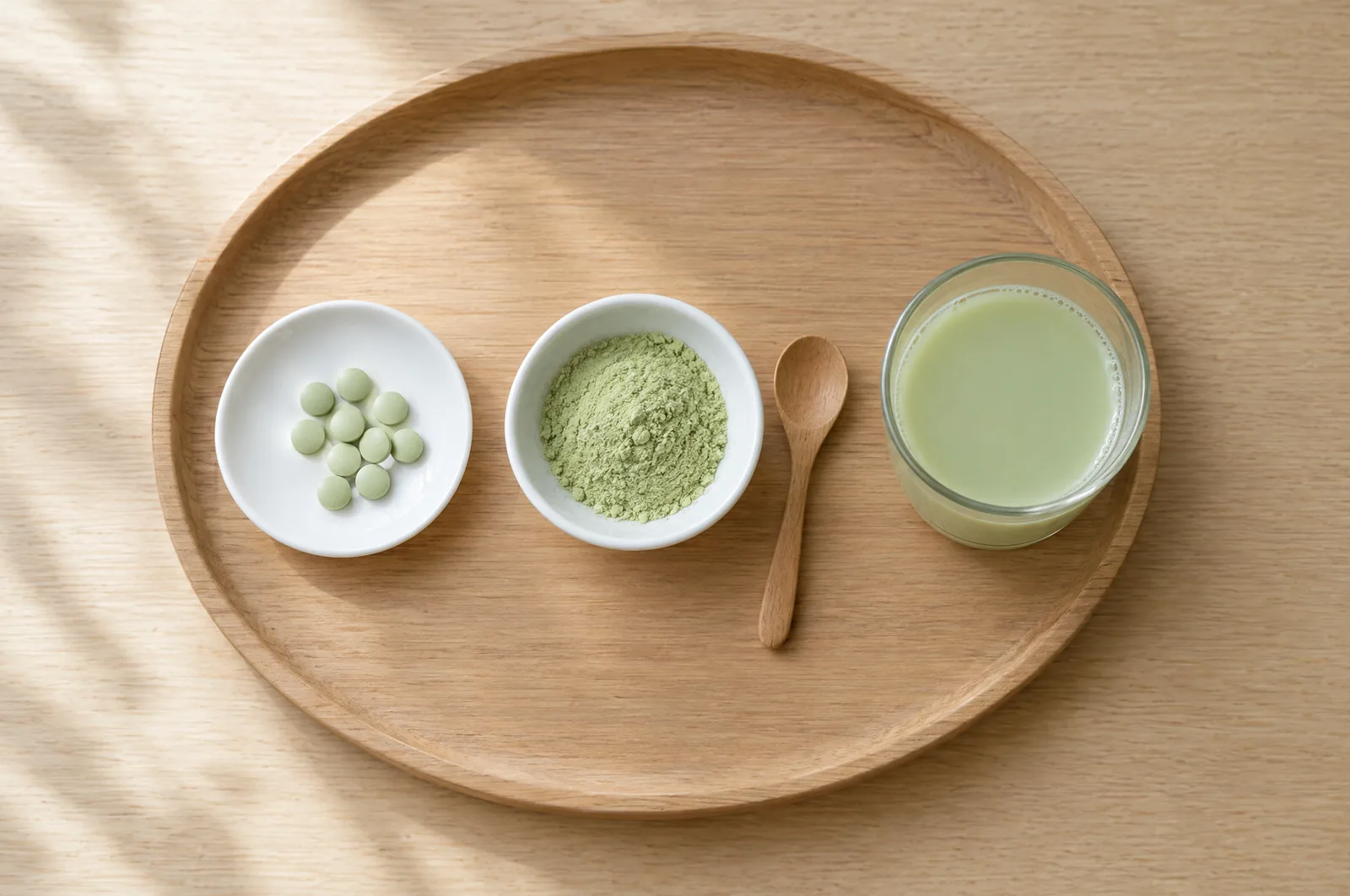
On euglena, the National Museum of Nature and Science introduces ways of using it, such as making it into a powder and adding it to smoothies, and the fact that it is sold as a dietary supplement. A search for 「パラミロン」 (paramylon) in the Consumer Affairs Agency’s notification information on Foods with Function Claims (機能性表示食品) displays foods including drinks, as well as tablets and capsules. NEW スピルリナEX is a tablet-type food, with 10 tablets a day as the suggested amount, taken with water or hot water. The forms of spirulina (powder, tablets and so on) are sorted out in What Is Spirulina?.
| What to look at | Spirulina (in the case of NEW スピルリナEX) | Euglena (midorimushi) |
|---|---|---|
| Form | Tablet type (2 bottles of 1,000 tablets in 1 box) | Differs by product (powder, tablets, drinks and so on) |
| Amount per day | 10 tablets (2.65g) a day as a guide (as shown on the outer box) | Check the product’s label |
| Ingredients | Besides spirulina, it also contains spore-forming lactic acid bacteria (有胞子性乳酸菌), fish collagen peptide and others (ingredient list on the outer box) | Check the product’s label to see whether it is euglena only or also contains other ingredients |
| Type of labeling | Food with Nutrient Function Claims (栄養機能食品), covering 10 vitamins. It has not undergone individual review | Some products have been notified as Foods with Function Claims (see the note below) |
※A search for 「パラミロン」 (paramylon) in the Consumer Affairs Agency’s notification information on Foods with Function Claims displays 39 results (including withdrawn ones and the like; checked October 15, 2026). A Ministry of Health, Labour and Welfare document explains that a Food with Function Claims is notified by the business on its own responsibility, and has not received individual permission from the Commissioner of the Consumer Affairs Agency. The type of labeling differs from product to product, so check the box in your hand or the product page.
Ease of keeping up is decided by the number of tablets or the amount per day, taste and smell, the cost per day, and so on. How to calculate the cost per day is sorted out in How Much Does Spirulina EX Cost per Day?, and the smell and taste in Worried About the Smell or Taste of Spirulina?. Because it lasts, the feeling of having “topped up” lasts too. ※Not a substitute for vegetables.
Comparing the three, including chlorella
Spirulina is a blue-green alga, chlorella is a green alga and euglena belongs to the class Euglenophyceae. All three are microalgae, but they come from different groups. Lined up side by side, the three look like this.
| Item | Spirulina | Chlorella | Euglena (midorimushi) |
|---|---|---|---|
| Position of the three (classification) | Blue-green alga (cyanobacteria) | Green alga (class Trebouxiophyceae) | Class Euglenophyceae |
| Cell type | Prokaryote (no nucleus) | Eukaryote (has a nucleus) | Eukaryote (has a nucleus) |
| Example of a characteristic ingredient | Phycocyanin (a blue pigment) | For details, see Spirulina vs Chlorella: How Do They Differ? | Paramylon |
On chlorella, the press release of the University of Tokyo and JST writes 「クロレラはトレボウクシア藻綱に分類される淡水産の単細胞の緑藻です。」 (chlorella is a freshwater single-celled green alga classified in the class Trebouxiophyceae). The same material also has a note saying that algal cells have a nucleus.
The differences between spirulina and chlorella (the feel and flavor of the tablet, the growing environment, a note for people taking warfarin, and so on) are sorted out in Spirulina vs Chlorella: How Do They Differ?, based on materials from public bodies and makers.
Can I take them together? How to think about combining and blended products
Within the range checked, no public document was found that looked into taking spirulina and euglena together. Public documents urge people not to take several health foods at the same time. If you do take them, keep to the suggested daily amount shown on each label, check the nutrition facts to see whether the same ingredient overlaps, and if you take medication or have a medical condition, check with a doctor or pharmacist.
The Ministry of Health, Labour and Welfare’s 『健康食品の正しい利用法』 (Correct Use of Health Foods) writes:
「一度に多種類の健康食品を摂取することは、健康被害の可能性を高め」(厚生労働省『健康食品の正しい利用法』「いくつもの製品を同時に摂取しない」の項より一部抜粋)
Translation: “Taking many kinds of health foods at one time raises the possibility of harm to health, …” (excerpt from the section “Do not take several products at the same time” of the Ministry of Health, Labour and Welfare’s “Correct Use of Health Foods”)
The same document also writes that caution is needed, because there is a possibility that combining many kinds of health foods results in taking too much of a particular ingredient.
The Consumer Affairs Agency, too, urges people 「錠剤・カプセル状の製品を複数利用したり、医薬品的な効果を期待して利用しない」 (not to use several tablet- or capsule-form products, or to use them expecting medicine-like effects) (Consumer Affairs Agency, 「健康食品(一般の方向け)」).
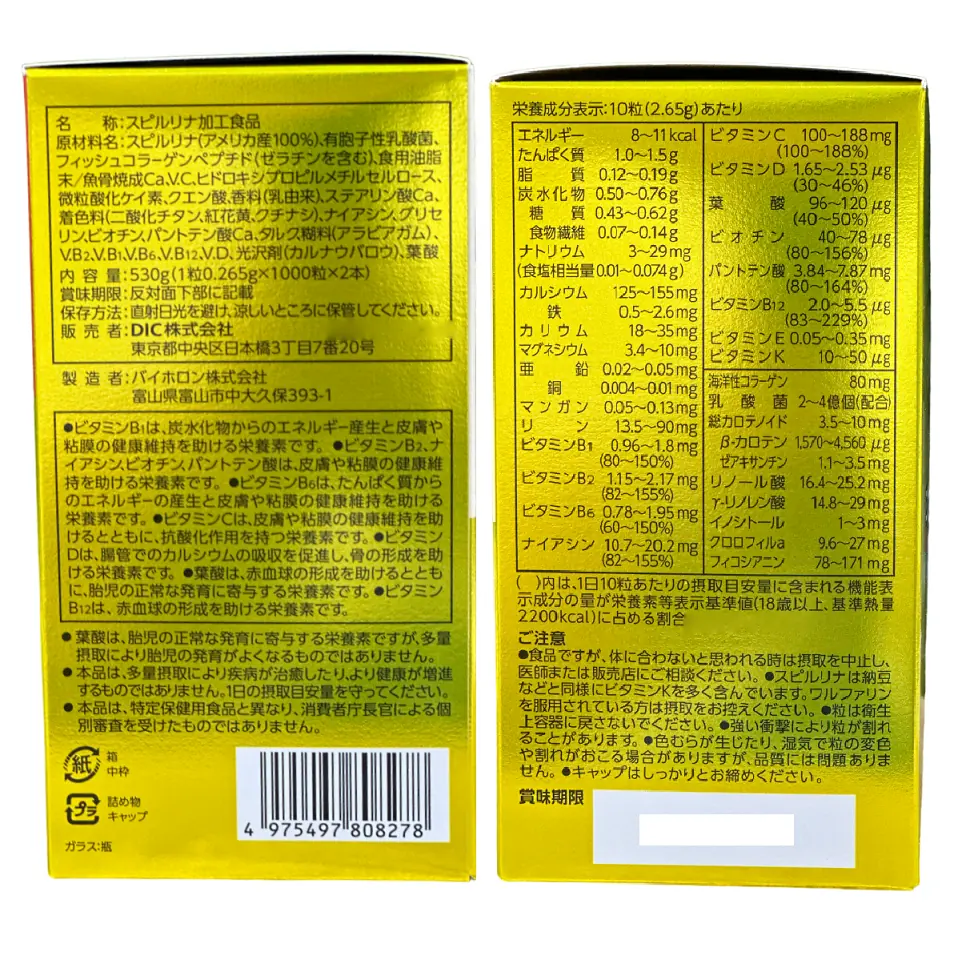
In products that combine several ingredients in one (blended products), what is included and how much differs from product to product. Check what is included in the ingredient list (原材料名). When you take them together, also check in the nutrition facts whether the same ingredient (such as a vitamin) overlaps.
The NEW スピルリナEX box says: 「スピルリナは納豆などと同様にビタミンKを多く含んでいます。ワルファリンを服用されている方は摂取をお控えください。」 (Spirulina, like natto, is high in vitamin K. People taking warfarin should refrain from taking it.) On euglena, within the range checked, no public document was found that describes its relationship with medications such as warfarin, but not finding one does not mean “there is no problem.” For euglena products, check the ingredient list to see whether chlorella or other ingredients have been added. PMDA’s Q&A for patients explains that, besides natto, chlorella and aojiru (green juice) are also high in vitamin K, so people taking warfarin are told to avoid them. If you take medication, check with a doctor or pharmacist before taking either spirulina or euglena.
The NEW スピルリナEX box also says: 「食品ですが、体に合わないと思われる時は摂取を中止し、医師または販売店にご相談ください。」 (It is a food, but if it does not seem to suit you, stop taking it and consult a doctor or the retailer.) Side effects and cautions are sorted out in Does Spirulina Have Side Effects?, and warfarin in Spirulina and Warfarin: Why People Taking Warfarin Are Asked to Avoid It.
Public documents were also checked for cautions on euglena (midorimushi). The report of the research group including the NIHS (FY2024 (Reiwa 6)) writes 「国内外ともにミドリムシの乾燥品等における健康被害事象は確認されておらず」 (no health-harm events have been confirmed for dried midorimushi products and the like, in Japan or abroad; excerpt from the “Conclusion” section), and at the same time also writes that the toxicity and similar information concerns the strains examined and does not necessarily apply as it is to other strains. What is written here is limited to what the report states; it does not declare euglena “safe.” Within the range checked, no public document was found that compares the safety of spirulina and euglena under the same conditions. Both are foods; if either does not seem to suit you, stop taking it, and if you take medication or have a medical condition, check with a doctor or pharmacist before taking it.
What do customer reviews say about euglena?
Of the 2,654 reviews collected by this site (posted up to September 2026; reviews of spirulina products, covering several shops and several products), 21 mentioned euglena (midorimushi) (counting variant spellings and masked characters). All 21 are reviews of spirulina products other than NEW スピルリナEX. About 13 of them say that the writer switched from euglena, or considered switching and then chose spirulina. Because these are reviews of spirulina products, it is natural for the numbers to lean this way; they are not figures showing which is better.
Please note that the voices of people who found euglena a better fit are unlikely to appear here. The remaining 8 or so reviews compared with euglena or mentioned it briefly, and some of them wrote that euglena suited them better (the numbers vary depending on how the reviews are divided into groups). The reasons for switching varied; reviews that described physical condition or personal impressions are not covered, because the basis cannot be checked.
Among the 134 reviews posted on the NEW スピルリナEX product page of 美健サイエンス on Rakuten Ichiba (checked October 15, 2026), none mentioned euglena (midorimushi) or chlorella. Reviews are a part of the impressions of people who bought the product. Perception differs from person to person, and they will not necessarily apply to everyone in the same way.
Choosing by purpose: a look by situation
Which to choose depends on what you are aiming for, and on form, ease of keeping up and preference. The table below lists what to look at, situation by situation. It is not a ranking.
| Situation | What to look at | Next step |
|---|---|---|
| Short on vegetables for several days | First, add one small dish of vegetables to a meal. Foods made from algae are only a supplement built on top of meals | Count yesterday’s vegetable dishes in Signs You May Be Short on Vegetables? |
| Want to choose by form: tablets, powder or a drink | The form differs by product. How easy it is to drink and to keep up differs from person to person. ※Perception differs from person to person | Check the daily amount and how to take it on the product’s label |
| Want to choose by ease of keeping up (amount and cost) | The number of tablets or the amount per day, and the cost per day calculated from the listed price | Check how to calculate it in How Much Does Spirulina EX Cost per Day? |
| Want to choose by what is inside | The ingredient list (原材料名), nutrition facts (栄養成分表示) and cautions (ご注意). Whether it is euglena only or a product that also contains other ingredients | Compare the box in your hand or the product page |
| Taking medication or have a medical condition | For both spirulina and euglena, do not decide on your own; check with a doctor or pharmacist | See also Spirulina and Warfarin: Why People Taking Warfarin Are Asked to Avoid It |
Others may suit you better
- People who keep taking a euglena product and find it easy to keep up: that choice is not a mistake. Euglena can also be chosen by your own purpose, preference and ease of keeping up; neither is “above” the other
- People who find it hard to swallow tablets whole: NEW スピルリナEX is a tablet type. Products in other forms, such as powder or drinks, are also an option
- People concerned about gelatin, milk ingredients or fish-derived raw materials: the ingredient list of NEW スピルリナEX includes gelatin and milk ingredients, and fish-derived raw materials (fish collagen peptide, calcined fish bone calcium) are also used. Check the ingredient list, including that of other products
- People taking medication or with a medical condition: check with a doctor or pharmacist before taking
Even on days short on vegetables, aim for days when you can think “at least I have topped up a little today.” ※Not a substitute for vegetables. For this kind of supplementary food, choosing by your own purpose, preference and ease of keeping up lasts longer than choosing by name or by what is in fashion.
A next step if you are unsure
- First, the label on the box: compare the ingredient list, nutrition facts and cautions of the products you are interested in.
- To learn a little more about the differences: you can check in What Is Spirulina? and Spirulina vs Chlorella: How Do They Differ?.
- To see what is inside NEW スピルリナEX before deciding: go to What Is Spirulina EX?. It is a tablet-type food, with 10 tablets a day as the suggested amount, taken with water or hot water. It carries labeling as a Food with Nutrient Function Claims for 10 vitamins.
It is not about which is better or worse, but about what suits you. Whether it suits you is for you to decide. Even on days short on vegetables, aim for days when you can think “at least I have topped up a little today.” ※Not a substitute for vegetables. ※Perception differs from person to person.