Spirulina and moringa are both green, and both are sometimes called “superfoods”. How do they differ, and is it all right to take them together? Those are surprisingly hard questions to look up. Even on days short on vegetables, aim for days when you can think “at least I have topped up a little today.” ※Not a substitute for vegetables.
This article is based on materials from Japan’s Ministry of Health, Labour and Welfare, a research report funded by the Ministry’s scientific research grants, the Ministry of Education, Culture, Sports, Science and Technology’s food composition tables and other sources (checked October 24, 2026). It is not a substitute for a diagnosis or for advice about an individual. All images in this article are AI-generated.
Spirulina Is a “Blue-Green Alga”, Moringa Is the “Leaf” of a Plant
Spirulina is a microorganism called a “blue-green alga” (藍藻), while moringa is a plant called 「ワサビノキ」 (“wasabi-no-ki”, its Japanese name); the two are different organisms.
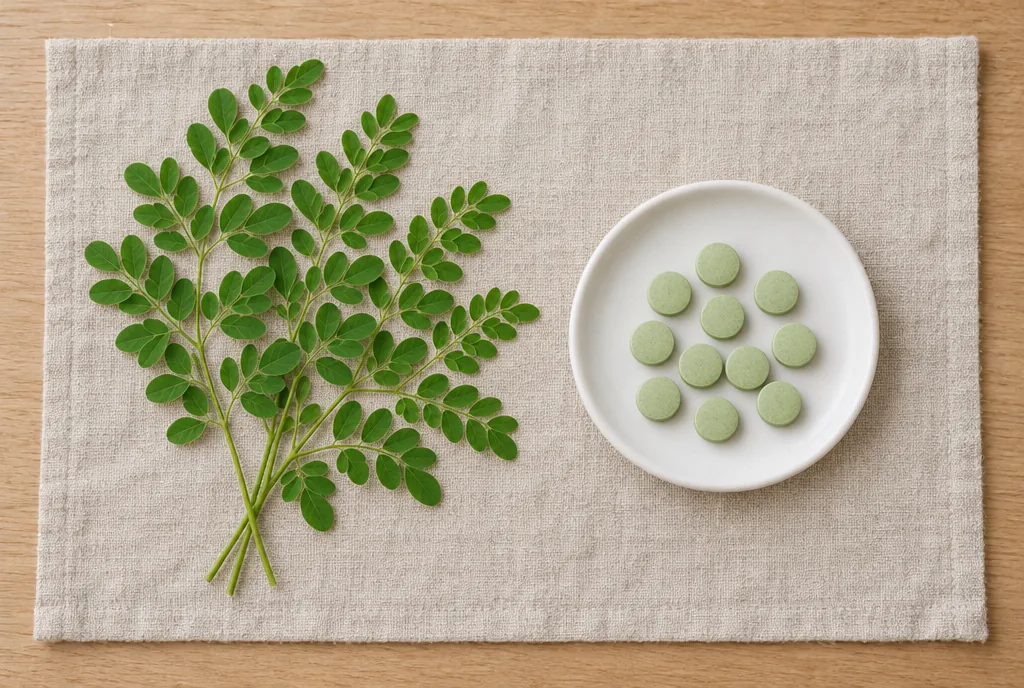
- Spirulina: about cyanobacteria, the group spirulina belongs to, Japan’s National Institute for Environmental Studies (NIES) writes: 「シアノバクテリアは酸素発生型光合成を行う細菌の一種であり,藍藻(らんそう)とも呼ばれています。」 (Cyanobacteria are a kind of bacteria that carry out oxygen-producing photosynthesis, and are also called blue-green algae.) A Kyoto University research release also puts 「食用藍藻スピルリナ」 (edible blue-green alga spirulina) in its title. For more, see What is spirulina?.
- Moringa: the fiscal 2025 (Reiwa 7) report of a research group funded by the Ministry of Health, Labour and Welfare’s scientific research grants (researchers of the National Institute of Health Sciences, NIHS) explains it as 「インド原産のワサビノキ科ワサビノキ属ワサビノキ(Moringa oleifera Lam.)の通称」 (the common name of Moringa oleifera Lam., a plant of the family Moringaceae and genus Moringa native to India; partial quotation). The Ministry’s 2004 page also gives “horseradish tree” as an English name.
- A note on the name: the Ministry of Health, Labour and Welfare writes: 「根に香味があることからワサビノキと呼ばれることもあるが、わさび(山葵)とは全く異なる植物である。」 (Because the root has a pungent flavor it is sometimes called “wasabi-no-ki”, but it is a plant entirely different from wasabi.)
- How it differs from other ingredients: see the comparisons in the articles on chlorella, euglena and aojiru (green juice).
How to Read Nutrient Tables: Different Amounts, Different Forms
Numbers can only be compared when they are for the same amount. Moreover, in the Standard Tables of Food Composition in Japan (8th revised edition, 2023 supplement), as far as could be checked, neither spirulina nor moringa has an entry.
| Material | Numbers are per | Point to note |
|---|---|---|
| Standard Tables of Food Composition in Japan (8th revised edition), 2023 supplement | 100 g of edible portion of food | Neither spirulina nor moringa has an entry in chapter 2 |
| Nutrition facts on a product | For NEW スピルリナEX, per 10 tablets (2.65 g) | Amounts and forms differ by product, so the numbers cannot simply be lined up |
| Scientific research report (on moringa) | Which components were found in leaf and seed extracts | It looked at the components present, not at a comparison of amounts with spirulina |
A per-100 g number is not the amount you eat in a day. Look at the per-serving (per-day) numbers on the package of the product you are considering.
Powder, Tablets, Tea: Forms and How to Take Them
Forms and ways of taking them differ by product. NEW スピルリナEX is a tablet, and its box gives a guideline of 10 tablets a day, with water, hot water or the like. For moringa, the commercial product examined in the research group’s reports was a leaf powder.
| Item | NEW スピルリナEX | Moringa (example confirmed in materials) |
|---|---|---|
| Form | Tablet | Leaf powder (the commercial product examined in the research group’s reports) |
| How to take | The box says: 「食品ですので特別な定めはありませんが、1日10粒を目安として1〜3回に分けて水またはお湯などでお召しあがりください。」 (It is a food, so there is no special rule, but take about 10 tablets a day, divided into 1–3 times, with water, hot water or the like.) | For one commercial powder the group tested, the report says the manufacturer’s page said 「水などに混和し飲用とするほか、料理などにも使用可」 (partial quotation; it can be mixed into water and so on to drink, and also used in cooking) |
| Amount | Shown on the box (10 tablets a day, 2.65 g) | Not confirmed in this material. Check the product’s labeling |
The Ministry’s 2004 page, citing a reference work on edible plants (Tanaka’s Cyclopedia of Edible Plants of the World), notes that the seeds, fruit, leaves and flowers are eaten. Products in other forms also exist, so check each product’s labeling.
You can choose a form and a way of taking it by how easy it is to keep up. Even on days short on vegetables, aim for days when you can think “at least I have topped up a little today.” ※Not a substitute for vegetables.
Can You Take Them Together?
In the materials checked this time (the Ministry’s moringa page, 『健康食品の正しい利用法』 and the research group’s fiscal 2025 report), no public material on taking spirulina and moringa together was found. HFNet was not read because it requires agreeing to its terms of use. Not finding one does not mean there is no problem.
- The heading in 『健康食品の正しい利用法』 (Correct Use of Health Foods; Ministry of Health, Labour and Welfare, February 2016) is 「いくつもの製品を同時に摂取しない」 (do not take several products at the same time). It writes: 「一度に多種類の健康食品を摂取することは、健康被害の可能性を高め、被害の原因究明も困難にします。」 (Taking many kinds of health foods at once raises the possibility of harm, and also makes it difficult to find the cause of harm.)
- The same booklet recommends keeping a note of what you took, for how long, and in what amount.
- If you take medication: the Ministry’s booklet says 「薬を飲んでいる人は、健康食品を摂取しない。」 (people who take medicine should, as a rule, not take health foods). If you really must use one, consult a doctor or pharmacist (see also “Choosing by Purpose, and Cautions” below).
Choosing by Purpose, and Cautions (Pregnancy, Medication)
Neither is simply better; choose by purpose and by your own health situation. If you are pregnant or breastfeeding, ask a doctor, because the Ministry’s booklet does not recommend actively taking health foods. For people taking medication, the Ministry writes 「薬を飲んでいる人は、健康食品を摂取しない。」 (people who take medicine should, as a rule, not take health foods) and advises that if they really must use one, they consult a doctor or pharmacist.
| Situation | What to look at | Next step |
|---|---|---|
| Several days short on vegetables | First, add one small dish of vegetables to your meals. Tablets and powders are an aid to meals, not a replacement for them | Count yesterday’s small dishes with signs of low vegetable intake |
| Want to choose by form and ease of keeping up | Tablet or powder, daily amount, effort | Read how to choose |
| Pregnant or breastfeeding | The Ministry’s booklet says actively taking health foods is not recommended (the Ministry’s words below) | Ask a doctor before taking |
| Taking medication | As a rule, do not take health foods (the Ministry’s words below) | If you really must use one, ask a doctor or pharmacist |
If you are pregnant or breastfeeding
- About moringa, the Ministry of Health, Labour and Welfare writes: 「極めて限られた情報として、モリンガの葉の抽出物を妊娠ラットに対し高用量を経口投与したところ、流産がみられたとの文献報告がありました。」 (As very limited information, there is a report in the literature that when a high dose of a moringa leaf extract was given orally to pregnant rats, miscarriage was seen), and urges 「妊娠している方又は可能性のある方は十分にご注意して下さい」 (people who are pregnant or may be pregnant to be very careful; partial quotation) (page from May 2004, Heisei 16).
- The fiscal 2025 (Reiwa 7) report writes about toxicity reports: 「妊娠ラットでの流産誘発を示す報告が確認された。また、肝・腎毒性を示唆する報告や、毒性がみられなかったという報告もあり、知見は一貫していなかった。」 (A report showing induction of miscarriage in pregnant rats was confirmed. There were also reports suggesting liver and kidney toxicity and reports that no toxicity was seen, and the findings were not consistent; partial quotation). These are reports on animals. In the same passage the report also says that no report evaluating systemic toxicity through general toxicity studies following OECD guidelines was found (partial quotation: 「OECD ガイドライン準拠の一般毒性試験による全身毒性評価の報告は確認されず」).
- About health foods in general, 『健康食品の正しい利用法』 writes: 「このため妊婦・授乳婦が積極的に摂取することは、おすすめできません。」 (For this reason, it is not recommended that pregnant or breastfeeding women actively take them).
- In the public materials checked this time, none compared the safety of spirulina and moringa.
If you are taking medication
- 『健康食品の正しい利用法』 writes 「薬を飲んでいる人は、健康食品を摂取しない。」 (people who take medicine should, as a rule, not take health foods), and then advises 「どうしても健康食品を使うのであれば、医師・薬剤師・アドバイザリースタッフなどに相談する。」 (if you really must use a health food, consult a doctor, pharmacist, advisory staff and the like).
- The box of the spirulina product (NEW スピルリナEX) says 「ワルファリンを服用されている方は摂取をお控えください。」 (people taking warfarin should refrain from taking it). See also the article on warfarin.
- On how moringa relates to medicines such as warfarin, nothing was found in the materials checked this time (as above). The HFNet database of Japan’s National Institutes of Biomedical Innovation, Health and Nutrition has information on ingredients, but it requires agreeing to terms of use, so its contents were not read. Not finding anything does not mean there is no problem.
One Step From Today
First, write down on paper what you are taking now or are thinking of taking.
- □ If you are taking medication: as the Ministry’s booklet says, as a rule do not take health foods; if you really must use one, take this note to a doctor or pharmacist
- □ If you are pregnant or breastfeeding: take this note to a doctor
- □ Write the product name and the daily amount
- □ Read “ingredients”, “nutrition facts” and “cautions” on the box or package
NEW スピルリナEX is a nutrient function food (栄養機能食品); the seller named on the box (販売者) is DIC; according to the packaging, the suggested daily amount is 10 tablets (2.65 g). The comparison in this article does not tell us what this product does. The box also states that it contains gelatin and milk ingredients, and that if it does not seem to suit you, you should stop taking it and consult a doctor or the seller. Even on days short on vegetables, aim for days when you can think “at least I have topped up a little today.” ※Not a substitute for vegetables.
For what is in the product, see What is Spirulina EX?.